 Vietnamnet.vn

 Podcast



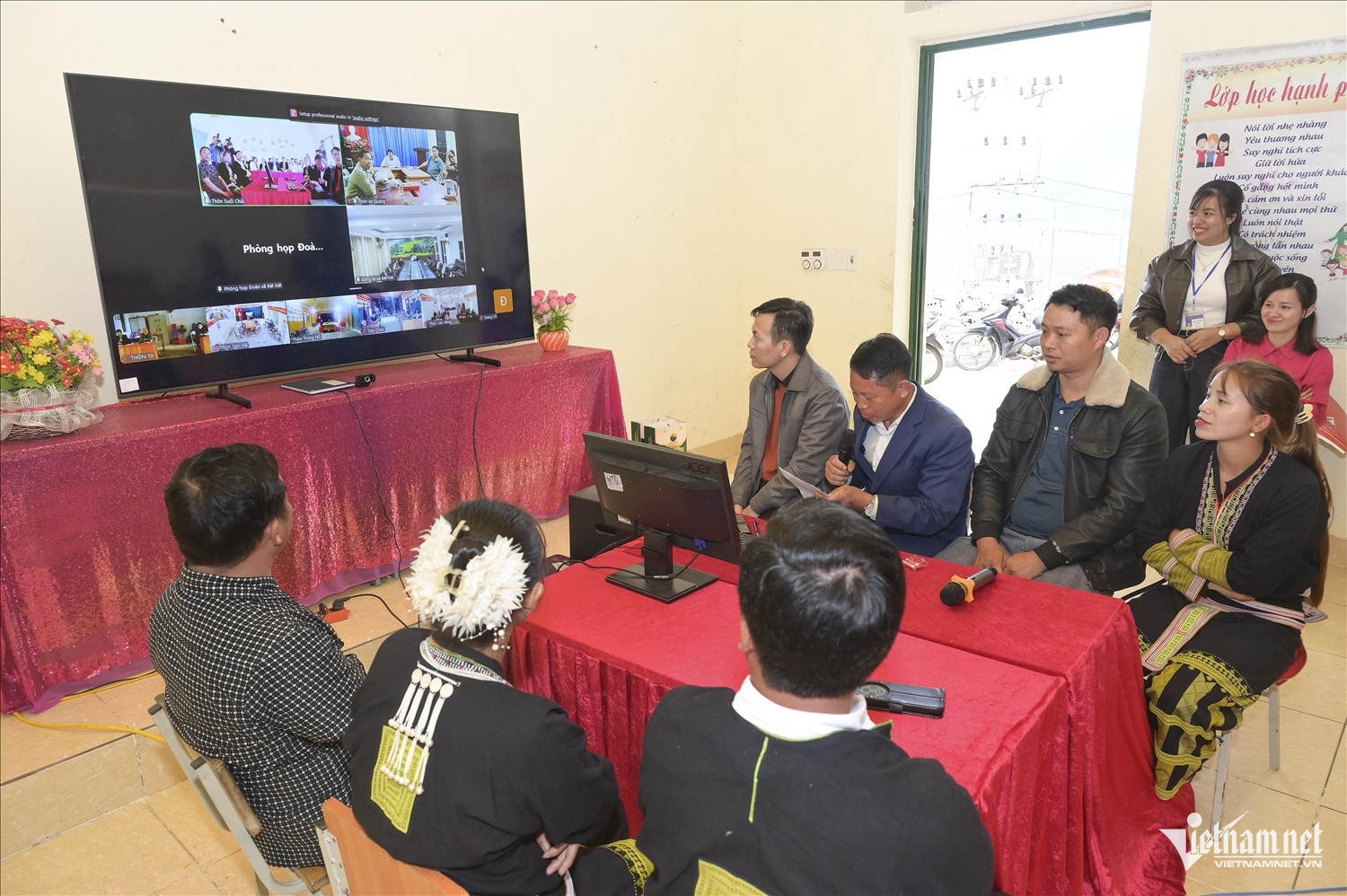
Located over 20 km from the commune center, Suoi Chai is one of the most remote and difficult villages of Bat Xat commune, Lao Cai province, particularly due to geographical isolation. Therefore, certain administrative procedures such as poverty household certification, student-related documents, and policy benefits have always been a hardship for many families in deep and remote areas.
To bring public services closer to residents, the local Party committee and authorities selected Suoi Chai as a pilot site for the “digital village” model.
Under this model, the village is equipped with computers connected to the Internet. Training sessions are organized to help village officials and residents gradually become familiar with and use basic digital services. The model focuses on supporting the installation and use of digital identification, submitting simple online administrative applications, and receiving government directives. As a result, many administrative procedures can now be handled directly in the village, while locals don’t have to travel to the commune center any more.
“Previously, I had to travel more than 20 kilometers to the commune to follow school-related paperwork for my children. Now that these procedures are available in the village, we no longer have to travel as much. Local officials and teachers guide us step by step,” said Ly Ta May, a resident of Suoi Chai.
According to Chao Cui Phu, secretary of the village Party cell, local officials, mass organizations, and especially teachers have been mobilized to support residents. At school sites, teachers in charge of IT directly guide village officials in using digital tools.
At the same time, existing school infrastructure such as Internet connections, projectors and loudspeaker systems is utilized to support community activities and the operation of the “digital village” model.
“Encouragingly, as people gradually become familiar with digital technology, it will be easier to promote and connect markets for local agricultural products such as sturgeon, black chicken and small indigenous pigs. This helps residents access markets more quickly, reduce dependence on traders and gradually increase product value,” Phu added.
The implementation in Suoi Chai shows that the “digital village” model does not require high-level technical skills. Instead, it is designed to be simple, accessible and suitable for the conditions and capabilities of highland residents. Local authorities have also mobilized youth volunteers to form community digital teams to support residents and expand the model.
Vu Hong Phuong, deputy secretary of the Bat Xat Party Committee, said the model is implemented flexibly and creatively, in line with local conditions. With a limited budget, the commune has mobilized social resources and made use of existing equipment, while engaging the entire political system to support digital transformation at the village level.
“In the short term, the goal is to help residents handle simple administrative procedures. In the long term, the locality will gradually enhance digital transformation and integrate technology into daily life. So far, the model has been deployed in seven remote villages with difficult access. By 2026, it is expected to cover all villages, making administrative procedures more convenient for residents,” Phuong said.
The “digital village” model in Bat Xat is a concrete step in implementing the Politburo’s Resolution No. 57-NQ/TW dated December 22, 2024 on breakthroughs in science, technology, innovation and national digital transformation.
With flexible and creative implementation, digital transformation in Bat Xat is delivering tangible results. The “digital village” model clearly demonstrates a government that is close to the people, improving administrative efficiency and ensuring practical benefits for residents.
Beyond shortening the distance to information, knowledge and essential services, technology is opening up new opportunities for livelihoods, improving education levels and strengthening confidence in a better future. Its presence in remote areas is not only a step forward in infrastructure, but also a journey toward more inclusive development, ensuring that no one is left behind on the path to modernization.
Trong Bao
.svg)
