 Vietnamnet.vn

 Podcast


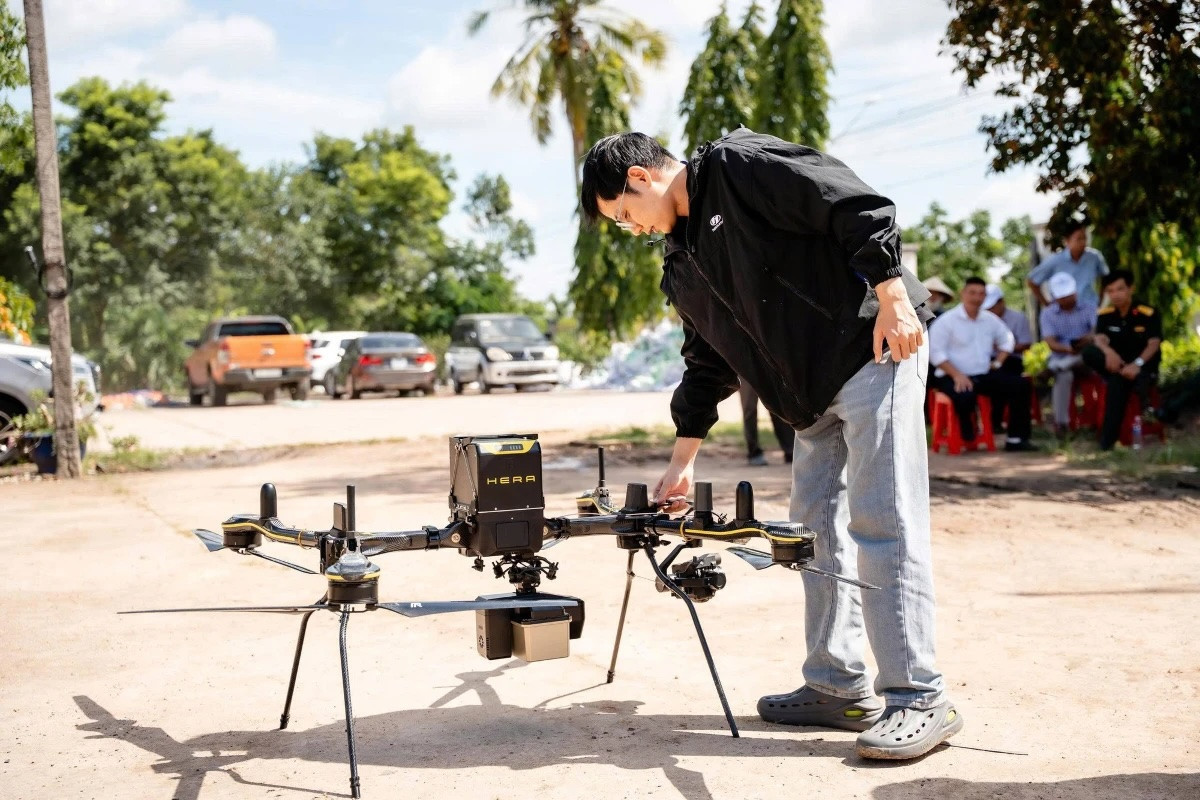
A dispatch on October 13, 2026, signed by Tay Ninh People’s Committee Chair Le Van Hanh and sent to the Prime Minister and the Ministry of Science and Technology, said the province has registered to establish a national-level flight testing zone and a low-altitude traffic management system.
A testing corridor 53km long and 6km wide is being prepared. For UAV developers, having a stable place to conduct test flights is a major step forward. Products are brought to the field and errors are detected to be fixed to meet requirements.
Tay Ninh has approved a strategy to develop the unmanned vehicle ecosystem for the 2026–2030 period, with a vision toward 2035. The province also signed cooperation agreements with Vietnam National University HCMC and Realtime Robotics Vietnam. The enterprise led by Luong Viet Quoc is participating in designing the technical specifications for the flight corridor.
According to the provincial proposal, the corridor comprises four independent operational blocks, 19 emergency landing points, and two test-flight zones at both ends of the route. The Unmanned Aircraft System Traffic Management (UTM) low-altitude system is designed to handle identification, tracking and flight logging.
This layout indicates that the province has prepared for tiered testing protocols. Operational intensity will expand only after meeting established safety criteria, laying the groundwork for routine test flights.
The province said it has completed a controlled testing scheme for UAV training and applications, and has invited the Air Force Officer Academy to participate in training and testing starting in November.
Tay Ninh committed to putting the corridor into operation before June 2027, following approval of airspace and operational conditions by competent authorities. Enterprises, research institutes, and training facilities across the southern region can use the infrastructure under provincial guidance.
A small business would struggle to independently secure a test-flight site equipped with full monitoring systems and emergency landing points. Coordinating with regulatory agencies requires a lead entity to organize operations, a role Tay Ninh is stepping up to fulfill.
Realtime Robotics has conducted test flights serving rubber farming monitoring, agriculture, as well as forest management and protection. The enterprise is currently researching expansion into power grid and technical infrastructure inspections.
Market demand exists. However, to convince farmers or power utility managers to purchase services, enterprises must demonstrate that their equipment operates efficiently and reliably. Test flights will help provide those answers.
Administrative procedures
Under current regulations, UAV research, manufacturing and testing facilities must hold certifications confirming personnel, infrastructure, and procedural qualifications. Vehicles must have valid registration or temporary registration, while operators must meet corresponding credentials. When organizing flights, enterprises must additionally comply with airspace licensing and management regulations.
These requirements exist for valid reasons: an out-of-control device could cause accidents on the ground or interfere with aviation operations.
Nevertheless, research workflows carry specific demands. Once engineers update software, they must verify how the aircraft performs. Replacing a camera or adjusting equipment may also necessitate field testing. If arranging a test flight proves difficult, subsequent work stalls.
Tay Ninh's initiative can help alleviate this bottleneck. However, the provincial dispatch has not yet defined which administrative procedures will be waived or whether a specialized licensing process will apply. Therefore, preparation efforts must immediately clarify operational contacts and document filing requirements for testing applicants.
The Ministry of Science and Technology requested that Tay Ninh's sandbox dossier explicitly outline points where legal exceptions apply, the responsibilities of involved parties, and the specific standards or regulations exempted or modified during the trial period.
The regulatory framework is also undergoing adjustments. Resolution 24/2026/NQ-CP streamlined several UAV-related procedures. The Ministry of National Defense is drafting amendments to Decree 288/2025/ND-CP to adapt to practical realities and foster this ecosystem.
Once operational, the Tay Ninh corridor will provide empirical data to propose revisions to unsuitable regulations. Regulatory authorities can also rely on monitoring outcomes to decide on expanding testing scopes.
The provincial dispatch directly registers tasks implementing Conclusion 99-KL/TW regarding low-altitude airspace. This approach also concretizes the mandate of Resolution 57: “Establishing pilot mechanisms for enterprises to test new technologies under State supervision.”
Quoc considers international marketability a primary benchmark for corporate capability. The Tay Ninh corridor must also target this outcome, ensuring that products improve through testing iterations and gain opportunities to reach global customers.
Tu Giang

