 Vietnamnet.vn

 Podcast


Teaching math with a wooden table in the kitchen
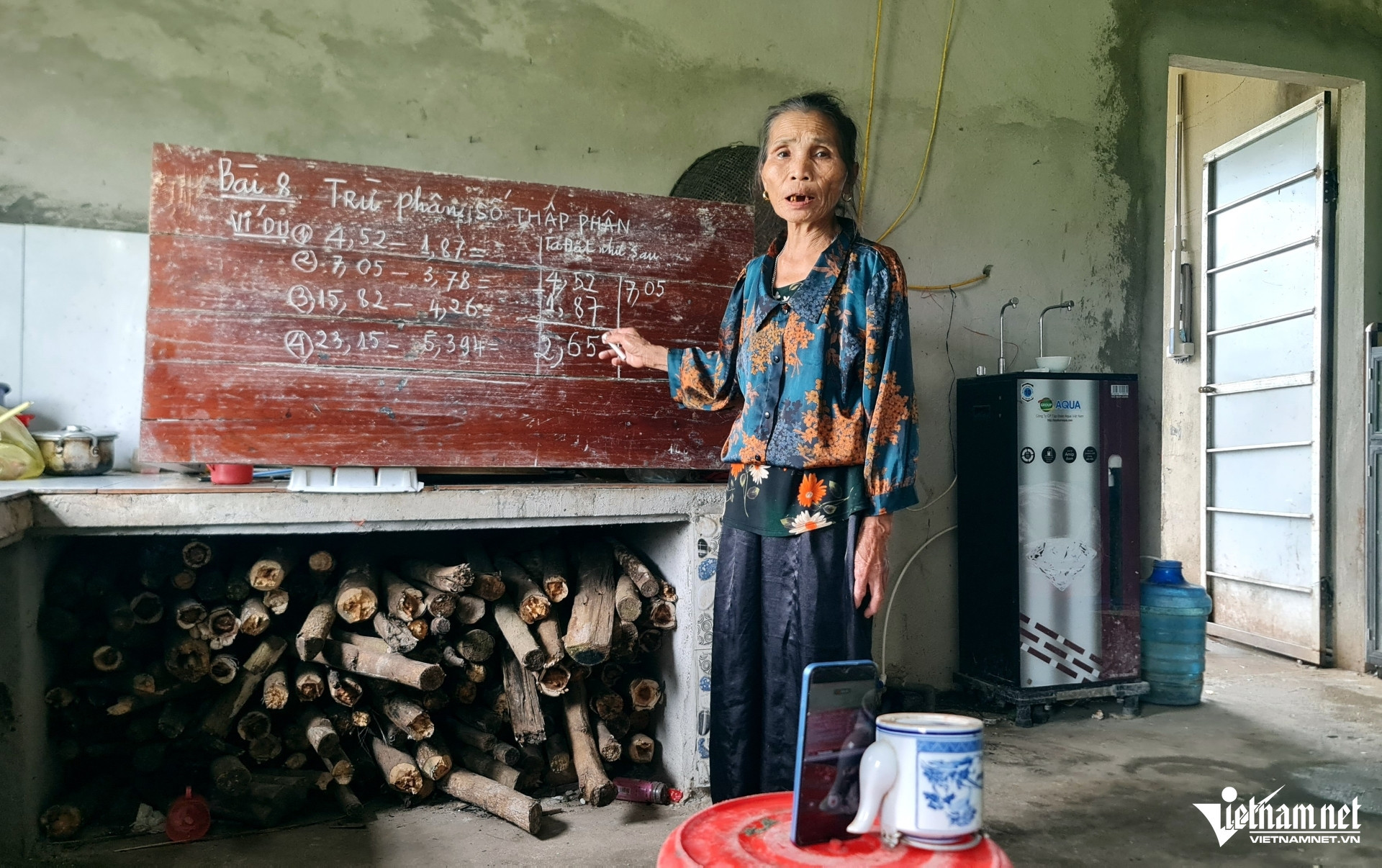
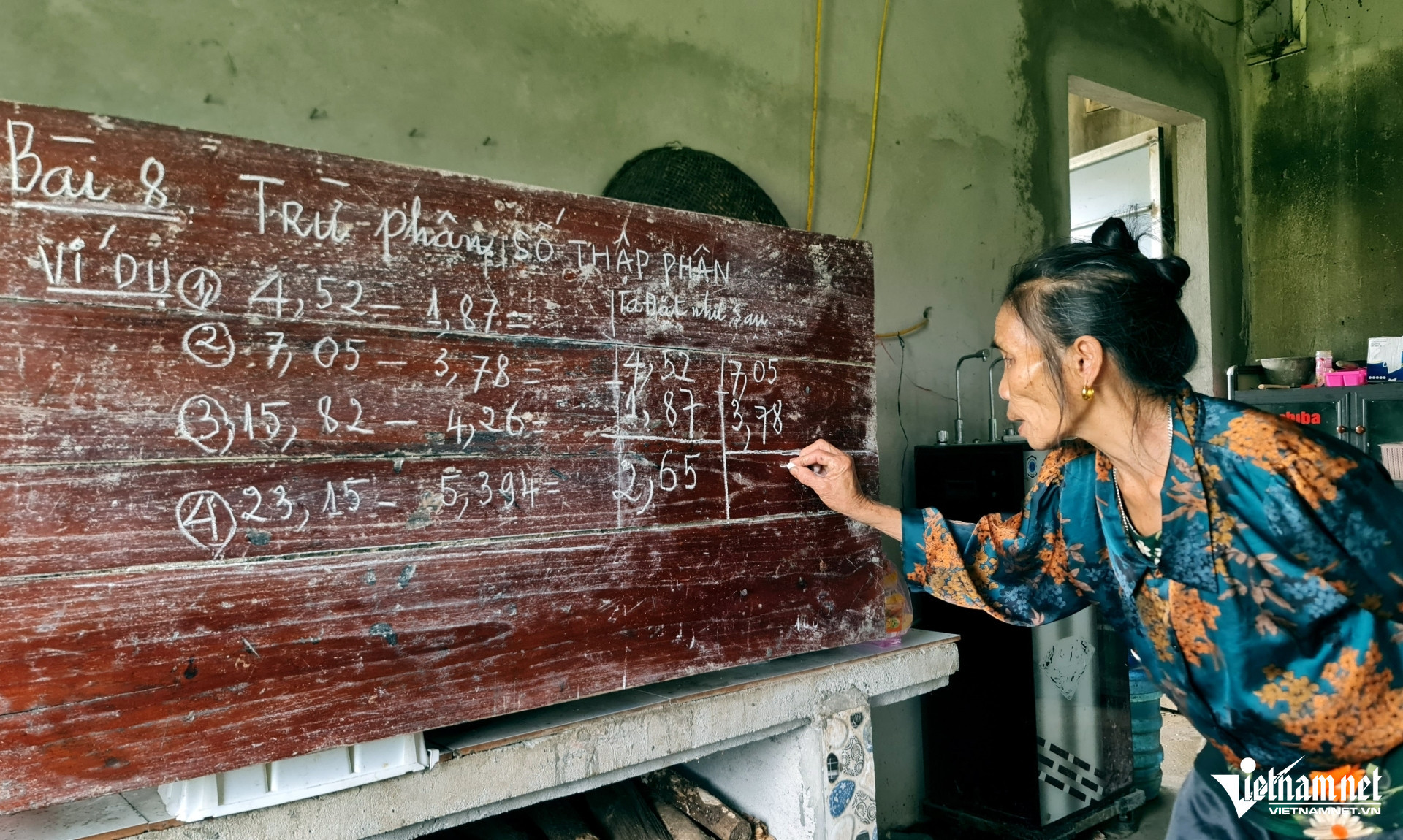
Inside a modest house in Xuan Tien Hamlet, Xuan Du Commune, Thanh Hoa Province, 74-year-old Bui Thi My carefully writes mathematical equations in chalk on a wooden tabletop propped upright.
A small speaker sits beside her, while her son's smartphone records the lesson.
There is no conventional blackboard, lesson plan or orderly rows of desks. Yet the elderly teacher remains deeply absorbed in explaining mathematical rules, just as she did in classrooms decades ago.
Sometimes she demonstrates how to add and subtract fractions. At other times, she moves on to solving linear equations with one unknown or explaining algebraic identities.
Her strong, clear voice and straightforward teaching style evoke the atmosphere of a traditional classroom, taking viewers back to their school days.
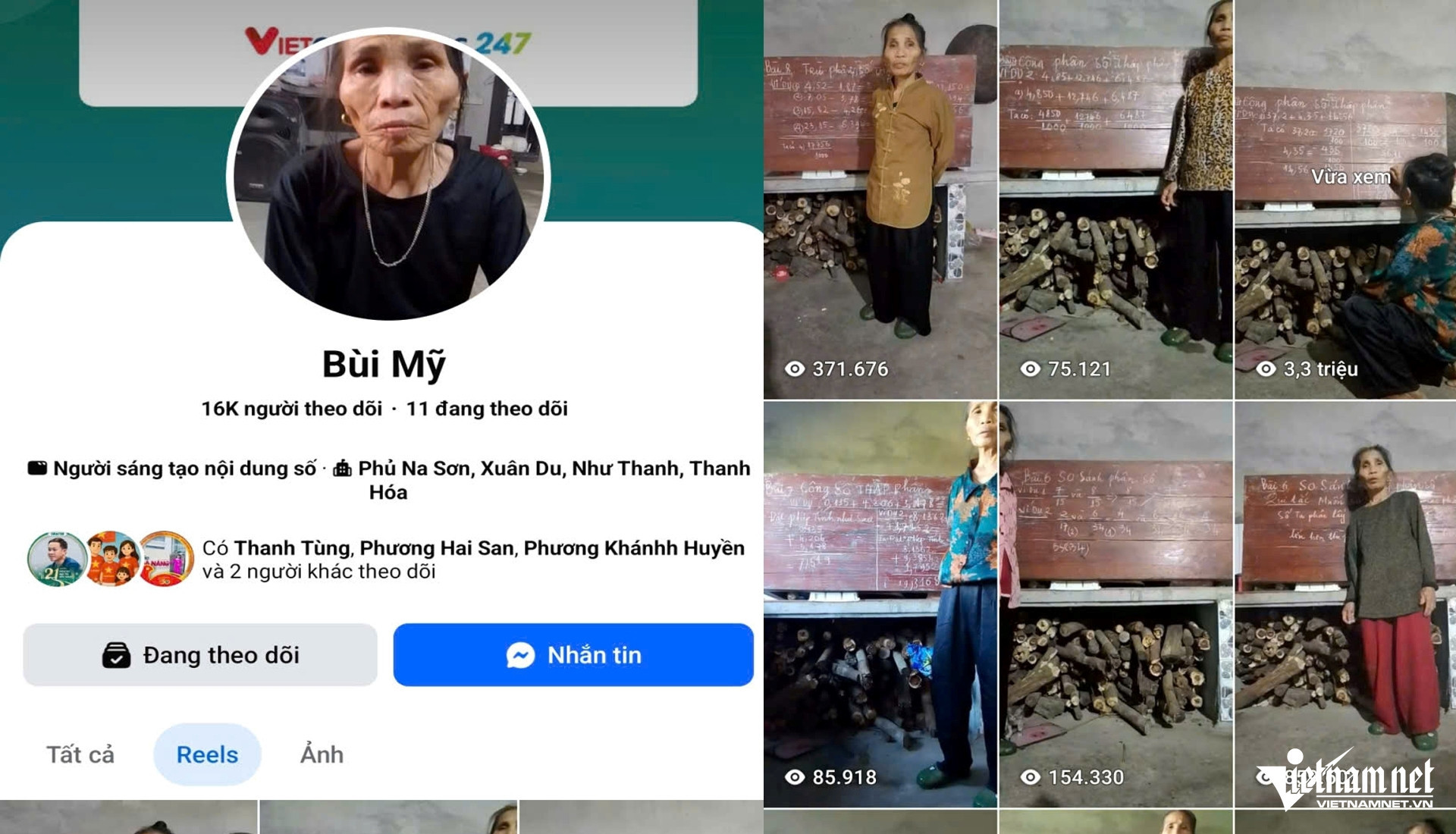
The lessons are filmed by her youngest son, Bui Van Dung, born in 1995, who uploads the videos to Facebook under the account name "Bui My."
Initially, Dung recorded the lessons simply for enjoyment, hoping to preserve his mother's teaching and share the videos with acquaintances.
To his surprise, many attracted hundreds of thousands of views, with some surpassing three million.
My said her return to teaching was inspired by her enduring love for the profession, memories of her former students and encouragement from her son.
To create a classroom without students, she looks into the smartphone camera and imagines a group of pupils sitting in front of her.
She then delivers her lessons as though she were standing at the front of a real classroom.
"We didn't have a blackboard at home, so my son stood a wooden tabletop upright in a corner of the kitchen for me to write on with chalk and teach," she recalled.
My does not use social media herself and relies entirely on her son to record and upload the videos.
"I don't know how to use social media. I only use my phone to make and receive calls. My son handles all the filming and posting," she said. "For me, this classroom is mainly a way to review what I know and ease the longing I have felt for teaching after more than 30 years away from the profession. Whether anyone watches is less important than being able to continue giving lessons."
She insists that every lesson should be taught thoroughly, from examples to mathematical rules, and lasts a full 45 minutes, just like a regular school period.
"If you rush through a lesson, students won't understand it," she explained.
For nearly two months, My has usually begun teaching at around 8am, depending on her health and household responsibilities.
Whenever she stands before her makeshift blackboard, she follows the familiar teaching sequence she used throughout her career: introducing examples, reviewing previous knowledge and gradually guiding learners towards new concepts.
Dung admitted that the unexpected attention from social media users initially made both mother and son somewhat anxious.
Their earliest videos were watched mainly by acquaintances in the surrounding area.
As the audience grew rapidly, they became concerned that Vietnam's education curriculum had changed considerably since My received her training decades ago.
"My mother is simply teaching the knowledge she learned and taught in the past. We hope people will find what is still relevant useful and understand if some parts are no longer appropriate," Dung said, conveying his mother's message.
Poverty forced her to leave teaching, but she never forgot her students
Born in 1952, My completed lower secondary school before applying to Ngoc Lac 7+3 Teacher Training School.
From 1972 to 1975, she studied natural sciences, specialising in mathematics and physics.
After graduating, she was assigned to teach at Cat Van Lower Secondary School in the former Nhu Xuan District of Thanh Hoa.
She spent four years teaching in the mountainous area before transferring to Xuan Du Commune Lower Secondary School, where she worked for another 18 years.
During Vietnam's centrally planned economy period, her monthly teaching salary was just VND45.
To obtain food and other necessities for her family, she had to walk to Yen Cat Town to collect rice and ration coupons.
Her husband was a demobilised soldier who suffered from recurring illnesses, while the couple had seven children to support.
Financial hardship forced My to balance her teaching duties with numerous responsibilities at home.
On some days, she would go into the forest to gather firewood before leaving for school.
After returning from teaching, she would bundle the wood, prepare meals and then work on lesson plans until 10pm or midnight.
The following morning, she would carry firewood to the market to sell or exchange for rice, sweet potatoes and corn for her children.
In 1990, facing her husband's illness, the demands of raising a large family and severe financial difficulties, she decided to leave teaching under a lump-sum severance arrangement.
"After I stopped teaching, I often missed my students terribly. At home, I could no longer hear them greeting me or asking questions about their lessons. I always felt that something was missing," she recalled.
Her attachment to teaching remained so strong that she eagerly awaited Vietnamese Teachers' Day on November 20 each year.
It was an opportunity to visit her former school, meet old colleagues and participate in activities organised by the retired teachers' association.
Even after leaving the classroom, My continued helping children in her village with their studies.
Bui Thi Tuyet, head of Xuan Tien Hamlet and one of My's former students, said village children had regularly visited the teacher's home for academic help over the years.
Sometimes, My would have just returned from catching crabs and not even had time to change her clothes when children arrived with questions.
She would nevertheless sit down and explain their lessons.
"The way she explains things to children today is exactly how she taught us years ago," Tuyet said. "Watching her stand at the board brings back all my school memories. It makes me wish I could become her student again."
According to Tuyet, My continues to face considerable financial hardship.
Although she is well beyond working age, she is still caring for a young grandchild whose father died from illness and whose mother left and has not been heard from since.
Last year, her household was classified as near-poor. This year, it was officially recognised as a poor household.
"Despite all her difficulties, she has never lost her passion for teaching. She is always willing to help children in the village without accepting any payment," Tuyet said.
The village head added that the widely shared videos have done more than introduce the elderly teacher to a broader audience.
They have also given generations of former students an opportunity to reconnect with memories of the woman who once guided them through their school years.
Le Duong

