 Vietnamnet.vn

 Podcast


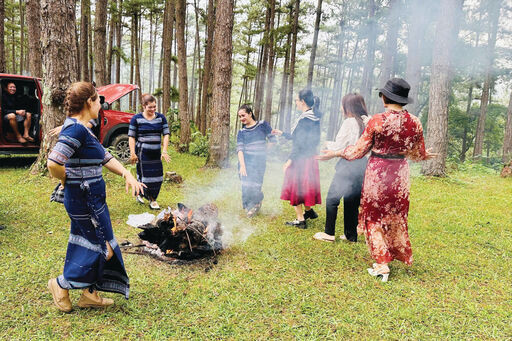
Amid vast forests, Dung K’No Parish in Dam Rong 4 Commune serves not only as a place of worship for the local Catholic community but also as a center for strengthening solidarity and preserving traditional cultural values.
Generations of unwavering faith
To reach Dung K’No, we traveled along Road 722, winding through seemingly endless stretches of lush forest.
For nearly 50 kilometers, there were hardly any houses in sight, only deep green mountains and forests and the occasional vehicle carrying local residents.
Amid this landscape, the peaceful village gradually emerged, with old wooden houses standing alongside modern, well-built homes.
Situated at the highest point in the area, Dung K’No Parish stands out with its weathered wooden entrance gate. More than a dozen stone steps lead to a wooden church, where aged timber bears the traces of generations of worshippers.
Rows of benches are neatly arranged inside the church and along its corridors. A statue of the Virgin Mary stands at the front, while a wooden bell tower rises behind the building.
Simple and unassuming amid the vast forest, the church serves as a spiritual anchor for the local Co Ho community.
Established in 2017, Dung K’No is the youngest parish in the Diocese of Da Lat. It currently serves more than 1,500 parishioners, most of whom are Co Ho residents of the village.
However, the community's journey of faith began many decades earlier.
According to village elders, Dung K’No was originally a Catholic congregation under Lang Biang Parish, established in 1953 when priests from the Paris Foreign Missions Society and catechists from the Lach ethnic community arrived to spread Christianity.
In 1955, a 54-square-meter wooden chapel was built, becoming a gathering place for local worshippers.
In those early years, poor transport infrastructure made traveling extremely difficult. Before a road into the village was constructed, residents had to trek through forests and muddy paths, sometimes spending an entire day traveling to attend Mass.
During the rainy season, the village was occasionally isolated for months, leaving residents facing numerous hardships.
From the late 1970s, there was a period when priests could no longer visit the village regularly. To attend Mass, residents had to walk more than 50 kilometers to a church in central Da Lat before making the return journey.
Despite these difficulties, the community remained steadfast in its faith.
In 2008, Father Gregory Nguyen Quy Trung, then parish priest of Lang Biang, returned to celebrate Mass with local worshippers, marking the beginning of a period of improved access to religious services.
In 2013, the chapel was expanded to 117 square meters to accommodate growing demand.
Dung K’No Parish was officially established in 2017, with Father Gregory Nguyen Quy Trung becoming its founding parish priest.
On August 10, 2022, Father Bartholomew Cil Yon was appointed parish priest and has continued serving the community ever since.
Connecting religious faith with cultural preservation
Today, the parish stands at the heart of the village, providing a gathering place where parishioners can meet, study religious teachings and participate in community activities.
Beyond providing spiritual guidance, priests encourage residents to adopt progressive ways of living, gradually abandon outdated customs and continue cherishing their traditional cultural heritage.
Speaking beside a kitchen fire, local resident Bon Nieng K’Pot said that, with guidance from priests, villagers had gradually abandoned costly marriage customs associated with women taking husbands under matrilineal traditions, as well as prolonged grave-abandonment ceremonies that consumed considerable time and money.
Traditional ceremonies are now conducted more simply, taking into account each family's financial circumstances while retaining their cultural significance and community spirit.
Importantly, these changes have not come at the expense of cultural identity.
The parish encourages residents to preserve traditional brocade weaving, gong music, xoang folk dances and awareness of forest conservation.
These values, passed down through generations, remain part of everyday life, shaping the distinctive identity of the Co Ho community within the Langbiang forest region.
We arrived in the village on a Sunday. Children were playing, men were chatting on their verandas, and women gathered around kitchen fires to prepare cakes for children attending afternoon Mass.
The warm and welcoming atmosphere demonstrated that the church is more than a place of worship. It is also a space that brings community members together.
Every year, during the Mid-Autumn Festival and Lunar New Year, the parish courtyard comes alive with recreational activities for children and local residents, with groups from Da Lat and elsewhere joining the celebrations.
These gatherings provide opportunities for cultural exchange, mutual learning and stronger community bonds, encouraging residents to lead fulfilling lives grounded in both civic responsibility and religious devotion.
Amid the ancient forests of Langbiang, Dung K’No Parish is helping transform village life.
From the days when worshippers trekked through forests to attend Mass to today's vibrant community gatherings, their journey demonstrates the enduring strength of religious faith when it is rooted in everyday life, respects cultural identity and fosters community solidarity.
Hoang Ngoc Thanh

