 Vietnamnet.vn

 Podcast



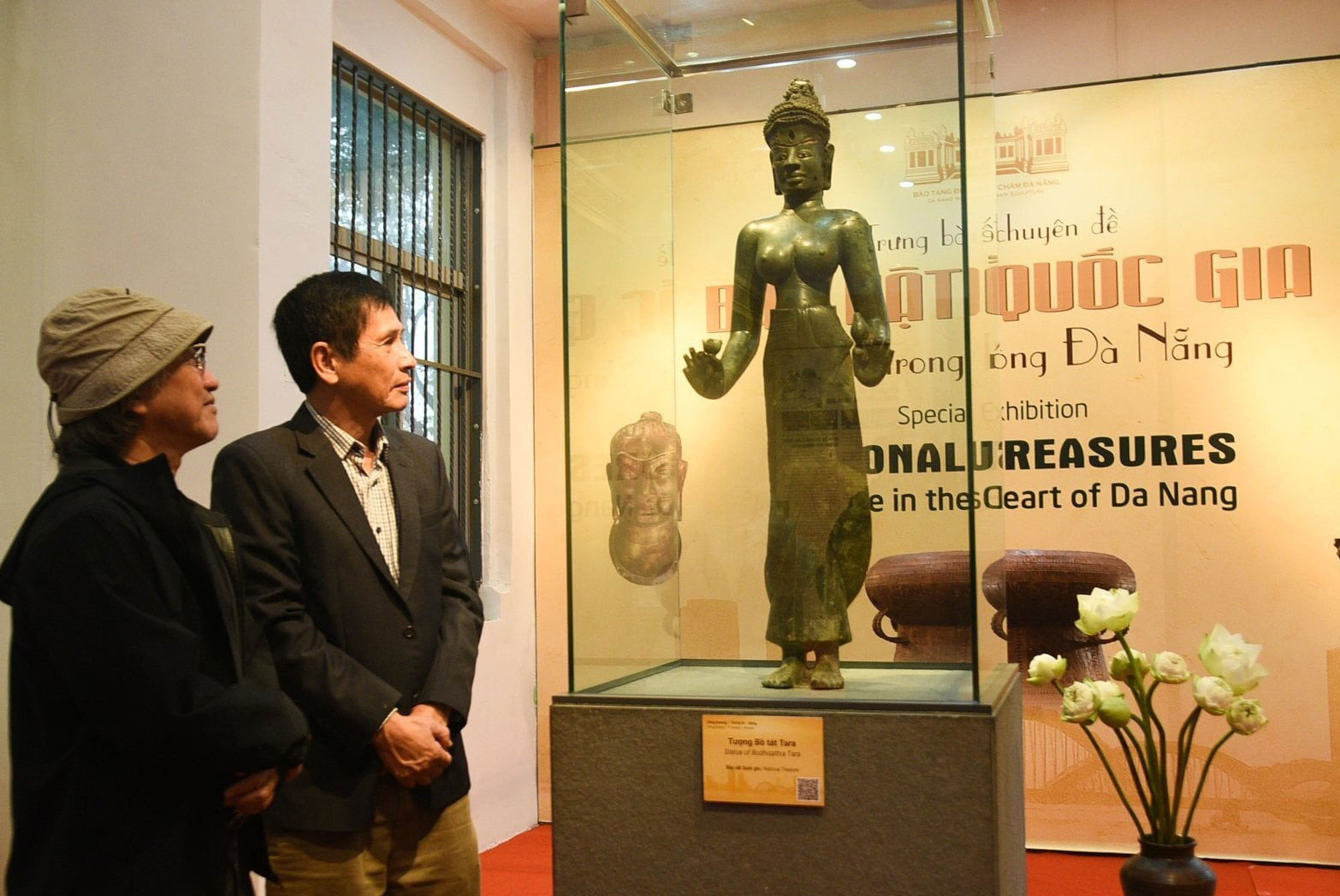
On November 19, 2025, the Da Nang Museum of Cham Sculpture unveiled the Tara Bodhisattva statue in its most complete form to date. The long-lost relics were reattached using neutral materials that do not affect the bronze, allowing the public to fully appreciate this Champa Buddhist masterpiece. The statue, recognized as a national treasure since 2012, once stood as the sacred icon of Dong Duong Monastery under King Indravarman II.
The Tara Bodhisattva statue-a national treasure over 1,200 years old-was recently reunited with its sacred relics: a lotus and a conch, after nearly five decades. This symbolic homecoming of a Champa Buddhist masterpiece was marked at the Da Nang Museum of Cham Sculpture, closing a long journey of absence, loss, and restoration.
Some partings in life bring personal sorrow. Others, like this, are historical ruptures that cause a civilization to sigh. We often accept impermanence as a natural law: birth, death; meeting, separation. Yet sometimes, in the cold, unrelenting current of time, something flows backward. The river of the past turns, bringing with it memories thought buried in the silt of forgetfulness.
The story of the Tara Bodhisattva statue-or, by its formal epigraphic name, Laksmindra Lokesvara-being reunited with its lotus and conch after nearly 50 years is more than a recovery. It is a parable. A parable of restoration.
Restoration is not simply about returning a statue to its physical state. It is, through the eyes of a pilgrim in search of beauty, an act of healing. It reconnects broken threads between the sacred and the earthly, between the cold silence of a museum and the warm hands of villagers. Why did it take 47 years? Why the lotus and the conch? And why does this return stir something so deep-as if we had just found a lost part of ourselves?
Close your eyes and imagine the 9th century. In the harsh, sun-scorched lands of central Vietnam, a king rises-Indravarman II. The name evokes Indra, lord of thunder and storm. Yet this king chose not the sword, but the Dharma. He embraced Mahayana Buddhism-not the austere, solitary path, but the great vehicle meant to carry all beings.
In 875, Indravarman II founded Dong Duong Monastery-a holy city, a capital of faith. Inscriptions from Dong Duong record that he built a temple to Laksmindra Lokesvara Svabhayada, a form of Avalokitesvara, the Bodhisattva of Compassion. This shift was monumental. Until then, Shiva reigned supreme in Champa, with My Son as his sanctuary. But now, Avalokitesvara-Quan The Am-ascended to spiritual and political prominence. This reflected a profound ideological turn: from reverence of elemental force to reverence of mercy. Indravarman sought to embody the Bodhisattva, to rule with boundless compassion, not just law.
Art, always a mirror of the soul of its time, transformed as well. Those familiar with the graceful curves of Tra Kieu or the majestic symmetry of My Son E1 might be stunned by Dong Duong’s art. Here, the sculptures are not “gentle.” They are intense, solemn-almost raw.
Faces are square, with low brows, thick lips, and eyebrows that meet in a stormy wave across the nose. This isn't technical ineptitude. The Cham artisans of the era were masters. They could make stone as soft as silk. But here, they chose fire over silk. The Dong Duong style pulses with an inner energy-its zigzagging patterns, flame motifs, and writhing forms portray a Buddha not detached but burdened. Here, the Buddha suffers. The beauty of Dong Duong is the beauty of engagement.
In this artistic furnace, the Tara statue was born. Over one meter tall, cast in bronze using the lost-wax method, it stands as a pinnacle of Champa metallurgy. Tara stands bare-chested, her torso full of life, a double-layered sarong wrapping her lower half in soft folds. But the true key to her identity lies atop her head: a tiny seated Amitabha Buddha in meditation. This detail confirms her as Laksmindra Lokesvara-a manifestation of Avalokitesvara within royalty, though we may call her Tara, evoking her feminine grace.
For 47 years, however, her hands were empty. That emptiness evoked both reverence and a haunting question: What did she once hold for the world? And what did the world take from her?
In 1978, villagers in Dong Duong struck history at a depth of 1.5 meters. A corroded green bronze form was unearthed after a thousand-year sleep. It was Tara-majestic still, but missing her two sacred objects: the lotus and the conch.
The statue was brought to the Da Nang Museum of Cham Sculpture and designated a National Treasure. But the relics-the “soul” of her hands-remained with the villagers. Why? Some might condemn this as ignorance. But let’s look with compassion. To the people of Dong Duong, that earth is sacred. When they found the statue, they saw “Ba”-the Goddess. Keeping part of her was not greed, but faith. The lotus and conch were kept, passed down through generations, absorbing the rhythm of village life far from the sterile halls of academia.
Why does their recovery matter? Because in divine iconography, objects are identity. Lose them, and a deity loses her voice.
In her right hand, Tara once held a lotus-not just a flower, but a symbol of rebirth and enlightenment. To hold a lotus is to say: “I too have emerged from mud. I have bloomed. And so can you.”
In her left, she held a conch shell-an ancient instrument, symbolizing the Voice of Dharma. The deep, resonant call of the conch dispels ignorance. Without it, Tara stood silent, unable to speak her truth.
Their return is not just aesthetic-it is metaphysical. It gives back her voice, completes her destiny. Beauty only radiates when made whole, when scattered pieces are gathered again in reverence.
Let me end with an imagined image. Tonight, in the Dong Duong gallery of the museum, the lights dim. Tara no longer stands alone. In her right hand, the bronze lotus quivers with silent enlightenment. In her left, the conch whispers of ancient oceans and timeless truths. This restoration doesn’t just beautify the statue-it revives her.
She teaches us, modern wanderers, the lessons of patience and reverence. That history does not die-it sleeps, waiting for us to wake it. And the Buddha is not far away. The Buddha is in our seeing. In seeing the pain of separation. In seeing the joy of reunion. In seeing the lotus bloom amid impermanence.
Truong Cong Tu
.svg)
