 Vietnamnet.vn

 Podcast



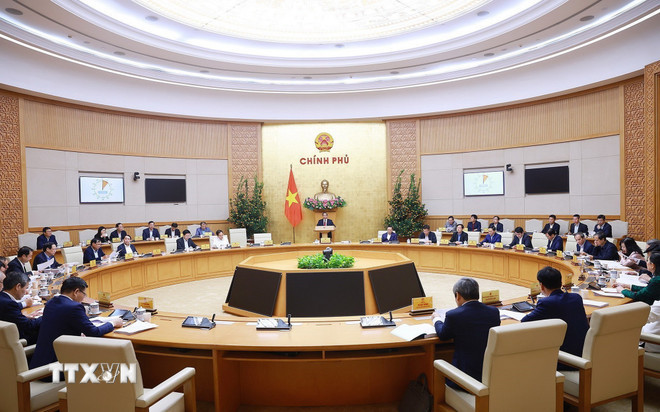
On the morning of February 27, the Government convened its thematic law-building session for February 2026 to review and discuss five major items.
At the meeting, Cabinet members listened to summary proposals and explanatory reports, and offered opinions on the draft revised Capital Law; the draft revised Law on Civil Status; the draft Law on Belief and Religion; the draft Law amending and supplementing a number of articles of the Law on Vietnamese Representative Missions Abroad; and a draft National Assembly resolution on coordination mechanisms and special policies to enhance the prevention and settlement of international investment disputes.
Regarding the draft revised Capital Law, the Prime Minister and delegates contributed numerous proposals on special, breakthrough and stable mechanisms with a long-term vision, in line with the unique position and role of the capital city within the broader national development context and global trends.
For the draft National Assembly resolution on coordination mechanisms and special policies to improve the effectiveness of preventing and resolving international investment disputes, Cabinet members proposed several preferential mechanisms for responsible individuals and agencies, as well as measures to strengthen inter-agency coordination.
In discussing the draft revised Law on Civil Status, the Government focused on supplementing and amending provisions to enhance the effectiveness of state management, while promoting stronger decentralization and delegation of authority in line with the two-tier local government model in the field of civil status.
As for the draft Law on Belief and Religion, delegates examined specific provisions on the right to belief and religion, ensuring full institutionalization of the Party’s guidelines and policies, and fostering the strength of great national unity.
To improve the performance of Vietnam’s representative missions abroad, Cabinet members stressed that the Law on Vietnamese Representative Missions Abroad must clearly define organizational structure, functions, tasks, powers and policies for remuneration and talent attraction.
Concluding the meeting, Prime Minister Pham Minh Chinh reiterated that legal institutions are both a driving force and a resource for development. Institutions must lead the way, removing bottlenecks and practical obstacles, and turning the institutional framework into a national competitive advantage. Recent Party Congress resolutions have consistently identified institutional building and refinement as one of three strategic breakthroughs for rapid and sustainable national development.
He requested that ministers and heads of ministerial-level and Government-affiliated agencies directly lead and participate in building both their sectoral institutions and the broader institutional framework under the Government’s responsibility. During the law-making process, he stressed, it is essential to fully institutionalize Party policies, resolve real-world constraints, and implement thorough decentralization accompanied by appropriate resource allocation, enhanced enforcement capacity and effective inspection and supervision mechanisms.
The Prime Minister emphasized that matters already clear and proven correct in practice should be codified into law, while issues not yet fully mature should be piloted, implemented gradually and expanded step by step without perfectionism or haste. Administrative procedures must be reviewed and cut to the maximum, reducing inconvenience and compliance costs. Laws should focus on fundamental principles, with detailed provisions delegated to implementing decrees. Policies, he said, must be expressed in a way that is easy to understand, easy to access, easy to implement, easy to inspect and easy to supervise.
He directed drafting agencies to fully incorporate feedback from Cabinet members, while seeking additional opinions from experts, scientists, legal practitioners, affected stakeholders and relevant international experiences suited to Vietnam, in order to finalize the drafts for submission to competent authorities.
In particular, ministries and agencies must coordinate closely with one another and with National Assembly bodies to build high consensus during appraisal, explanation, revision and finalization of draft laws in line with feedback from the National Assembly Standing Committee and deputies. Ministries were also urged to promptly draft and issue decrees and circulars guiding the implementation of newly effective laws.
At the first session of the 16th National Assembly, the Government is expected to submit 34 dossiers and documents, including 15 draft laws and resolutions, many of which are complex and far-reaching. The Prime Minister therefore required ministries, especially ministers and heads of ministerial-level agencies, to prioritize time and resources, directly oversee the completion of draft laws and resolutions already reviewed by the Government, ensuring both quality and timely submission for consideration at the first session.
Reiterating the spirit of “running while lining up,” Prime Minister Pham Minh Chinh instructed that completed dossiers, documents and reports be promptly sent to National Assembly bodies for appraisal and submission to the National Assembly Standing Committee. Ministries must also report to the Government and the Prime Minister on the incorporation and revision of draft laws in accordance with regulations, as well as any arising issues beyond their authority.
For the draft laws and resolutions discussed at this session, the Prime Minister assigned the Ministries of Justice, Foreign Affairs, and Ethnic and Religious Affairs to fully absorb feedback from Cabinet members and the meeting, and to urgently finalize the drafts in line with schedule and quality requirements.
Deputy Prime Ministers were tasked with directly overseeing ministries and agencies in building and refining legal institutions within their respective areas of responsibility. For draft laws and resolutions included in the National Assembly’s April 2026 session agenda but not yet submitted to the Government, ministries were instructed to urgently complete and submit the dossiers to ensure timely consideration.
For draft laws and resolutions already approved by the Government, the Prime Minister directed ministries to swiftly incorporate feedback, finalize documentation and send it to National Assembly bodies for appraisal in accordance with regulations, while proactively coordinating with relevant agencies throughout the review and revision process.
During the process of incorporating and refining draft laws and resolutions in line with opinions from the National Assembly and its Standing Committee, ministries and agencies must strictly comply with the 2025 Law on the Promulgation of Legal Normative Documents, ensuring the Government’s full and consistent responsibility until the National Assembly considers and adopts the legislation.
TTXVN
.svg)
