 Vietnamnet.vn

 Podcast


Smart Banking 2026 took place in Hanoi on October 21-22, jointly organized by the Vietnam Banks Association and IEC Group under the auspices of the State Bank of Vietnam (SBV). The event brought together more than 1,000 delegates, including regulators, banking executives, technology companies and financial experts.
Under the theme "Shaping a New Era of Banking Through AI, Customer Trust and Digital Resilience", the conference focused on AI strategies, payment innovation, fraud prevention, cybersecurity and the resilience of the banking system.
Discussing the industry's direction in the AI era, SBV Deputy Governor Pham Tien Dung stressed that technology adoption must deliver tangible benefits rather than serve as a showcase for innovation.
"AI must create real value for customers and institutions, rather than simply being a fancy outfit that makes a bank appear technologically advanced," he said. "The competitive advantage no longer lies in which bank adopts more technology, but in its ability to turn data into value, technology into productivity, and solve specific problems for customers and organizations."
Achieving this, he said, requires the coordinated development of four essential elements: robust technology, high-quality data, rigorous governance and a capable workforce.
"AI makes banks smarter, but customer trust and resilience will ultimately determine how sustainably they grow," Dung added.
Turning AI strategies into everyday banking operations
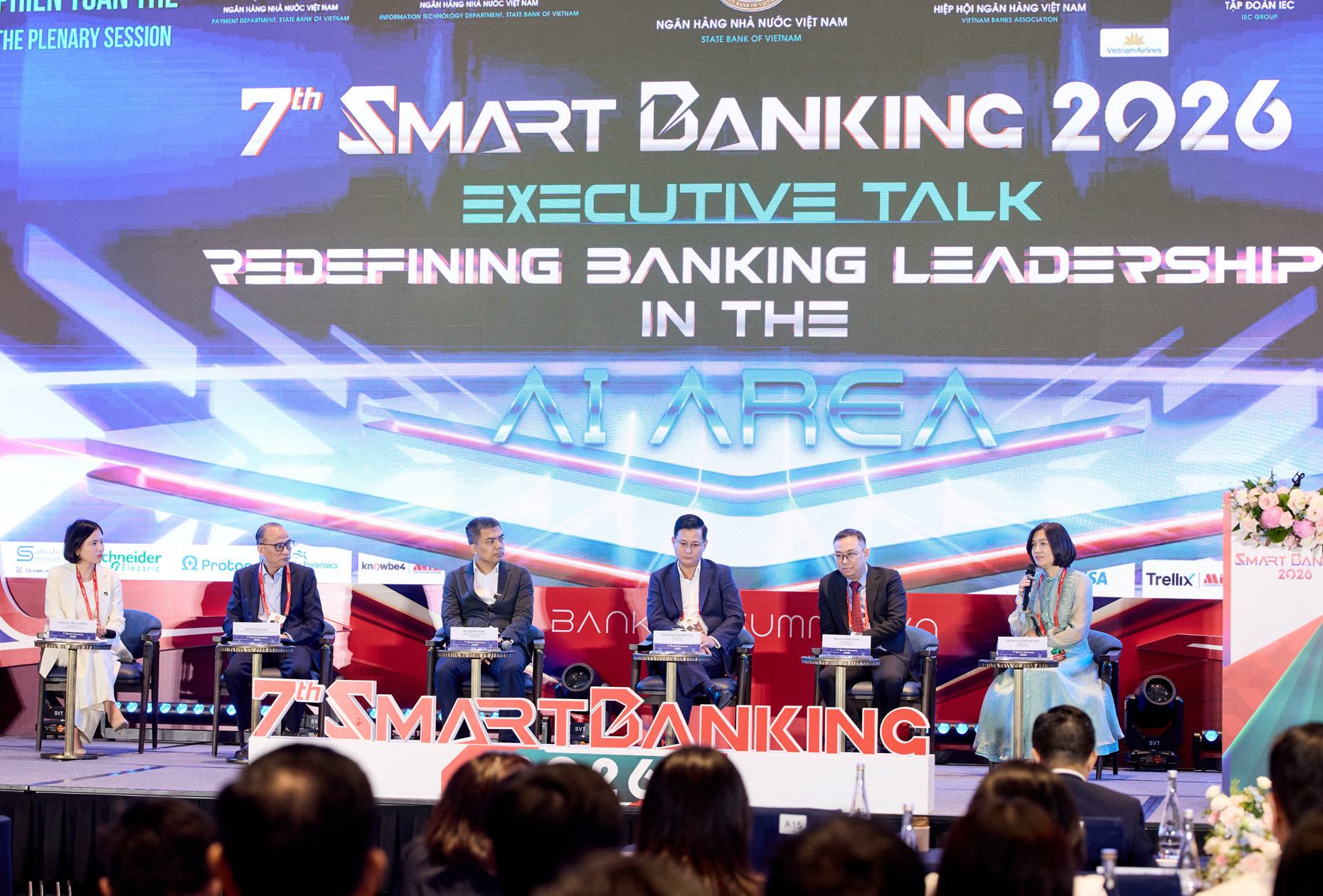
Opening the high-level discussion on "Banking Leadership in the AI Era", Nguyen Thuy Duong, chairwoman of EY Consulting Vietnam, noted that many banks already have AI strategies. The question, however, is whether those strategies have moved into actual operations or remain plans on paper, particularly as AI adoption is advancing much faster than governance capabilities.
"AI is evolving from a technological tool into a strategic capability for banks. From a regulatory perspective, what capabilities and governance principles should the banking industry develop?" she asked. "Banking is an industry where decision-making speed, trust and risk management must always go hand in hand. Where should the red line be drawn between using AI for decision-making and business support, and maintaining risk controls to prevent data breaches or financial losses?"
From the regulatory perspective, Doan Thanh Hai, deputy director of the SBV's Information Technology Department, said banks need to develop six capabilities in parallel: legal compliance, data management, technology infrastructure and architecture, human resources, AI governance and cooperation.
He emphasized that greater AI autonomy demands tighter oversight. As banks deploy growing numbers of AI agents, they may eventually need to consider establishing AI governance boards.
With limited resources, banks must carefully select which problems to address and how to reorganize their operations.
Phung Nguyen Hai Yen, deputy CEO of Vietcombank, said the bank evaluates each proposed AI application using three DVF criteria: Desirability, Viability and Feasibility.
These assess whether a project is worth pursuing, whether it makes economic sense and whether it can realistically be implemented. She stressed that Vietcombank would not sacrifice risk management for speed.
Tran Cong Quynh Lan, deputy CEO of VietinBank, said AI is fundamentally changing how banks operate, with the traditional boundaries between technology teams and business units becoming increasingly blurred.
He predicted that AI agents could carry out approximately 50% of banking transactions within the next three years.
Banking teams, he added, are also likely to become smaller, potentially operating with three core employees supported by around 10 AI agents.
Meanwhile, Nguyen Anh Tuan said Techcombank currently serves 18 million customers with approximately 12,000 employees.
Its workforce has remained largely unchanged since 2020-2021, even as revenue has grown by 20-25% annually. The adoption of AI and Copilot tools alone has helped increase productivity by 25-30%, he said.
As AI becomes a core banking capability, another strategic question emerges: how much technology should banks build themselves, and which functions should they outsource to specialized partners?
Vu Thanh Tung, CEO of GreenNode, said each institution must clearly distinguish between the capabilities it needs to control directly and those better handled by external providers.
According to Tung, Vietnamese banks face three major challenges at the AI infrastructure level.
The first is the substantial investment required, with a server equipped with eight GPUs costing around VND20 billion (approximately $760,000).
The second is the lengthy time needed to acquire equipment, even as AI technology continues to evolve rapidly.
The third is a shortage of professionals in Vietnam capable of operating large-scale AI infrastructure.
"Banks need to control two things: the speed at which their people develop new skills, and their own data and business knowledge, because every bank is different," Tung said. "Infrastructure, meanwhile, can be entrusted to specialized partners to make better use of resources across the wider ecosystem."
GreenNode is addressing these challenges by deploying AI infrastructure clusters powered by NVIDIA GPUs near banks' existing data centers, with the aim of maintaining security, confidentiality and data sovereignty.
Concluding the discussion, speakers agreed that people must remain at the center of banks' AI transformation.
Yen noted that technology is becoming cheaper and more accessible, while organizational capabilities take years to build.
In her view, the banks that lead the industry over the next three years will be those whose organizations adapt to AI the fastest.
Strengthening cyber defenses as AI adoption accelerates
Senior Lieutenant Colonel Trieu Manh Tung, deputy director of the Department of Cybersecurity and High-Tech Crime Prevention (A05) under Vietnam's Ministry of Public Security, warned that criminals are increasingly exploiting AI to commit payment fraud.
"The use of artificial intelligence for fraud in the payment sector is an issue of particular concern to us," he said. "Criminals use AI to generate fraudulent messages and deepfake technology to create impersonation scenarios, including posing as senior officials, to manipulate victims, take over their accounts and steal their assets."
He warned that some banking security systems can still be bypassed when attackers substitute images or short video clips for genuine biometric verification.
"Banks must invest in cybersecurity at a level commensurate with their investment in digital infrastructure," Tung said.
He also urged financial institutions to coordinate closely with the Ministry of Public Security's specialized cybersecurity units when incidents occur, enabling timely responses and remediation.
Banks must also communicate emerging risks and threats to customers so they can take appropriate precautions, he added.
Workforce capabilities and risk governance, two priorities repeatedly emphasized during the conference, were also central to practical exercises held alongside Smart Banking 2026.
These activities allowed technical and business teams from financial institutions to strengthen their defenses against cyber threats while applying AI to real operational challenges.
A total of 58 teams representing commercial banks, financial institutions, securities companies and insurance providers nationwide began competing on October 21 in the DF Cyber Defense exercise and an AI Hackathon.
The competitions were designed to test participants' cybersecurity readiness and their ability to develop practical AI solutions for the financial sector.
Thai Khang

