 Vietnamnet.vn

 Podcast



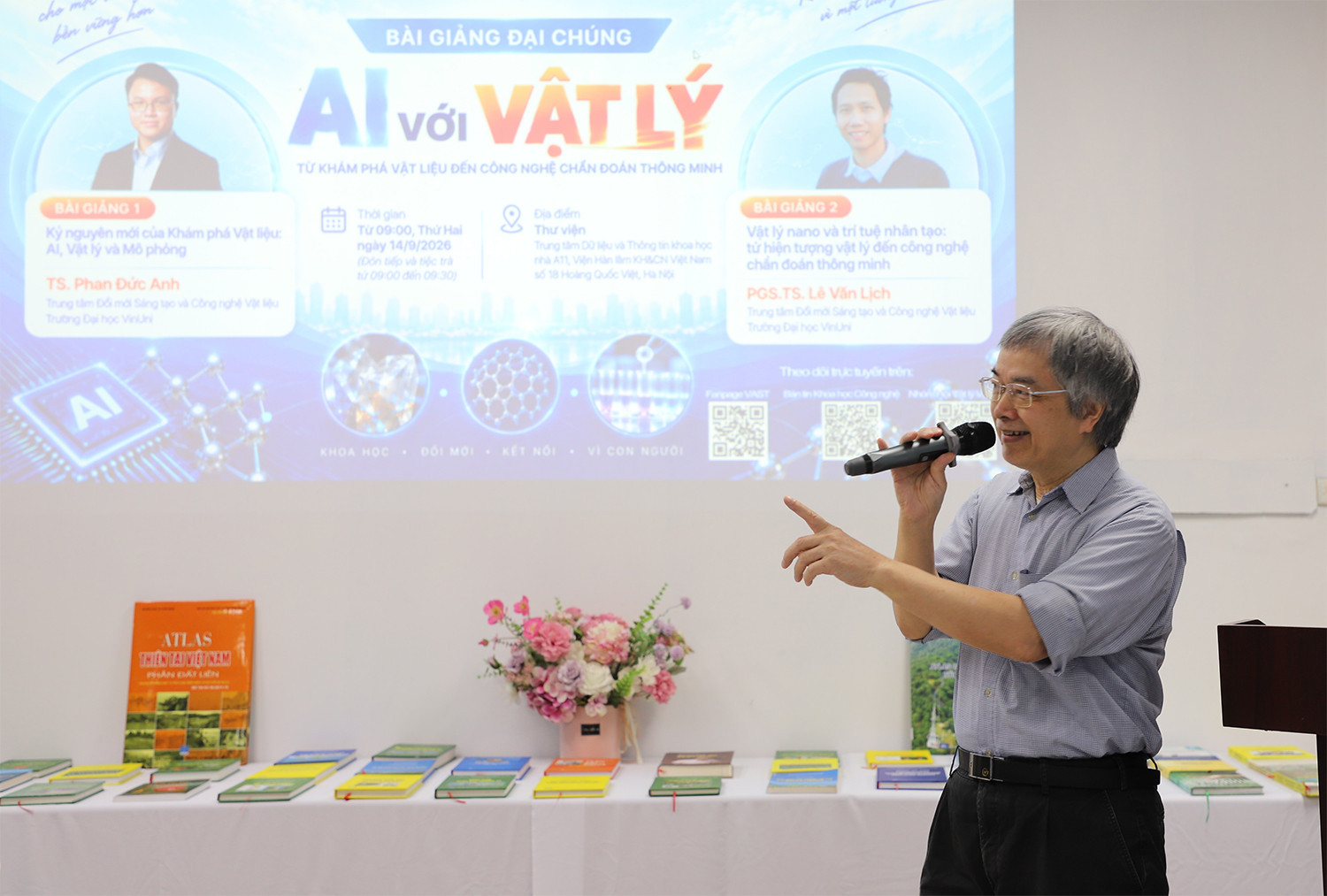
On September 14 in Hanoi, the public lecture "AI with Physics" attracted scientists, lecturers, students, and thousands of online viewers. The event was organized by the Center for Scientific Information and Data (Vietnam Academy of Science and Technology) in coordination with VinUni and the Vietnam Physical Society.
Assoc. Prof. Dr. Nguyen Hong Quang, Vice President of the Vietnam Physical Society, noted that AI is creating a new technological period, and for researchers, the issue is not merely understanding AI, but finding ways to apply the technology effectively within each specialized domain.
In search for new materials
Dr. Phan Duc Anh of the Center for Innovation and Materials Technology at VinUni said traditional materials research often begins with experimental observation, followed by the development of theories and models to explain phenomena and formulate hypotheses.
The emergence of computers in the mid-20th century marked a major shift, as simulations made it possible to study complex physical systems before conducting experiments. Along with advances in computing power and supercomputers, simulations have increasingly been used to predict material properties.
AI is expanding these capabilities further. By processing vast amounts of data, AI models can support data analysis, predict material properties, search for new structures and identify relationships among multiple variables.
One notable approach is “inverse design.” Instead of starting with a structure and then predicting its properties, researchers first determine the desired characteristics and use AI to search for a suitable structure. Humans define the scientific questions and objectives, while AI helps screen options across a vast data space.
AI can also summarize scientific publications, identify trends, suggest unresolved research questions and predict the properties of polymers, drugs, metals and alloys.
However, predictive capability does not mean that AI can replace scientists. A model’s effectiveness depends on the quality, scale and suitability of the data. Researchers must still define the problem, select the data, evaluate the model and verify the results.
From gold nanoparticles to hepatitis B viral load
Associate Professor and PhD Le Van Lich, also from VinUni, presented an approach combining AI with nanophysics to detect and quantify hepatitis B virus (HBV).
The research team used gold nanoparticles, nano-optical phenomena and machine-learning models. Changes in the color of a solution containing gold nanoparticles can reflect reactions taking place within the system. Based on this, the team has developed a biosensing method to distinguish HBV-positive and HBV-negative samples.
Instead of merely observing color changes with the naked eye, AI is used to analyze images and convert color signals into quantitative data on viral load.
The research dataset consists of 990 images corresponding to samples with viral concentrations ranging from 0 to 10^8 copies per reaction. Of these, 810 data points were used for training, 162 for validation and 18 for testing. The team compared three machine-learning models and three deep-learning models to identify the most suitable approach.
The long-term goal is to integrate image-processing algorithms and AI models into a smartphone application. Users could conduct rapid tests, photograph samples with their phones and have the system automatically analyze the images and return quantitative results.
To move toward practical applications, the team is focusing on the ability to expand the method to other pathogens and integration into a point-of-care diagnostic solution.
One challenge is that differences among smartphone cameras, lighting conditions and shooting environments can alter color data. The team is working to develop datasets and algorithms that are less dependent on imaging devices, helping the system remain stable under real-world conditions.
AI does not replace scientific process
Discussions at the program showed that applying AI in physics is not simply a matter of choosing a model and feeding it with data for training. Data noise, input variables, nanoparticles, pH levels and differences among cameras can all affect the results.
AI must therefore be incorporated into an interdisciplinary process that combines specialized knowledge, data, algorithms, simulations and experiments.
According to Dr. Phan Duc Anh, using AI has helped his team increase its scientific publication output, producing around 10 papers within one to two years.
From materials discovery to smartphone-based testing, the common thread is that AI does not operate independently. The technology delivers value only when it is tied to a specific scientific question, sufficiently high-quality data and a reliable verification mechanism.
Hai Phong
.svg)
