 Vietnamnet.vn

 Podcast



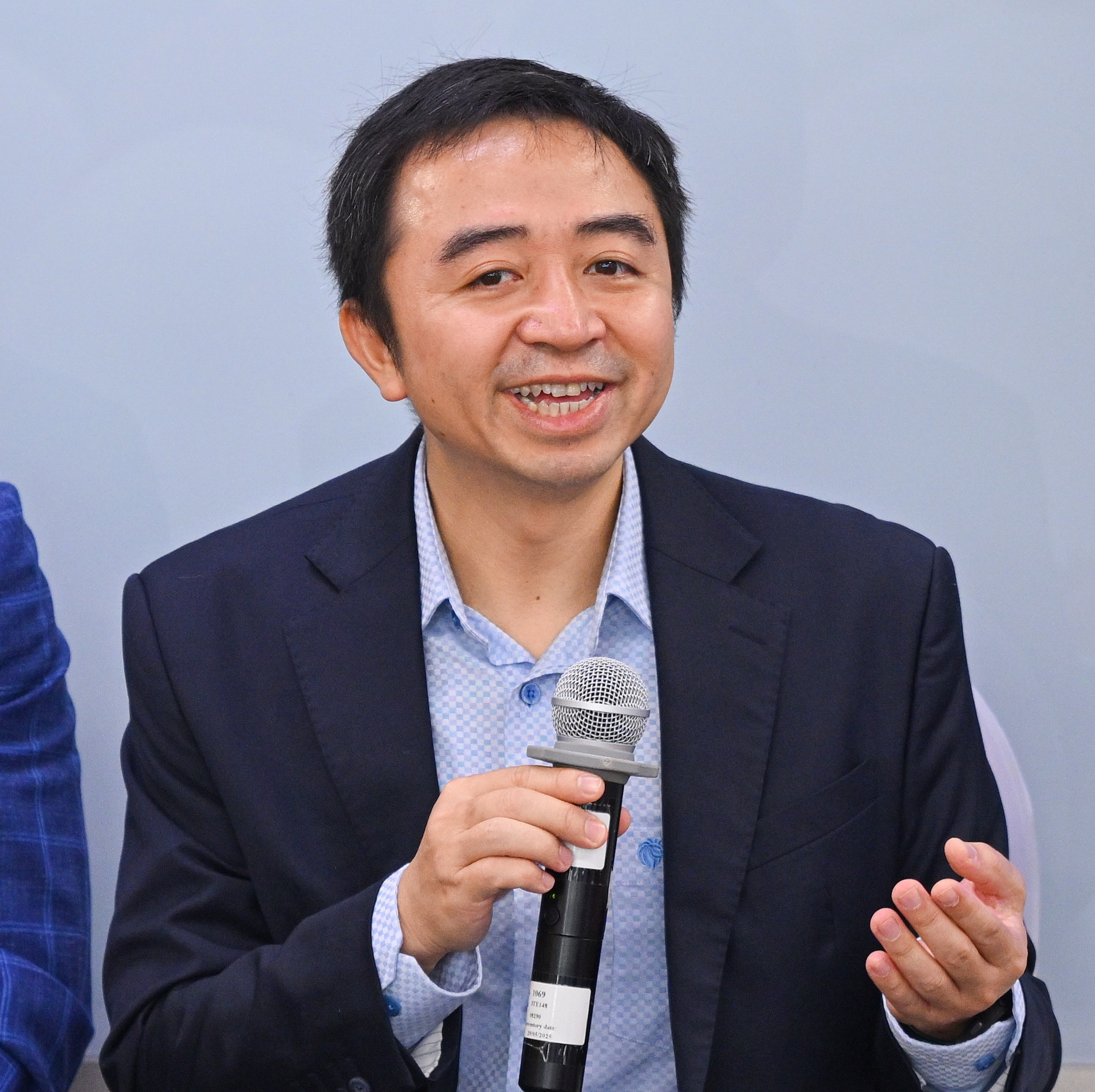
At the seminar "Future of Work – Global Canvas of Opportunities" organized by Fulbright University Vietnam January 11, speakers discussed the role of AI in education and the future labor market.
Quan cited two approaches to this issue. The first is to ban AI and return to traditional learning methods like handwriting and rote memorization. However,learning is not just for remembering knowledge but also for human interaction, maintaining dialogue, and building relationships.
Sometimes just a timely "insight" is enough to create a connection, something AI cannot replace. In reality, even within families, many children tend to enjoy chatting with AI more than with their parents.
The second approach, and Fulbright’s choice, is to treat AI as a tool. What can be automated should be left to AI, but learners must think, create, and generate new value.
"When designing our curriculum, we encourage students to use AI as a labor tool, but the focus is on a training mindset rather than just tool-using skills,” said Quan. “Students compare products made entirely by AI with solutions formed through many rounds of deep discussion. Evaluation criteria lie not in technical proficiency but in the true value of the product for the user.”
Students can use AI to search for information, but they must know how to refine it and develop new ideas, then participate in group discussions without AI to enhance teamwork and the "human touch."
"At the university, lecturers are encouraged to bring AI into the classroom. Computer science faculty also support students from other majors to understand how AI operates, its pros and cons, so they do not rely entirely on it and remain aware that the human touch remains an irreplaceable factor," Quan emphasized.
Dao Thien Huong, Deputy General Director of EY-Parthenon Strategy and Transactions at EY Vietnam, said that AI does not necessarily make people lazy; on the contrary, it can help improve "prompting" skills. To get good results from AI, users have to ask clear questions with specific contexts and goals.
A new competency in the labor market is "boss skills." When joining an organization, young people must know how to effectively manage "at least ten AI employees" to optimize work. In the AI era, human value is further affirmed: for the same task, individuals or businesses prefer working with you over others, something achieved only through credibility, personality, and personal ethics.
Huong emphasized that the ability to ask the right, clear, contextual, and purposeful questions is the core of critical thinking, a capacity that AI cannot form on behalf of humans.
Tran Le Nam, former Boston Consulting Group expert and former strategy director at Vietnam Oman Investment, said the university’s training philosophy is built on three layers: Know (understanding problems), Do (skills, practice, coding), and Be (what kind of person one becomes).
The biggest challenge lies in the Be layer, not only for students but for every individual: what kind of person do you want to become, and what do you want to contribute to society? Education has long focused heavily on Know and Do, while Be has received less attention.
However, the core questions are not just what you can do, but for whom you do it, for what purpose, and with whom. Values that may seem simple like living kindly, being responsible, and respecting others, are in fact the most difficult and most important part of education.
As a former educator, Nam said problem-solving is the skill students can be most confident in, and one that the labor market always needs. With this skill, AI becomes merely a supporting tool and cannot replace humans.
“Between the world of academic knowledge and the real-world environment, there is always a gap that only humans can fill. We often joke: AI can act as a secretary, but it cannot sign on your behalf,” Nam shared.
Tran Le Nam added that using AI frees up human time to think about new ideas and new ways of doing things. In the AI era, building and leading human relationships becomes a group of skills that must be invested in more deeply than ever.
Le Nam
.svg)
