 Vietnamnet.vn

 Podcast



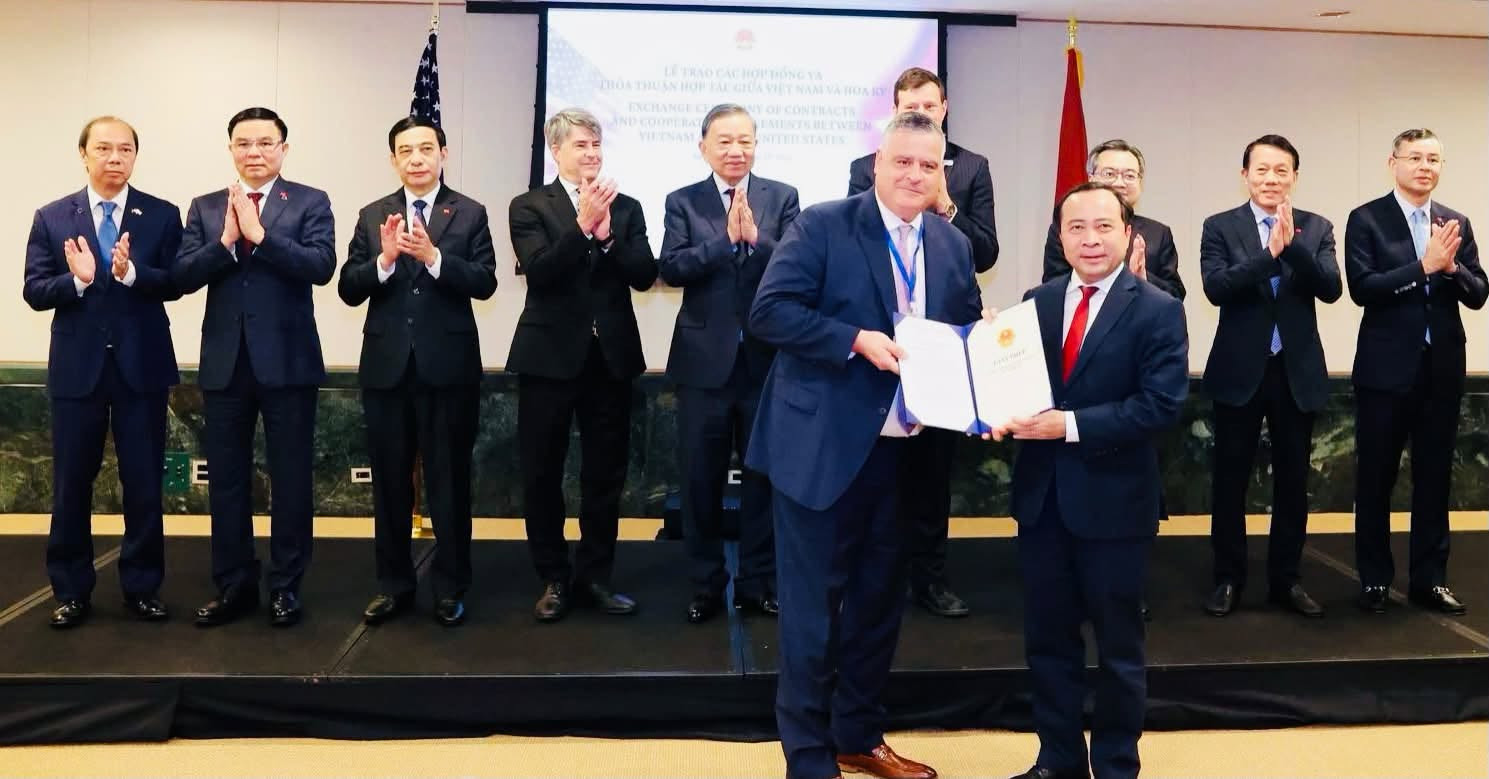
Minister of Science and Technology Vu Hai Quan presents Amazon Kuiper Vietnam with a license to establish a private telecommunications network. Photo: Ministry of Science and Technology
On September 23, 2026, Minister of Science and Technology Vu Hai Quan presented Amazon Kuiper Vietnam Co., Ltd. with a license to establish a private telecommunications network.
The license allows the company to use satellite links to test and check the operation of customer terminals, evaluating the quality of products manufactured in Vietnam.
The private network will connect the satellite system with ground infrastructure in Vietnam to support terminal testing and quality checks.
Its authorized coverage is nationwide, and it must comply fully with laws and regulations governing telecommunications, radio frequencies, technical standards, service quality, and information safety and security.
Established in 2024, Amazon Kuiper Vietnam is Amazon’s legal entity in Vietnam for satellite connectivity.
Amazon Leo, formerly known as Project Kuiper, is a broadband network using more than 3,000 low-Earth-orbit satellites, designed to provide high-speed, low-latency connections in areas difficult to reach with conventional infrastructure.
The license provides a basis for Amazon to test equipment manufactured in Vietnam, helping advance high-tech manufacturing, expand supply chains and strengthen cooperation on next-generation connectivity infrastructure.
In August 2025, Deputy Minister of Science and Technology Pham Duc Long met an Amazon delegation led by Gonzalo de Dios, director of global licensing and international regulatory affairs for Project Kuiper.
The two sides discussed Kuiper, an initiative to deliver broadband internet through low-Earth-orbit, or LEO, satellites and support digital transformation and connectivity in Vietnam.
Amazon said Vietnam held a special place in its development strategy. It described Kuiper as a strategic initiative to build a constellation of more than 3,200 LEO satellites, providing high-speed, low-latency internet at speeds of up to 400 Mbps for individuals and 1 Gbps for businesses. Its focus includes unserved and underserved areas, such as remote communities and islands.
At the time, Amazon reported having launched 102 satellites, with plans to deploy at least half the constellation by 2026. The system uses Ka-band frequencies, compact terminals that are easy to install, and integrated security from Amazon Web Services (AWS).
Amazon had established Amazon Kuiper Vietnam Co., Ltd. in Ho Chi Minh City. It also said it had submitted an application on August 6 to join a controlled pilot program for LEO satellite telecommunications services, with plans to serve up to 600,000 subscribers. The proposed services would cover consumer and business connectivity, telecommunications backhaul, aviation, maritime operations and government services.
The project aligns with Vietnam’s strategy and goal of achieving nationwide internet coverage by 2030.
Deputy Minister Pham Duc Long emphasized that Vietnam consistently prioritizes digital infrastructure development, with LEO satellite technology playing an important role in ensuring universal access to high-speed broadband for socioeconomic development.
He also said Kuiper matched Vietnam’s development needs, offering a way to bring more people online and help them access digital services for administrative procedures through better connectivity, particularly following the country’s provincial-level administrative mergers.
In August 2026, Starlink announced that its service had officially become available in Vietnam. Two US technology groups have thus invested in providing LEO satellite services in the country.
Nguyen Anh Cuong, deputy director general of the Vietnam Telecommunications Authority, said Starlink Services Vietnam Co., Ltd. had received two licenses from the authority to provide telecommunications services with network infrastructure for a pilot deployment using LEO satellite technology.
The pilot is capped at 600,000 subscribers, equivalent to only about 2.5% of Vietnam’s existing fixed broadband subscriptions.
LEO satellite services are therefore unlikely to pose significant competition to the fixed and mobile broadband services offered by Vietnamese operators.
Thai Khang
.svg)
