 Vietnamnet.vn

 Podcast



On December 29, the Thang Long - Hanoi Heritage Conservation Center, in collaboration with the Institute of Archaeology under the Vietnam Academy of Social Sciences, hosted a scientific conference to present preliminary findings from a 2025 archaeological excavation at the central Kinh Thien Palace site.
Excavation site at Kinh Thien Palace, revealing deep foundation layers over 3 meters thick.
The conference unveiled new discoveries that clarify the historical depth, spatial scale, and architectural layout of one of the most sacred spaces in the ancient Thang Long Citadel.
The excavation followed UNESCO/ICOMOS recommendations and World Heritage Committee Decisions 46 COM 7B.43 and 47 COM 7B.92, which endorsed Vietnam’s vision for researching and preserving the central sector of the Thang Long - Hanoi Imperial Citadel. This included approval to dismantle several modern buildings obstructing the site’s central axis, allowing comprehensive archaeological study.
Specifically, Decision 46 COM 7B.43 permitted the removal of six modern structures: the Artillery Headquarters Building (CT04), the Operations Department Building (CT17), and buildings CT20, CT21, CT24, and CT25. All removals were carried out under strict conservation protocols reported to UNESCO, complying with the 1964 Venice Charter and Vietnam’s 2024 Cultural Heritage Law to ensure controlled preservation.
Based on these permissions, the Thang Long Heritage Center and the Institute of Archaeology, under directives from the Hanoi People’s Committee and Decision No. 1344/QĐ-BVHTTDL (issued May 13, 2025, by the Ministry of Culture, Sports, and Tourism), conducted a major excavation of the Kinh Thien Palace foundation along the citadel’s central axis. The dig spanned 580 square meters, located at the former site of the Artillery Headquarters, dismantled earlier this year.
Associate Professor Dr. Tong Trung Tin, President of the Vietnam Archaeological Association, stated that the site revealed a stratigraphy roughly 6 meters deep, encompassing six distinct cultural layers from the Pre-Thang Long period (7th–10th centuries) through to the modern era (19th–20th centuries). The thickest layer - almost 3 meters - dates to the Le dynasty, covering both early and restored Le periods.
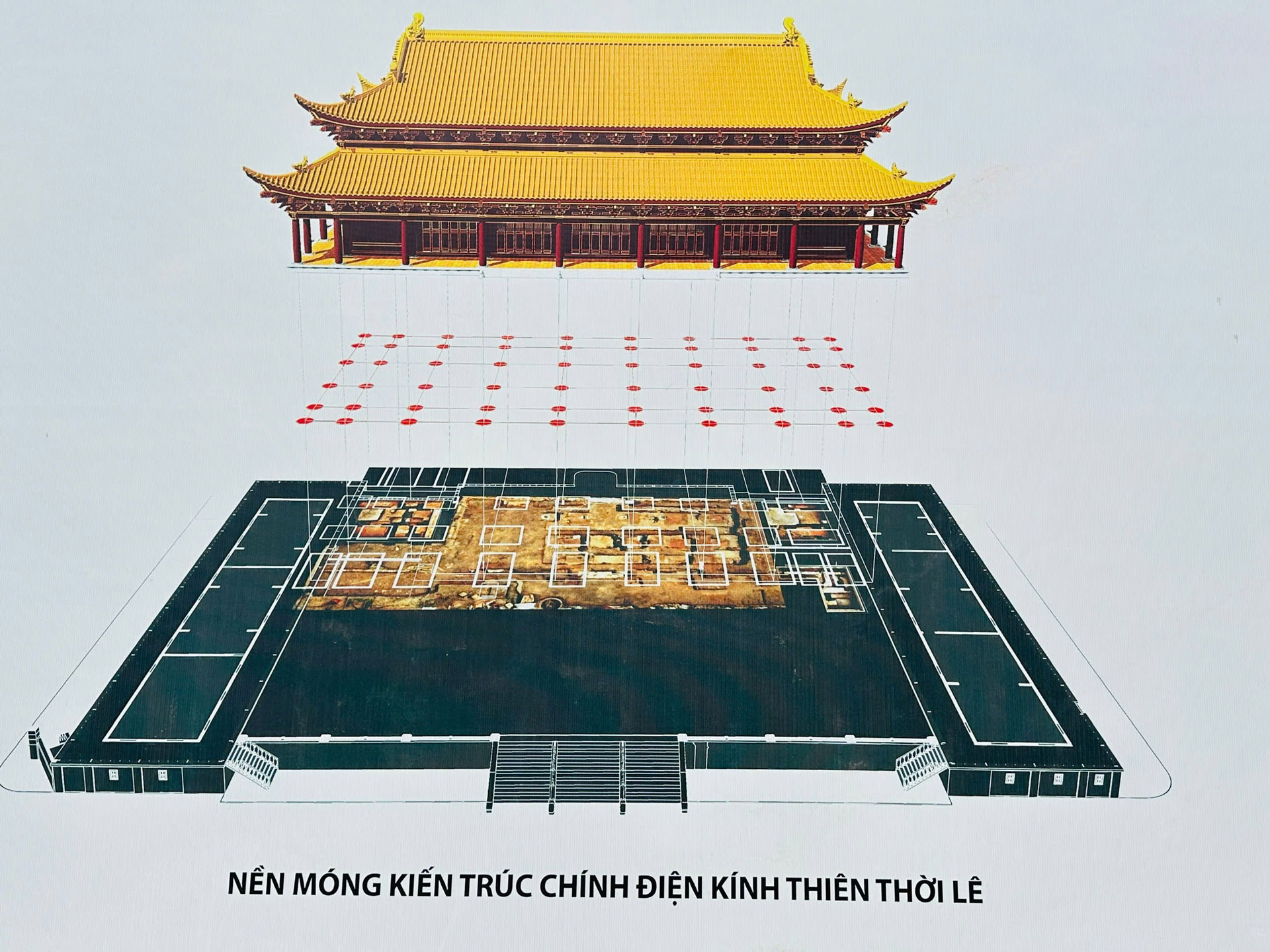
Each cultural layer corresponds to distinct architectural remnants. Notable findings include a red brick wall from the Tran dynasty (13th–14th centuries), a grey brick wall from the early Le period (15th–16th centuries), stone paving from the imperial walkway (Ngự Đạo), and 14 column bases from the Kinh Thien Palace under the Later Le dynasty (17th–18th centuries). Including previous excavations in 2011, 2023, and 2025, a total of 30 out of 36 column bases have now been uncovered - classified into single and double types.
Archaeologists also uncovered two water drainage channels and 26 out of 64 column bases from the Long Thien Palace, built during the Nguyen dynasty (19th century). The layout of Long Thien Palace matches precisely with the east-west footprint of the former French-era Artillery Headquarters, indicating that the structure was originally commissioned by Emperor Gia Long in a layered architectural style - featuring both front and main halls unified on a single platform, connected by a transitional bay (gian thừa lưu).
The excavation also clarified the construction scale and method used for the Kinh Thien Palace. Its platform was entirely man-made, built from compacted clay and debris, with column bases strategically placed atop. Column foundations from the Later Le period are exceptionally large - single bases range from 2.8 to 3.5 meters wide, while double bases reach up to 5.4 to 6.1 meters. These were formed from 81 layers of rammed earth, about 4 meters thick, making them the largest column bases ever recorded in Vietnamese architectural history.
Based on the uncovered bases, the palace is estimated to have consisted of nine chambers along the east-west axis. The north-south dimensions remain under investigation.
Remarkably, this is the first time that verifiable traces from the Ly, Tran, and Pre-Thang Long periods have been discovered at the Kinh Thien site - proving continuous architectural occupation from the Dai La period through the Ly, Tran, Le, Nguyen, and into the modern age.
According to scholars, the 2025 excavation marks a major advancement in understanding the scale, spiritual significance, and structural evolution of the Kinh Thien Palace - the sacred heart of imperial Thang Long and the Dai Viet kingdom. These findings form a solid scientific basis for future restoration and conservation efforts, aligning closely with UNESCO/ICOMOS recommendations and reinforcing the global value of the Thang Long Imperial Citadel as a World Heritage site.
Tinh Le
.svg)
