 Vietnamnet.vn

 Podcast



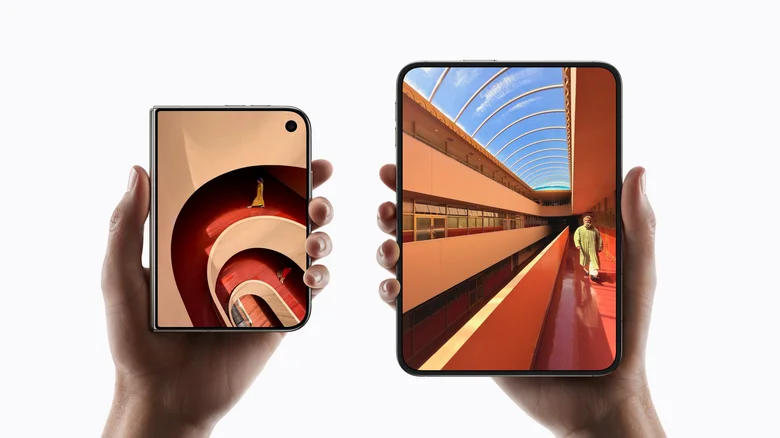
After years of rumors, the foldable iPhone Duo emerged as the biggest attraction at Apple’s “Awe Dropping” event on Sept. 10.
Book-style foldable design
The iPhone Duo uses a book-style horizontal fold similar to Samsung’s Galaxy Z Fold series. When closed, it features a 5.4-inch outer display.
Unfolding the device reveals an approximately 7.6-inch Super Retina display, with the FaceTime camera located on the inner screen.
The design allows the Duo to function like a conventional smartphone when folded while providing a much larger display when opened.
Unlike the traditional Face ID system used on recent iPhones, the iPhone Duo integrates a Touch ID fingerprint sensor into its side button for biometric authentication.
Users can register multiple fingerprints for convenient unlocking from different holding positions, while the device can also be quickly unlocked using an Apple Watch.
The phone has a frame made from durable, lightweight grade 5 titanium and comes in two finishes: Star White and Night Sky.
It carries an IP68 rating for water and dust resistance, addressing one of the longstanding durability concerns surrounding foldable devices.
The iPhone Duo also features dual speakers positioned at the top and bottom, delivering spatial audio when watching movies, listening to music or making video calls.
One of the key challenges Apple has focused on is the display crease, a readily visible weakness of many foldable smartphones currently on the market.
Apple has spent considerable time developing the hinge and display to create a device that is thin and durable while minimizing the crease.
Larger display built for multitasking
The nearly 8-inch inner display is one of the main features distinguishing the Duo from conventional iPhones. Apple has developed a dedicated software interface to take advantage of the additional screen space.
The device can run two apps side by side, supporting multitasking and displaying content in a way that more closely resembles an iPad.
Users can browse the web, watch videos, read documents or work with multiple apps on the same screen.
The Duo also supports Apple Pencil, expanding its potential uses to note-taking, drawing and document editing.
iOS has been extensively optimized to adapt intelligently to different positions and configurations of the foldable device.
Users can operate the phone in different orientations, lay it completely flat or keep it partially folded like a miniature laptop.
Multitasking is further enhanced through Split View, which divides the display between two tasks.
A streaming video, for example, can be pinned to the upper half of the screen while the user continues working, taking notes or browsing the web on the lower half.
Powered by A20 Pro and Apple’s C2 modem
At the heart of the iPhone Duo is Apple’s new A20 Pro processor, featuring a dedicated display engine that can independently control the inner and outer screens simultaneously while keeping latency to a minimum.
The device also uses Apple’s internally developed C2 cellular modem, designed to provide faster data transmission while improving power efficiency on cellular networks.
By eliminating the physical SIM slot entirely and adopting eSIM worldwide, Apple has used the additional internal space for a dual-battery system, with a battery housed in each half of the device.
The configuration delivers up to 31 hours of continuous video playback when using the large inner display and up to 44 hours when operating solely through the outer screen.
Dual 48MP cameras and an under-display sensor
For photography, the iPhone Duo borrows technology from Apple’s Pro lineup with a high-end dual-camera system.
Its 48-megapixel Fusion main camera supports 2x optical-quality zoom at 12MP and 4K video recording at up to 120 frames per second.
The 48MP Fusion Ultra Wide camera provides greater detail and improved wide-angle photography in low-light conditions.
For selfies and video calls, the outer display features a 12MP camera with Center Stage, which automatically keeps subjects framed. The larger inner screen uses an under-display FaceTime camera, preserving an uninterrupted viewing area.
Apple is also introducing two accessories specifically for its new foldable: an iPhone Duo Folio case with an integrated kickstand for hands-free use on a flat surface, and a two-piece protective case covering the two halves of the device separately.
The iPhone Duo starts at VND64.999 million in Vietnam, equivalent to about US$2,460, for the standard 256GB version. The top-end 2TB model costs VND103.999 million, or around US$3,940.
Apple’s global starting price for the device is US$2,000.
Pre-orders in Vietnam will open at 7 p.m. on Oct. 16, with deliveries beginning Oct. 23.
Apple’s entry into the foldable smartphone market could have a significant impact on the wider industry. Samsung and several Chinese manufacturers have spent years developing foldable phones, while Apple has entered the segment only after the technology has become relatively mature.
Apple’s advantages include its iOS ecosystem, large user base and ability to tightly integrate hardware and software. But the Duo will also face the familiar challenges confronting foldable smartphones, including high prices, durability, battery life and software optimization.
If Apple can overcome those limitations, the Duo could mark the beginning of an entirely new branch of the iPhone family.
Du Lam
.svg)
