 Vietnamnet.vn

 Podcast



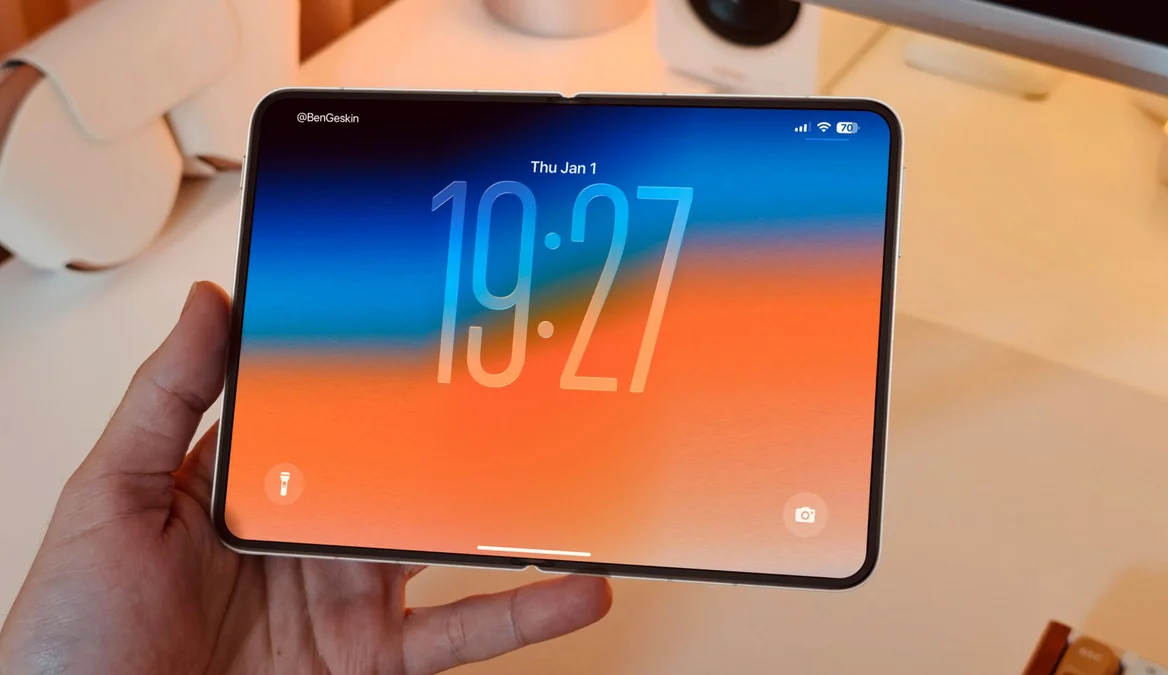
During Apple’s prolonged absence, Samsung pushed forward with its Galaxy Z Fold lineup, refining designs across multiple generations. Yet in doing so, it may have inadvertently served as a testing ground for Apple. While Samsung experimented, improved and absorbed user feedback, Apple observed, learned and prepared its own entry.
What has emerged is not just a product, but a carefully timed move.
A design aimed at reshaping the category
One of the most striking aspects of the rumored foldable iPhone is its design. Rather than adopting the now-familiar vertical fold, Apple is expected to introduce a wider, horizontal folding format. When unfolded, the device would resemble a compact tablet more than a conventional smartphone.
This approach suggests Apple is not merely following an existing trend, but attempting to redefine it. Reports indicate that the unfolded experience will closely mirror that of an iPad, with a strong focus on multitasking and productivity.
The impact of these rumors has already been felt. Samsung is said to be developing a “Wide Fold” variant to align with this emerging direction. Even before launch, Apple appears to be influencing the trajectory of the market.
Yet the strategy runs deeper. Apple may be signaling just enough to provoke competitors into action, while retaining the flexibility to pivot if needed. The company can still revert to a more conventional design should market reception fall short.
Pricing as a strategic equalizer
Another potentially disruptive factor is pricing. Sources suggest the foldable iPhone could start at US$1,999 - aligning directly with Samsung’s Fold series.
If accurate, this removes one of Samsung’s key advantages. The competition would no longer be defined by price gaps, but by overall appeal.
In terms of hardware, the foldable iPhone is expected to match top-tier specifications, including 12GB of RAM and a base storage of 256GB. It may also feature the A20 Pro chip built on a 2nm process, positioning it firmly as a high-performance flagship rather than an experimental device.
More critically, Apple is rumored to have developed an advanced hinge system and a display with a significantly reduced crease. Some reports even suggest the crease may be less noticeable than on current Fold models. If confirmed, this would address one of the most persistent weaknesses of foldable phones.
A battle years in the making
Samsung has long led the foldable segment, but that leadership has come with risk. Over the years, users have encountered issues ranging from hinge failures to screen damage, even on premium devices priced close to US$3,000.
These challenges have effectively provided Apple with real-world data - without requiring it to bear the cost of early experimentation.
In this light, Samsung has done the heavy lifting: pioneering the technology, testing its limits and refining it through iteration. Apple, meanwhile, has waited for the formula to mature before entering with its own interpretation.
This is why many observers view Apple’s move as a calculated strike at the perfect moment.
As Samsung approaches maturity with its traditional foldable design, Apple is preparing to introduce a different vision. The competition is no longer about who arrives first, but who defines what comes next.
With a powerful ecosystem, strong brand loyalty and a strategy built on timing, Apple could push the foldable smartphone market into an entirely new phase.
Whether the foldable iPhone succeeds or falters, one thing is clear: Samsung has been drawn into a contest shaped long in advance - a slow-built trap, executed with precision.
Hai Phong
.svg)
