 Vietnamnet.vn

 Podcast



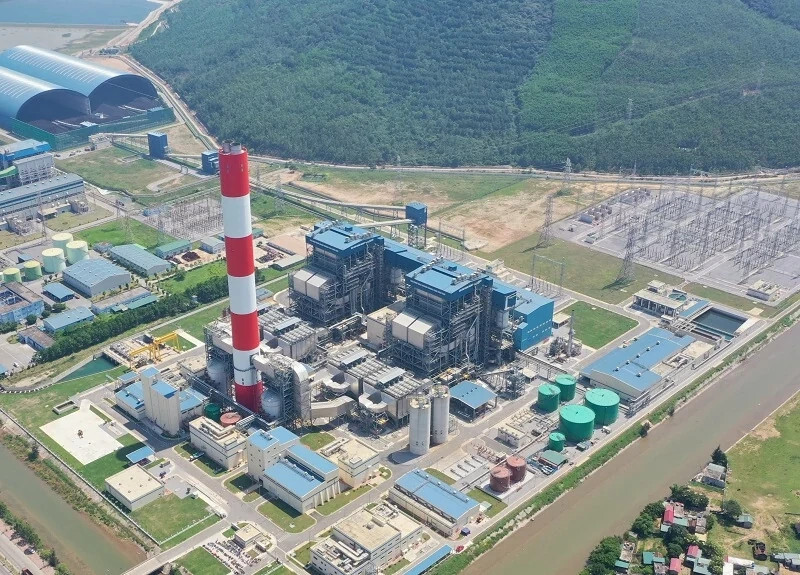
MOF has submitted to the Ministry of Justice (MOJ) a draft document on the amendments and supplements to certain provisions of National Assembly Resolution No 107/2023 on additional corporate income tax (CIT) under global anti-base erosion rules.
BOT power projects face $400 million in additional taxes
In its submission, MOF cited the Ministry of Industry and Trade’s (MOIT) assessment on the impact of the global minimum tax on BOT thermal power projects in Vietnam.
MOIT’s dispatch attached to the document showed that seven BOT power projects (Build-Operate-Transfer power plants) with government guarantees are subject to additional tax obligations under the Qualified Domestic Minimum Top-up Tax - QDMTT).
These projects have large-scale capacity and huge investment capital, with 75-80 percent funded by loans from international financial institutions and 20-25 percent from investor contributions.
These BOT power projects belong to multinational corporations covered by Resolution 107.
Preliminary assessments show significant financial impacts from applying QDMTT to these BOT power projects. The figures are $14.4 million (until 2040) for Mong Duong 2; $65 million (until 2043) for Vinh Tan 1; $189.53 million for Nghi Son 2 (until 2047); $10 million (until 2049) Van Phong; $52.9 million (from 2033-2040) for Vung Ang 2; and $94 million for Hai Duong.
Thus, the total additional corporate income tax for six of the seven BOT power projects is estimated at $425.83 million (Duyen Hai 2 lacks impact assessment data).
Given this situation, MOIT has recommended that the Government report to the National Assembly for an exemption in accordance with Resolution 10 applied to BOT power plant projects, or introduce appropriate exemption mechanisms.
The submission also noted that during the drafting of Resolution 107, an exemption from QDMTT for projects with guaranteed investment incentives was considered. However, after the NA Standing Committee’s review and revisions, this was replaced by Clause 2, Article 8 of the current resolution.
Nevertheless, MOF believes that amending and supplementing Resolution 107 to include a mechanism allowing the Government to consider tax exemption requests is necessary and appropriate.
The Ministry explained that the global minimum tax policy is a new, complex, and unstable issue. Many countries have yet to finalize its domestic implementation. Thus, the policy remains fluid, lacking practical precedents, requiring Vietnam to adopt flexible handling mechanisms.
Implementation in Vietnam is still novel, with many unforeseen scenarios. Resolution 107, enacted in late 2023 and applied from the 2024 tax period, has a QDMTT declaration deadline of December 31, 2025. During implementation, unique cases, such as BOT power projects with government guarantees, may arise, which cannot yet be fully anticipated.
Without flexible mechanisms, there could be legal risks, complaints, or impacts on Vietnam’s investment reputation.
Additionally, ensuring the Government’s timely management and handling role while maintaining the NA’s supervision is crucial. Thus, flexible delegation to the Government is needed to address specific emerging situations promptly.
BOT power projects should be exempted from global minimum tax
MOF proposes adding Clause 10, Article 4 to Resolution 107 as follows:
“The domestic QDMTT will be set at 0 for the fiscal year for enterprises implementing BOT power projects, provided the Build-Operate-Transfer contract includes tax commitments and was signed before Resolution 107 took effect (January 1, 2024).
If an enterprise implements the BOT power project is a constituent entity of a multinational enterprise group with more than one constituent entity in Vietnam, the amount of qualified domestic minimum top-up tax for this enterprise shall be the portion allocated based on the income criteria of the qualified domestic minimum top-up tax of the multinational enterprise group, and the allocated tax amount shall be determined as zero.
If the enterprise implementing the BOT power project is the sole constituent entity or the only joint venture of a multinational enterprise group in Vietnam, the enterprise shall file tax declaration as prescribed in Article 6 of this resolution and declare the qualified domestic minimum top-up tax as zero.”
MOF stated that this addition aims to establish a mechanism equivalent to exempting QDMTT application (specifically, setting the domestic minimum top-up corporate income tax at 0) for enterprises implementing BOT power projects with government guarantees (GGU).
Tam An
.svg)
