 Vietnamnet.vn

 Podcast


More than a decade ago, an individual investor holding just six shares in Hoa Phat Group (HPG) received a large envelope at home inviting them to attend the company's annual general meeting.
Despite the modest shareholding, the investor was welcomed and allowed to participate like any other shareholder.
The seemingly insignificant episode illustrates a principle that has helped shape Hoa Phat's development under billionaire chairman Tran Dinh Long: every shareholder, regardless of the size of their investment, has a stake in the company and deserves recognition.
It also reflects a broader strategic decision made nearly two decades ago. By listing Hoa Phat on Vietnam's stock market, Long accepted the obligations of a publicly traded company in exchange for greater access to capital, stronger corporate governance and opportunities for long-term industrial expansion.
From six shares to more than 300,000 shareholders
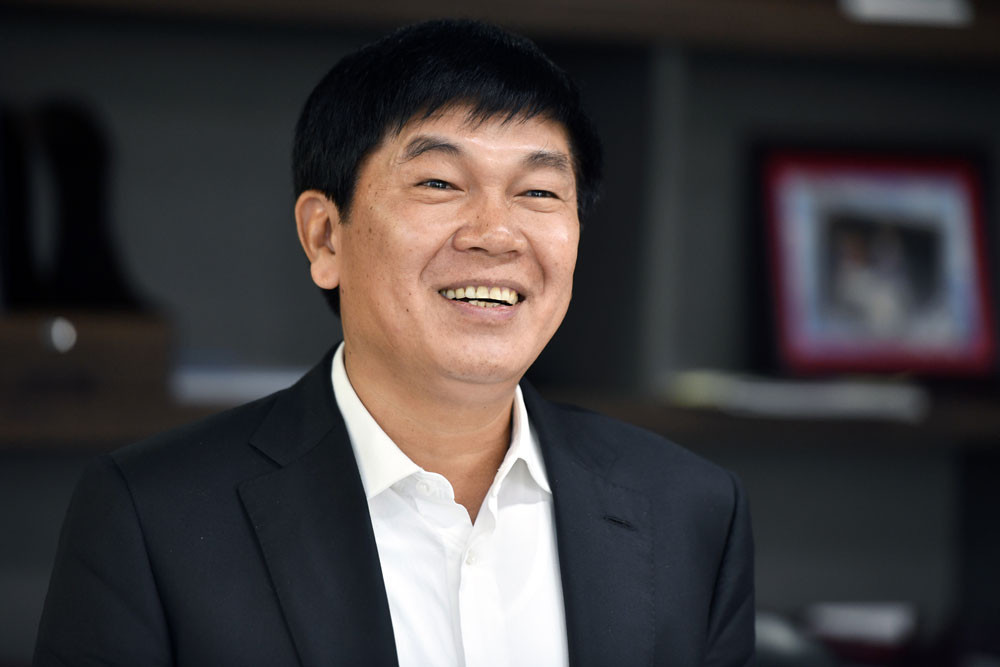
Long moved to take Hoa Phat public relatively early in the group's development.
On January 9, 2007, Hoa Phat adopted a parent-subsidiary corporate structure, laying the organisational, governance and financial groundwork for its stock market listing.
Later that year, the group issued 20 million shares to strategic investors, increasing its charter capital from VND 1.1 trillion to VND 1.3 trillion and generating nearly VND 1.2 trillion in share premium.
On November 15, 2007, approximately 132 million HPG shares began trading on the Ho Chi Minh Stock Exchange (HoSE), with a reference price of VND 110,000 per share.
At the time, Hoa Phat had around 2,000 shareholders.
The listing represented more than an additional fundraising channel. It required the company to embrace financial transparency, comply with disclosure regulations and accept scrutiny from outside investors.
On HPG's first trading day, Tran Tuan Duong, then general director of Hoa Phat Group, emphasised that the company no longer belonged solely to its executives and employees but also to its wider shareholder community and society.
That shift in ownership created a foundation for Hoa Phat's subsequent expansion.
By its 2026 annual general meeting, the group had more than 300,000 shareholders, compared with approximately 2,000 when it first listed.
Against that backdrop, the invitation sent years earlier to an investor holding only six shares takes on greater significance.
It illustrates how retail shareholders, however small their individual investments, became part of the company's development.
From 132 million shares to billion-dollar industrial projects
As early as 2007, Long had set an ambitious target for Hoa Phat to become one of Vietnam's private economic groups generating $1 billion in annual revenue by 2012.
At the time, its annual revenue stood at approximately VND 5.642 trillion.
The ambition reflected Long's view that a stock market listing could help transform Hoa Phat into a modern industrial group capable of attracting substantial external investment.
A major turning point came in 2017, when Hoa Phat decided to develop the Dung Quat Iron and Steel Integrated Complex in Quang Ngai Province.
To strengthen its equity base for the project, the company issued more than 252.8 million shares to existing shareholders at a ratio of one new share for every five shares held.
The offering raised more than VND 5 trillion, approximately $196 million, demonstrating how capital markets could help finance large-scale industrial investments.
Rather than relying exclusively on retained earnings or bank loans, Hoa Phat was able to mobilise additional capital directly from shareholders.
The group also prioritised reinvestment over cash dividend payments, retaining financial resources to expand production capacity and strengthen its long-term competitiveness.
The first Dung Quat complex required total investment of approximately VND 86 trillion, or $3.37 billion.
It was designed to produce six million tonnes of steel annually, including three million tonnes of hot-rolled coil (HRC).
The project marked a significant transition for Hoa Phat, moving beyond its traditional strength in construction steel into industrial steel production.
In May 2020, the group produced its first HRC product.
The milestone signalled Hoa Phat's entry into a more technically demanding segment of the steel industry, supplying materials for galvanised steel production, automobile manufacturing, shipbuilding and mechanical engineering.
Building on Dung Quat 1, Hoa Phat subsequently invested in the Dung Quat 2 complex, with an initial investment of approximately VND 85 trillion, or $3.33 billion.
The second complex was designed to produce 5.6 million tonnes of HRC annually.
It began producing commercial products in September 2025, helping raise the combined HRC capacity of the two Dung Quat complexes to approximately 8.6 million tonnes per year.
These projects illustrate how access to equity capital has supported Hoa Phat's transition from a construction steel producer into a large-scale industrial manufacturer.
Tran Dinh Long's strategy: Building on industrial strengths
Long has previously acknowledged that Hoa Phat's competitive advantages lie primarily in large-scale projects and heavy industry.
At the same time, he has recognised that the group has fewer advantages in sectors requiring sophisticated technology and high levels of specialised intellectual expertise.
That assessment reflects an approach centred on understanding the company's existing strengths, identifying its limitations and investing strategically to move into higher-value activities.
From its origins as a prominent construction steel producer, Hoa Phat has increasingly focused on products with greater technological requirements and added value.
HRC production has become a central part of that transformation.
For 2026, Hoa Phat set a target of selling nearly 15 million tonnes of steel.
During the first nine months of the year, the group produced 10.7 million tonnes of crude steel and sold more than 10.3 million tonnes of various steel products.
HRC sales reached 5.47 million tonnes, an increase of 59% from the same period a year earlier.
The figures highlight the growing contribution of industrial steel to Hoa Phat's overall business.
They also reflect the scale of the production capacity developed through its successive investments in Dung Quat.
Nearly two decades of growth through the stock market
Nearly 19 years after listing 132 million shares on HoSE, Hoa Phat has grown into a major industrial group with more than 300,000 shareholders and steelmaking complexes representing billions of dollars in investment.
Its expansion illustrates a broader role played by Vietnam's stock market over the past three decades.
While the stock market does not directly build factories or operate production lines, it provides a mechanism for connecting investors' capital with businesses pursuing long-term development plans.
For Hoa Phat, this has meant converting shareholder investment into tangible industrial assets, expanded manufacturing capacity and increasingly sophisticated steel products.
The company's decision to go public in 2007 can therefore be viewed as a long-term strategic commitment.
By accepting greater transparency, sharing ownership and submitting to market scrutiny, Long created opportunities for Hoa Phat to access the financial resources required for industrial expansion.
Nearly two decades later, the results are evident not only in the group's size or its expanding shareholder base, but also in the industrial production capacity it has built.
The story of the investor holding just six HPG shares remains a reminder that Hoa Phat's development has involved both major institutional investments and the participation of individual shareholders.
From a single shareholder invitation to multibillion-dollar steel complexes, the group's journey demonstrates how Vietnam's capital markets have helped support the growth of domestic industrial enterprises.
Manh Ha

