 Vietnamnet.vn

 Podcast



Tien Giang to develop sea-based economy

The Mekong Delta province of Tien Giang is setting goals and solutions to develop sea-based economy through 2030 with a vision to 2045.
Secretary of the provincial Party Committee Nguyen Van Danh said the locality will pay attention to marine economic development based on green growth and biodiversity conservation.
The province will focus on restructuring the marine economy, developing science-technology and marine human resources, protecting the environment and coping with climate change and rising sea levels, Danh, who is also Chairman of the provincial People’s Council said.
It aims to reduce the number of inshore fishing vessels by 30 percent and establish a chain of connectivity from supplying materials to transportation of products, processing and sales.
In addition, it will develop brackish water aquaculture by applying environmentally friendly technology.
Tien Giang is interested in promoting marine tourism and services, developing coastal industry and improving commercial infrastructure to form economic, industrial and coastal ecological urban areas.
With a coast of 32km, Tien Giang has potential to develop aquaculture and marine tourism.
The province now has 1,047 offshore fishing vessels, 330 logistics fishing ones, two fishing ports, and 15 shipbuilding facilities.
The total output of seafood each year surpasses 101,000 tonnes.
Sao Mai Group plans to pay dividend in shares

Construction and real estate group Sao Mai (ASM) on March 20 will finalise the list of beneficial shareholders that will receive bonus shares for 2017 and 2018’s performance.
The company plans to pay a 5 per cent dividend by bonus shares for its performance in 2017 and make an advance dividend payout rate of 2 per cent for 2018.
The group is listing nearly 242 million shares on the Ho Chi Minh Stock Exchange with code ASM.
The company is expected to issue nearly 17 million bonus shares in the payout.
In 2018, the firm recorded VND8.9 trillion (US$382 million) in total revenue, four times the 2017 figure (VND2.1 trillion).
Its post-tax profit in 2018 reached a record of VND1.15 trillion – seven times the number made the previous year.
The firm posted more than VND1 trillion in undistributed post-tax profit at the end of last year, up from VND240 billion as of the end of 2017.
ASM shares rose 1.3 per cent to end Thursday at VND8,690 per share.
Strict import requirements usher in changes to agricultural production

Tough quality requirements laid down by major importers are pushing local agricultural firms and farmers into changing their methods of production whilst boosting market expansion.
Several importing countries have imposed a set of strict standards on product quality as well as food safety and hygiene which are equal to, or even higher than those usually found among international importers.
Vietnam has joined 16 free trade agreements (FTAs), the most lucrative of which is the new-generation Comprehensive and Progressive Agreement for Trans-Pacific Partnership (CPTPP) . These FTAs are expected to enable Vietnamese exporters to enjoy extensive tariff cuts.
However, despite the initial or complete removal of tariffs, a number of other barriers have been emerging for the nation’s exporters as many importing countries have imposed stringent quality and quarantine regulations on agro-aquatic imports.
China for instance is the most significant market for Vietnamese farm produce, but has been hardening its rules related to product origin, export registration, and packing, according to To Ngoc Son, deputy head of Asia-Africa Market Department under the Ministry of Industry and Trade.
Furthermore, Japan, the Republic of Korea, and some ASEAN members have also toughened animal and plant quarantine regulations for imports. Some of these nations have imposed a set of strict standards on product quality as well as food safety and hygiene which are equal to, or even higher than those usually found among international importers.
Nguyen Xuan Cuong, Minister of Agriculture and Rural Development, admitted that the domestic agricultural sector is currently running on small scale with a fragmented production process, therefore making it difficult to satisfy standards set by demanding importers.
As such, Cuong noted the need to define and tap into certain advantages of each farm produce as well as to step up the use of cutting-edge scientific and technical applications in agricultural production. These advancements could help local farm produce penetrate further into domestic and overseas markets.
Agricultural production must stick closely to various market requirements, Cuong said, claiming this as an unavoidable trend.
He explained that the domestic market, with the urbanization rate of some 40 per cent is in increasing demand for high-quality products, while the global market of 7.5 billion consumers has far more varied consumption demands.
The country has so far managed to create national brands for tea and rice products and is currently working on developing two national brands for shrimp and tra fish (catfish) products.
Building brands for different farm produce is an essential pathway for sustainable development in the local sector, Minister Cuong stressed.
Assoc. Prof. Dr. Nguyen Quoc Thinh, an adviser to the Vietnam National Brand Program, claimed that most farm produce exports are raw and preliminarily processed products; hence they lack clear information about their producers or processing firms, and even their geographical origin.
As a result, the added value which agricultural exports bring about falls short of expectations while high risks remain for many farm produce shipments, Thinh said.
He gave an example that up to 100 firms have joined the export of Vietnam-branded rice, however the brand will suffer negative effects if only one of the exporters sends poor quality rice shipments abroad.
Branding goes beyond a simple logo, image, and slogan, but it is aimed to build consumer trust and familiarity, the expert said. He called for a drastic approach to be taken to building and protecting national brands for the long-term benefit of farm produce exports.
Vietnamese farm produce has so far penetrated 180 countries and territories while the country has leapt up to the 2nd largest exporter of farm produce in Southeast Asia and 15th in the world.
The agricultural sector this year looks to earn US$43 billion from exports. In order to reach the target, Minister Cuong highlighted the significance of further restructuring agricultural production and categorizing the structure of three key groups at respective national, provincial, and communal levels.
Gov’t fixes loan interest rate for social housing in 2019
The Government has decided to keep loan interest rate unchanged at 5% this year for purchase, rent or hire of social housing projects, according to Decision No. 255/QD-TTg signed by the Prime Minister.
The decision took effect since March 4, 2019.
Loan term shall be at least 15 years but borrowers and bankers may reach agreement on shorter term.
Last year, the Prime Minister also signed Decision No. 117/QD -TTg dated January 22, 2018 stipulating this kind of interest rate, which was only applicable in 2018.
GoBear to improve financial inclusion for the Vietnamese people

GoBear Vietnam has joined hands with FE CREDIT to drive greater financial inclusion for the people
A renewed partnership agreement was signed in HCMC on March 4 by GoBear Vietnam and FE Creditto drive greater financial inclusion to Vietnam’s market. This partnership is one of the key projects for GoBear Vietnam this year, aligned with their growth strategy.
In this partnership, GoBear Vietnam will synergize with FE Credit’s award-winning end-to-end digital lending mobile app $NAP, which offers loans to consumers with the ability to get real time loan pre-approval within 15 minutes. The new GoBear powered by FE Creditapp will further streamline GoBear Vietnam’s user journey and provide millions of unbanked Vietnamese people better access to unsecured loans. This app employs new technologies including Facial Recognition, AI algorithms, Optical Character Recognition (OCR) and Intelligent Character Recognition (ICR), Voice Based Virtual Assistant, Speech to Text, eSignature, and more, to enable the lender to extend credit to unbanked consumers while keeping risk in check.
GoBear, Vietnam’s leading financial comparison website, is focused on improving financial inclusion to sustaineconomic development. Mr. Bao Nguyen, Country Director of GoBear Vietnam, said: “Improving financial inclusion and serving the unbanked is very important in an emerging market like Vietnam. They have limited access to mainstream financial services, which is a significant problem as it can substantially restrict the flow of capital to would-be entrepreneurs and small businesses. With the new GoBear powered by FE Credit app, I believe we can help to improve financial accessibility for our users.”
Partnership is one of the key projects for GoBear Vietnam this year, and it’s well-aligned with its growth strategy and company value, adding more products for comparison, help users to make better informed choices and improve their quality of life through easier access to basic financial products. For GoBear, the collaboration with FE Credit is the first strategic partnership initiative to go to market, reinforcesits commitment to find innovative solutions to local challenges in increasing financial inclusion.
“This is our first strategic partnership of its kind in the region and Vietnam. Our ambition is to become the financial products supermarket of Asia,” said Mr. Adrian Chng, CEO of GoBear. Financial inclusion remains a challenge for many of the emerging markets in Asia. Vietnam, Indonesia and the Philippines, represent some of the largest unbanked population in the region, where financial services is still limited for up to 75% of the population. Part of the company’s strategy this year is to actively grow its product breadth and services regionally. “We want to demonstrate that we're an innovation leader in Asia’s Fintech space, and we're doing so with products that will help increase financial access for millions of unbanked consumers in SEA. We're set to grow this year in volume of users and product offerings,” he added.
Unsecured loans are an important source of credit for the unbanked who are unable to gain access to the traditional banking system. Now GoBear’s users can compare different products to make better informed choices on the website, before applying for a loan that best suits their needs either from FE Credit via the new app, or any other lenders conveniently and very transparent. This is the confirmation that technology companies and traditional financial providers can collaborate well to better serve the customers, with each party utilising their own strengths.
Besides partnering, GoBear is initiating some new technology innovations in 2019 to continue last year’s development. Towards the end of last year, the company announced a partnership with the smartphone-based alternative credit scoring provider CredoLab to develop the Easy Apply app, which will utilise smartphone data to generate alternative credit scorecards that can accompany applications for credit cards and loans. These alternative scorecards can increase applicants’ chances of approvals on such products.
The Easy Apply app can help their unbanked users to apply for loans and credit cards from different banks and consumer finance companies. The app will use non-traditional data and predictive data analytics, which are gathered from the users’ unique digital footprint, to produce highly predictive digital credit scorecards that enable them to access financial services.“This is a companywide initiative, and also a key project for Vietnam this year. Our main direction for Vietnam is to improve financial inclusion through technology innovations,” Mr Bao, Country Director of GoBear Vietnam said.
Currently, CIC is the only official source of credit scorecard information. The unavailability of credit risk information is a significant problem as it can substantially restrict the flow of capital to the people in need. And there is still a big pool of unbanked consumers in Vietnam with no formal credit histories on the CIC. They have little in terms of a personal banking history from which lenders, including banks and finance companies, can determine creditworthiness should they request a loan.The Easy Apply app willprovide applicants from all demographics - including the unbanked who have little to no traditional credit history – greater access to financial services such as credit cards, personal loans, and other forms of unsecured credit. For financial institutions, this app will help them to further expand their pool of customers while keeping risks in check.
As GoBear evolved after a few years coming to the market, now the company directs itself to be the supermarket where various digital financial products will be offered to consumers. While the traditional financial institutions do not fully tap the unbanked segment due to the lack of traditional credit history,GoBear brings its technology solution to fill this gap. GoBear’s data center will be able to impact both the consumer and financial institutions to match them together, and also supply the alternative credit scores of the borrowers. The company hopes to increase the digital financial penetration by tapping intodigital lending, digital insurance brokerage, etc.,and better matching lenders and borrowers.
Businesswise, GoBear Vietnam has signed more than 20 partners and achieved over 200% YOY revenue growth, and has landed 10 million visitors on their website www.gobear.com/vnafter two years of operation.As of this moment, GoBear Vietnam offers eight products on their comparison platform, which are Credit Cards, Personal Loans, Travel Insurance, Fixed Deposits, Bank Accounts, Home Loan, Home Equity Loan, and Car Loan. The company’s directors firmly believe that GoBear is now one of the most trusted financial comparison platforms for the Vietnamese people.
The new app can provide millions of unbanked Vietnamese people easier access to financial products
This year GoBear will also bring more initiatives to utilise the data to fulfill their ambition to be a marketplace of financial products. This database is believed to be very valuable to financial institutions who are expanding their market with different types of data utilisation.
Mr. Bao shared the further development of the company in Vietnam: “Our plan is to keep adding and improving new products and features for our users, especially the unbanked. Starting with our strategic partnership with FE Credit of which we have just announced.The next key target for this year will be to successfully launch and seamlessly integrate the new Easy Apply app into our users’ journey. I believe with these initiatives, GoBear will not only enable our users to access useful and affordable financial products that meet their needs in a timely manner, but also help our partners to better serve the unbanked.”
GoBear Vietnam also has a plan for life insurance products. Different from other types of general insurance, consumers often find it quite hard and time consuming to search for the right life insurance plan, especially when the benefits of more than one family member have to be taken into consideration.Later this year, the company will introduce a free and transparent comparison of life insurance plans available to the market, and users can find a range of products that match their specific needs in just a few seconds.
Commenting on the partnership with GoBear, Mr. Kalidas Ghose, Vice Chairman and CEO of FE Credit said, “We are delighted to be renewing this partnership with GoBear Vietnam which started in 2017. The partnership demonstrates FE Credit and GoBear Vietnam’s unwavering commitment to our customers in Vietnam. As Vietnam's economy continues to thrive, we see many opportunities to collaborate with financial technology companies to accelerate financial inclusion for the country. We are proud to play a role in Vietnam’s growth story.”
P2P lending under scrutiny

Deputy Prime Minister Vuong Dinh Hue chairs a meeting on peer-to-peer lending in Hanoi on March 6 - PHOTO: VGP
Despite welcoming new business models, Deputy Prime Minister Vuong Dinh Hue has requested the relevant ministries and agencies to enhance control over peer-to-peer (P2P) lending and handle violations strictly, the Government news website reported.
At a meeting on P2P lending on March 6, the deputy prime minister ordered an assessment of the operations of 40 enterprises providing P2P lending services in Vietnam and assigned the State Bank of Vietnam (SBV) to map out regulations on the risk management of this lending model as well as on inspections and responsibilities of the relevant ministries and agencies.
He confirmed that the State will hand down harsh punishment to those caught taking advantage of this lending model to earn a profit. He cited the 2010 Law on Credit Institutions to say that individuals and organizations other than credit institutions are prohibited from conducting banking operations, except for making deposits or purchasing and selling securities of securities companies.
P2P lending is the practice of lending money to individuals or businesses through online platforms instead of official financial entities. P2P lending firms launch online platforms to connect borrowers with lenders.
This lending model has developed rapidly since it was first introduced in the United Kingdom in 2005. In Vietnam, the model appeared two years ago, but the State has yet to issue regulations on the management of P2P lending activities.
According to Nguyen Chi Quang, deputy director of SBV’s Monetary Policy Department, if P2P lending is managed well, it will contribute to boosting the finance sector, particularly in areas where residents, household businesses and small and medium enterprises find it hard to access financial and banking services with low costs and simple procedures.
However, this lending model has created fertile ground for violations, such as swindling; offering loans impulsively, leading to bad debts; and illegal payment intermediaries, SBV Deputy Governor Nguyen Kim Anh remarked, adding that P2P lending has crashed in China and several Southeast Asian countries.
When the Chinese Government tightens control over P2P lending, service providers tend to flow to other countries, including Vietnam.
Some P2P lending firms operating in Vietnam have violated banking and credit regulations, Anh said, proposing that the Government bar financial institutions from using the P2P lending model and P2P lending firms from mobilizing capital for lending.
At the meeting, representatives of the Ministries of Science and Technology, Planning and Investment, Information and Communications, Finance, and Justice agreed that a legal framework is needed for P2P lending management.
Mai Linh rolls out QR payment service

A customer pays the taxi fare by scanning a QR code
Mai Linh Corporation, a traditional taxi operator, signed a cooperation agreement with Vietnam Payment Solution JSC (VNPAY) today, March 7, to enable taxi fare payments through scanning quick response (QR) codes.
Customers of Mai Linh can now pay taxi fares in a fast, convenient and safe manner without using bank cards or cash. They just need to scan QR codes on mobile banking apps.
The QR code payment solution has been integrated into the mobile banking services of 19 local banks and four international card service providers in Vietnam, such as BIDV, Vietcombank, Agribank, VietinBank, VPBank, TPBank, Visa, MasterCard and UnionPay.
Mai Linh Chairman Ho Huy remarked that passenger transport services have been developing rapidly and taxi firms need to always improve their services and apply new technologies to enhance their competitiveness.
The deployment of the VNPAY-QR service will help the corporation improve its service quality, better meeting its customers’ demand for new payment methods, Huy added.
Mai Linh Corporation currently has more than 16,000 vehicles in 63 localities, facilitating customers nationwide to use the service.
Khang Gia Tan Huong condo building faces risk of foreclosure

Nam A Commercial Bank has announced it will seize the Khang Gia Tan Huong apartment building, used by Khang Gia Investment and Development Real Estate Corporation as collateral, to write off the company’s debt from 2011, Thanh Nien newspaper reported.
The bank has written to grassroots authorities in HCMC’s Tan Phu District and the relevant agencies informing them of the decision to foreclose on the land and land-attached assets, located in Tan Phu District. The big problem is that apartments there had been sold to individual homebuyers for years.
Accordingly, the seizure will occur on April 15. The bank will put up the property for auction in line with prevailing regulations.
If Khang Gia Corporation fails to hand over the property, the bank will work with the competent agencies to handle the seizure.
On the other hand, if the firm clears its debt prior to the foreclosure of the property, it will have the right to take back ownership of the condo building.
Nguyen Manh Hung, chief manager of the building, noted that the announcement of the seizure had raised concerns among the hundreds of residents living in the building, which was put into service in 2014.
It is known that the initial design of the building was created in 2008, with 323 units. In 2010, the project was introduced to the market with 338 apartments. However, the number of apartments was increased to 409 in 2014, when residents moved into the building. As such, the 71 apartments were built illegally.
Besides this, Khang Gia Corporation encroached on several public areas, including public toilets and parking lots, while constructing the building.
While being too early to predict the near future for the real estate merger and acquisition (M&A) market, the sentiment from investors in 2018 was resoundingly positive. Most believe the market is firmly in mid-cycle, and the beginning of 2019 is so far showing this to be true, leading to the belief that Vietnam shall continue to enjoy success in the next two to three years.
Last year, GDP growth was strong at 7.08 per cent, inflation was steady at 2.8 per cent, and the Vietnamese dong remained competitive against the dollar despite rate hikes by the FED. This year promises to be successful, however early indications show a slight dip in GDP growth to 6.5 per cent.
Last year Vietnamese stock markets were turbulent, with the VN-Index taking only six weeks in April and May to erase yearly gains of 22 per cent. Fund managers noted that investors panicked and were selling despite the fundamentals of the market showing no change.
The outlook for 2019 is, however, quite bullish with average projections from a recent Bloomberg survey indicating that most managers believe the VN-Index will reach around 1,049 points this year. This, perhaps, suggests that storms have been weathered.
Cushman& Wakefield feel that the source of capital flowing into real estate shall continue to come from the Asia-Pacific region this year, with Japan and South Korea remaining the main players, and Singapore and Thailand continuing a strong commitment to invest as well.
It will be interesting to see if the involvement of the United States will increase after Warburg Pincus forged a partnership with Becamex at the beginning of 2018. Will this year be one of American private equity giants? It certainly feels like this will be the case.
Despite their economic growth slowing, China may start to play a more active role in the real estate M&A market as the year progresses.
Cushman & Wakefield are aware of a large volume of capital coming from Hong Kong over the second half of 2018, and this has led to our consensus that it is likely they will be more widely present in the market this year.
The fact that real estate M&A is the quickest and most effective way to gain exposure to the Vietnamese market is the continuing driver for investors into this space. There is speculation that the government intends to streamline and simplify licensing policies as well as undertake continued regulatory reform, which is a positive step. We are also looking forward to the new draft law on securities having its public consultation.
Whilst not impacting real estate directly, the proposed lifting of the foreign ownership limits of public companies will be welcomed and long overdue. That said, the proposed lock up of three years for strategic investors is a concern, and it would be preferable to move away from this and instead have the market self-regulate in a reasonable manner.
In 2019, the real estate M&A space will see dealmakers and investors remaining focused on the economic fundamentals of Vietnam rather than the potential for disruption from global trade.
Investors will need to be aware of valuations, as seller expectations are not in line with the market, as well as some sellers being over-optimistic about their projects and companies. Much like this year, investors in 2019 will continue to face challenges in the management and the accounting standards of some target companies.
We believe that while the likelihood of an M&A transaction being concluded after the diligence period is very low in Vietnam. We think that real estate will continue to outperform other sectors in regards to deals being closed.
To financiers considering both development and yielding assets: if you want to discover which asset classes will be hot this year, you will simply have to wait and see.
Sao Mai Group plans to pay dividend in shares
Construction and real estate group Sao Mai (ASM) on March 20 will finalise the list of beneficial shareholders that will receive bonus shares for 2017 and 2018’s performance.
The company plans to pay a 5 per cent dividend by bonus shares for its performance in 2017 and make an advance dividend payout rate of 2 per cent for 2018.
The group is listing nearly 242 million shares on the Hồ Chí Minh Stock Exchange with code ASM.
The company is expected to issue nearly 17 million bonus shares in the payout.
In 2018, the firm recorded VNĐ8.9 trillion (US$382 million) in total revenue, four times the 2017 figure (VNĐ2.1 trillion).
Its post-tax profit in 2018 reached a record of VNĐ1.15 trillion – seven times the number made the previous year.
The firm posted more than VNĐ1 trillion in undistributed post-tax profit at the end of last year, up from VNĐ240 billion as of the end of 2017.
ASM shares rose 1.3 per cent to end Thursday at VNĐ8,690 per share.
MB snaps up 47 million treasury shares for $56m
Military Joint Stock Commercial Bank (MB) has bought back 47 million treasury shares for VNĐ1.3 trillion (US$56 million).
The result is equal to 43.6 per cent of the bank’s target. It previously registered to purchase 108 million shares.
Transactions were carried out between January 29 and February 27. Average buying price was VNĐ21,999 per share.
In 2018, MB earned nearly VNĐ19.54 trillion in total revenue, up 40.9 per cent year on year.
Its pre-tax profit gained 68.3 per cent year on year to VNĐ7.76 trillion. The post-tax profit was up 77.3 per cent yearly to VNĐ6.19 trillion.
MB is listing more than 2.16 billion shares on the Hồ Chí Minh Stock Exchange.
The bank shares inched up 0.2 per cent to end Thursday at VNĐ22,200 per share.
Social enterprises in need of more support

Detailed support policies are needed to promote the development of social enterprises (Photo: thoibaonganhang.vn)
Detailed support policies are needed to help develop social enterprises, experts have said.
Nguyen Thi Minh Thao, head of Business Environment and Competitiveness Research Department under the Central Institute for Economic Management (CIEM), said that Vietnam had a number of support policies for social enterprises. However, most were too general and it was difficult for social enterprises to benefit from them.
“There are already support policies. But they must be made more detailed,” Thao stressed.
She pointed the six biggest difficulties for social enterprises: access to capital, talent, markets, corporate governance, administrative procedures and society’s low awareness about the importance of social enterprises.
A survey carried out by CIEM and non-governmental and non-profit organisation Centre For Social Initiatives in Hoa Binh and Lao Cai – two poor northwestern mountainous provinces – found that social enterprises were encountering various difficulties, such as small scale and limited competitiveness.
In Hoa Binh, only 10 of 14 social enterprises could access banking credit. In Lao Cai, it was 16 out of 22. In addition, their credit limits remained modest and interest rates high.
Tan Thi Su, director of a social enterprise operating in tourism in Sa Pa, said it was difficult for her company to borrow money from banks. Her company was provided with a modest loan of 50 million VND (2,100 USD), she said.
Su said that it was necessary to establish a board at district or provincial levels to consult small- and medium-sized enterprises, especially social enterprises.
Social enterprises also need credit incentive policies and corporate governance training to help them overcome difficulties and operate efficiently, Su said.
Agreeing with Su, Phan Duc Hieu, CIEM’s Deputy Director, that it was vital to deregulate business laws to create favourable conditions for firms like Su’s to develop.
According to Thao, the Law on Enterprise should clarify standards for an enterprise being social.
Nguyen Trung Kien, from the Institute of Policy and Strategy for Agriculture and Rural Development, said social enterprises should be allowed to participate in supplying public goods and services to impoverished areas.
Social enterprises’ role in promoting links with small business households should also be promoted, Kien stressed.
Social enterprises were officially regulated in the Law on Enterprise 2014 but this type of business already existed for about a decade in Vietnam and account for about 4 percent of all firms in Vietnam.
Workshop seeks to boost Vietnam’s digital economic development

World Bank Country Director for Vietnam Osmane Dione
The Vietnamese Government should paid due attention to outlining policies to promote breakthrough technologies as well as to bolster digital economic development in the context of the Fourth Industrial Revolution, World Bank Country Director for Vietnam Osmane Dione said on March 7.
At a workshop themed “Policy Aspects for Vietnam Digital Economic Development”, jointly held by the Ministry of Industry and Trade (MoIT) and the World Bank Group in Hanoi, he described cyber security and its crucial role in protecting online customers as important factors to develop Vietnam’s digital economy.
Enhancing digital skills for local residents should be priorities in the Government’s policies to ensure that equal opportunities from the digital economy are offered to all, the official suggested, adding that the education system must be improved to well meet the market requirements.
According to Dang Hoang Hai, head of the MoIT’s Department of E-commerce and Digital Economy, Vietnam has a total population of more than 96 million people, 64 million of whom get access to the Internet and 57 percent of the population have social accounts.
Last year, e-commerce grew 30 percent with a total revenue from retail sale reaching 8 billion USD, and the figure is expected to surge to 13-15 billion USD, Hai said.
Meanwhile, Natasha Beschorner, Senior Information and Communications Technology (ICT) Policy Specialist at the World Bank’s Global ICT Department, said that digital economy does not mean Internet access only, but it must integrate digital services of both Government and businesses, especially as cash is still the most common and credible means of payment in Vietnam.
Also, she said that the Government should prioritise policies to promote online transactions and tax services to branch out the logistics sector, which plays an important part in the digital economy.
Favourable policies will decide the growth and the quality of the digital economic development in Vietnam, she added.
Trade promotion eyes new markets
Viet Nam is seeking new markets to diversify export destinations and raise export turnover.
Experts proposed that amidst increasingly competitive trade disputes, besides surrounding markets and partners with FTAs, Viet Nam should explore new and far-reaching markets including the Middle East, Africa, and Latin America to diversify export markets and raise export revenues.
An official from the Ministry of Industry and Trade assessed that Latin America is a dynamic region with high average growth rates, ranking the second in the world only after Asia.
Over the recent years, Latin America has become an important trade partner of Viet Nam in which trade volume yearly surges by about 20%. Brazil, Argentina, Mexico, and Chia are Viet Nam’s trade partners with over US$ 1 billion two-way trade turnover each.
The region has an over 650 million population with high income per capita with VND 15,000-15,000 per year. It also has high demands for Vietnamese exports including rice, footwear, garments and textiles, aquaculture, furniture, and computers.
Viet Nam’s overseas shipment to Latin America is expected to help Vietnamese exports to diversify market and reduce pressure for traditional markets. Viet Nam targets to raise two-way trade turnover to US$ 15-18 billion by 2021.
In addition, other two markets – the Middle East and Africa are potential heavens for Vietnamese exports. The Middle East has big purchasing power and high payment capacity thanks to abundant finance sources.
The Middle East heavily relies on imports which Viet Nam has strengths. Meanwhile, Africa has high demands for food, foodstuff, and consumer goods.
Experts suggested enterprises attend trade promotion activities including market research and fair attendance to catch up with customers’ demands. Enterprises were proposed to build strategies to penetrate the markets and produce appropriate products.
Besides geographical market accession, experts suggested Viet Nam explore new markets in consumption subjects especially Muslim countries.
Statistics showed that there are 1.6 million Muslim people worldwide chiefly in the Middle East and ASEAN.
Muslim countries set few technical barriers and low import tariffs. These are vast opportunities for Viet Nam to tap the markets and raise export turnover.
Central bank steps up rice consumption loaning in Mekong Delta
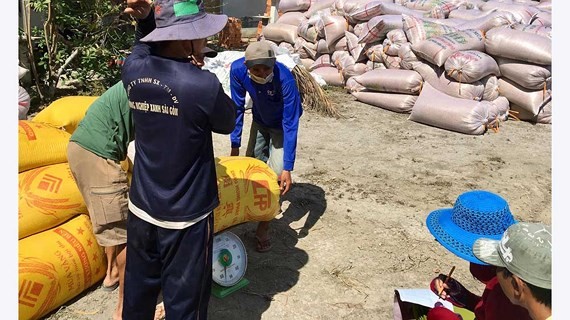
The State Bank of Vietnam (SBV) has issued a document on speeding up rice production and consumption loaning in the Mekong Delta, in which Governor Le Minh Hung required commercial banks to continue implementing credit policies for agricultural and rural development and rice export.
In addition, he requires commercial banks to step up loaning programs for connectivity models from rice production to consumption and agricultural production loss reduction.
According to the document, commercial bank branches in provinces and cities should arrange loans for businesses to purchase rice for stockpiling, processing and export in the winter spring crop in order to solve difficulties and stablize selling prices for farmers.
Aside from that, they should take the initiative in creating advantageous conditions for businesses to get loans, intensify mid and long term loans for them to expand rice warehouse system, simplify loan procedures, reduce loan approval time, diversify credit products and provide flexible loan terms to suit the trading cycle of rice firms.
Governor Le Minh Hung asks SBV branches in provinces and cities in the Mekong Delta to require credit institutions to arrange funds to meet businesses’ loan demand in a timely manner, keep a close eye on market situation and credit institutions’ rice purchase loaning in their localities to report to provincial and municipal people’s committees and SBV about solutions to clear difficulties during the implementation process.
Farmers in the Mekong Delta have entered peak harvest time of the winter spring crop in March and businesses have sped up purchase. After slightly increasing, rice price has stood still at VND5,000 a kilogram.
On March 6, traders paid ND4,500-4,600 a kilogram of IR 50404 rice variety at rice fields in An Giang, Hau Giang provinces and Can Tho city. Long grain fragrant rice fetched VND4,800-5,000 a kilogram, VND600-700 lower than the same period last year.
Meantime, fragrant and Jasmine rice price has been in down trend in An Giang and Kien Giang province. Traders have paid VND4,700-4,900 a kilogram, down about VND1,000 over the same period last year.
According to the Ministry of Agriculture and Rural Development, farmers in the Mekong Delta reap about 500,000 hectares of winter spring rice with the output of over 3.3 million tons in March. Of these there are 2.4 million tons of commercial rice for export.
Notably Vietnam Food Association (VFA) said that Vietnamese rice export price is about US$32 a ton lower than Thai rice price, swinging from US$343-347 a ton of five percent broken rice and $327-330 a ton of 25 percent broken product.
VFA chairman Nguyen Ngoc Nam believed that in 2019 Vietnam’s rice export will reach six million tons, a little lower than 6.1 million tons last year. Mr. Nam forecast that the main export market of Vietnam will be Asia this year.
From January 1 to February 15, the country shipped abroad 491,308 tons accounting for 66 percent of the volume during the same period last year. The number of contracts is expected to increase in the second quarter when Vietnamese rice price will be more competitive plus new import demand from China, the Philippines, Indonesia and Malaysia, according to him.
Firms urged to erase recruitment inequality

A female worker at Dai Dung Electrical Mechanical JSC
Experts have urged local firms to erase recruitment inequality during a conference addressing women and men's equal opportunities and treatment in the Labour Code.
The conference aims to gather opinions from firms and employees and held by the Studies of Society, Economy and Environment (iSEE).
Nguyen Xuan Son from Manpower Group said, "When customers tell us that they want to hire only men or women, we'll consult with them that they will lose 50% of potential candidates. We always suggest expanding their recruitment sources."
Vietnam has a high rate of working women compared to other countries, however, there is still discrimination. For example, women in the coastal areas are often not allowed to work aboard vessels or become a captain.
Trinh Manh Hung, director of Dai Dung Electrical Mechanical JSC, said that their line of work was more suitable for men but they still had preferential policies for female workers which account for 15% of total 3,000 workers. During maternity leave, the workers will be paid 85% of the extra shift salary.
According to Son, in order to improve recruitment equality, firms must be more open-minded, pro-active and use technology that can enable women to work from home.
At the conference, many experts suggested letting workers decide their retirement age. Hung said manual workers often wanted to retire at 50 while male managers wanted to retire at 60, while female managers wanted to retire at 55.
Nguyen Giang Nam from Ho Chi Minh City Bar Association agreed, saying that there were many people wanted to keep working despite their age.
.svg)
