 Vietnamnet.vn

 Podcast



Farmers need support to expand fruit production

Dragon fruits is a key produce in Chau Thanh District, Long An Province. — Photo dangcongsan.vn
Fruit is a key produce of provinces around the Mekong Delta. However, small-scale production and poor links from production to purchase, from process to export, are hindering the development of orchards, attendees heard at a workshop held yesterday in the Mekong Delta province of Long An.
According to the Ministry of Agriculture and Rural Development, the southern provinces have an area of 596,330ha of fruit trees, accounting for 60 per cent of orchards nationwide. Their annual productivity has reached over 6.6 million tonnes, accounting for 67 per cent of the country. Productivity has risen 61 per cent against that of 2010.
Due to scattered production, it is difficult for investors to pour capital into developing infrastructure, setting up links in production and controlling product quality. There are 71 fruit processing facilities in the southern provinces but most of them are lacking material.
According to Cao Van Hoa, deputy director of Tien Giang province’s Department of Agriculture and Rural Development, Tien Giang Province has increased its fruit growing area to over 77,700ha last year, up 9,000ha against 2013.
Its productivity has reached 1.5 trillion tonnes, an increase of 0.34 tonnes compared with 2013. However, the development of orchards has not been as expected.
Hoa blamed small scale production and lack of connectivity in terms of investment and techniques. Climate change was also a matter of concern. Thus, he said, great support from the Government was needed.
Addressing the workshop, Truong Canh Tuyen, vice chairman of Hau Giang Province People’s Committee, said the management of seedlings faced difficulties due to the lack of legal documents on granting of licences for individuals and organisations who took part in the production or trading of industrial crops and perennial fruit trees.
The cultivation of fruit trees with seedlings with unclear origin has led to an increase in plant diseases, affecting the production of farmers, he said.
Pham Van Canh, vice chairman of Long An Province People’s Committee, proposed concerned agencies to push up trade promotion in domestic and foreign markets, providing more information on market price and science and technology to serve farmers’ production. More support should be given to the study and creation of dragon fruit varieties with a view to diversify the production and measures to prevent insects on this kind of fruit.
Participants at the workshop agreed that building a large-scale and high quality fruit tree growing area is an urgent matter.
To reach the ministry’s target of achieving fruit export value of over US$3.6 billion by 2020, it was necessary to set up projects and plans for the development of key fruit trees with priority given to market factors, especially large markets, said Le Quoc Doanh, Deputy Minister of Agriculture and Rural Development.
Each province and city should establish concentrated planting areas for certain key fruit trees and develop product chains for those fruits.
He said that farmers should be encouraged to collaborate with each other towards forming cooperatives or production groups whose role was connecting farmers with enterprises who would purchase their products.
The ministry had directed localities to promptly make plans for the cultivation of 5 key fruits namely dragon fruits, mango, rambutan, durian and longan, Doanh said.
They were also requested to promote trade promotion relating to fruits in big markets to increase consumption.
More support should be paid to enterprises and localities in building brands and geographical indication registration as well as obstacles relating to market accession need to be solved so that more and more fruit will be exported in the near future, he said.
NA leader lauds model port operator on 30th anniversary

National Assembly Chairwoman Nguyen Thi Kim Ngan presents the Labour Order, first class, to the Sai Gon Newport Corporation at a ceremony on March 15.
National Assembly Chairwoman Nguyen Thi Kim Ngan lauded efforts and achievements by the Sai Gon Newport Corporation (SNP) over the past three decades when attending its 30th traditional day on Friday.
A defence-security enterprise of the Vietnam People’s Navy, the corporation contributed to implementing the Vietnam Maritime Strategy, fulfilled its role of serving as a logistics base and military port, and built military facilities in border and island areas. Notably, in March 2018, it put into operation the Cam Ranh International Port – the largest logistics and technical services supply centre for aircraft carriers and military ships in Southeast Asia, Ngan noted.
She said that the corporation was a model State enterprise in terms of international integration and effective business, forming a network of 28 ports and warehouses in major economic zones, and providing jobs for nearly 20,000 people with relatively high incomes.
The top legislator affirmed that the SNP had become a bright spot in the combination of economic development with defence security.
In the context of complicated regional and world developments, she requested the Defence Ministry and the Vietnam People’s Navy to direct the corporation to continue abiding by the Party’s policies and the State’s laws, and exert efforts to fulfill all assigned tasks, thus helping create a motivation for Viet Nam’s maritime economic development and increase the country’s brand in the fields of maritime economy and logistics services.
She also asked ministries, sectors, HCM City and other localities to create favourable conditions for the corporation to expand operation and implement its military, production and business missions.
On behalf of the Party and State leaders, Ngan presented the Labour Order, first class, to the Sai Gon Newport Corporation.
According to SNP General Director Colonel Ngo Minh Thuan, since its establishment on March 15, 1989, the SNP served over 76,000 ships, with a total container goods volume of nearly 900 million tonnes.
It has become the biggest container terminal operator and logistics services supplier in Viet Nam, which accounts for 91 per cent of the import-export container market shares of the city, and 50 per cent nationwide.
The SNP launched a fundraising campaign among its staff, collecting VND4.2 billion (US$181,000) in support of the poor people.
UAC to kick off $170 million factory in Danang
The construction of the $170 million Sunshise aerospace components factory invested by Universal Alloy Corporation (UAC) will be started on March 29, right on the 44th anniversary of the liberation of Danang city.
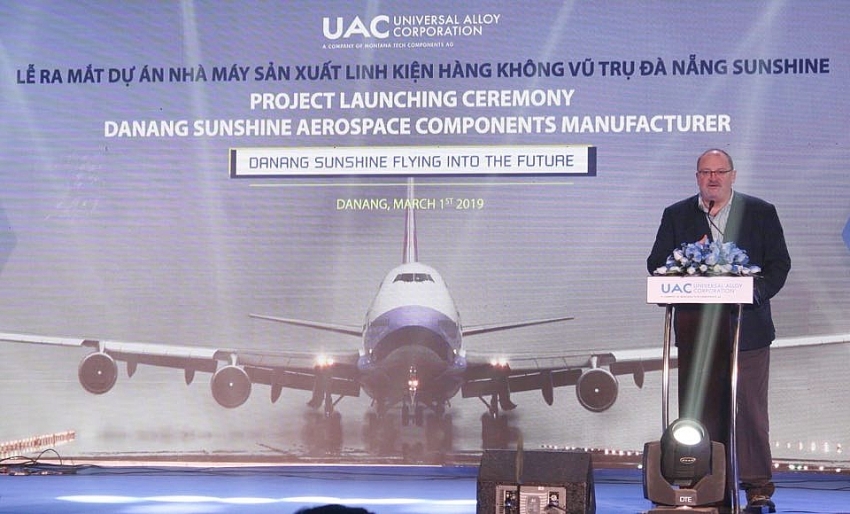
Kevin Loebbaka, managing director and president of UAC speaking at the meeting
Deputy Chairman of the Danang People's Committee Ho Ky Minh has just chaired a meeting where the departments and agencies reporting and reviewing the preparation of inaugurating some key projects of the city on the occasion of the 44th liberation anniversary of Danang (March 29, 1975 – March 29, 2019), one of which is the project of UAC.
UAC is the world's leading manufacturer of aircraft components for airlines such as Boeing, Airbus, Embraer, Bombardier, and their related supply chains.
UAC has a 51-year history of operating in this field, often offering long-term contracts for: Boeing 787, 777, 767 and 737; Airbus A350, A330, A320, A220, and ATR; Embraer E195; and Bombardier CRJ aircraft. This is also one of the three world-leading corporations in supplying special aluminium for aircraft production.
In Danang, UAC plans to produce 4,000 of the 5 million aircraft details for exportation to North America and Europe.
With the facility in Danang, UAC expects to reach the export value of $25 million in 2021, raising to $85 million by 2022 and creating an export value of over $180 million per year after 2026.
When the facility comes into operation, UAC Group will provide jobs for 1,200 highly skilled workers in the field of mechanics, electricity, and automation in Danang and surrounding areas, while simultaneously developing the production chains of industries with the attraction of over 2,000 other workers.
Lexus Viet Nam recalls GX460 cars to fix airbag faults

Nearly 300 Lexus GX460 cars will have their airbag inflators checked and replaced. — Photo plo.vn
Lexus Viet Nam is recalling nearly 300 Lexus GX460 units due to airbag faults, according a report from the importer.
The vehicles, which were manufactured from May 15, 2014 to February 10, 2017, will be checked and airbag inflators for the front passenger seat will be replaced.
The airbag inflators, supplied by Takata Company, may be at risk of moisture as a possible cause for inflator malfunctions of vehicles on the road. In case the inflator is broken, metal pieces can enter the inflated airbag, posing serious risks of injury to the passenger in the event of an accident.
According to Lexus Viet Nam, it will check and replace the inflators for free if needed. The recall campaign started on March 15 and the test and replacement will take from one to five hours.
In Viet Nam, Lexus has not yet recorded any accidents related to this error.
As for Lexus GX460 imported from unofficial suppliers, Lexus Viet Nam will contact Toyota Japan Group to confirm the information and will conduct free tests and replacements for affected vehicles.
Sony launches new camera 
Sony Electronics unveiled a new addition to its E-mount mirrorless camera lineup in HCM City on Thursday, the α6400 (model ILCE-6400).
The Japanese giant said the new camera has the world’s fastest autofcous (AF) acquisition speed of 0.02 seconds plus 425 phase-detection and contrast-detection AF points covering approximately 84 per cent of the image area.
The prices range from VND22.99 million (US$1,000) to VND32.99 million ($1,400) for the camera and lenses.
Sony said the α6400 brings many of its most advanced technologies like the acclaimed full-frame lineup.
It introduces the new advanced real-time eye auto focus and real-time tracking capabilities, and comes with high-speed shooting, a new-generation BIONZ X image processing engine that produces excellent image quality, 4K6 video recording, and a 180-degree tiltable LCD touch screen, meaning it can be used by everyone from professionals to everyday vloggers.
The camera has an XGA OLED Tru-finder viewfinder, extensive customisation with 89 functions that are assignable to custom keys, My Dial and My Menu functionalities, enhanced overall menu usability, a help screen for menus, star rating for images, and other features that allow for a seamless shooting experience.
It is built from tough magnesium alloy, is dust and moisture resistant and has a durable shutter that is rated for approximately 200,000 cycles. It can seamlessly transfer files to a smartphone or tablet when connected to the new ‘Imaging Edge Mobile’ application.
Solutions to prevent the development of black creditThe increasing development of consumer finance, especially in rural areas, in collaboration with simplifying procedures for loan application would be effective solutions to prevent black credit.
These opinions were voiced by experts and representatives of companies at the consumer finance seminar themed “Developing consumer finance as a solution to ward off shadow banking” organised by VIR this morning.
According to statistics published by StoxPlus, 47 per cent of Vietnamese people have taken up loans, however, only 18.5 per cent of loans come from finance organisations, while the rest is from friends, relatives, and black credit organisations. The complex loan procedures are a major reason behind this situation. StoxPlus’ report also shows that rural and peri-urban areas with the total population of 60 million people are most at risk of black credit because credit organisations have fewer opportunities to approach consumers in these areas.
In order to deal with this problem, Tran Minh Hai, manager of Basico law firm, stated that, “It is necessary to licence more financial organisations to meet people’s increasing demand for loans. Borrowing money is a practical demand of people and both foreign and local financial organisations are willing to meet this demand.”
Tran Kim Anh, financial and banking expert, said that financial organisations need to expand their operations to areas where banks cannot fully cover people’s consumer finance needs, which are also hot spots of black credit.
Along with the expansion of consumer finance networks, it is necessary to complete the legal framework in order to harmonise the benefits of people and financial organisations, accordingly people will find it easier to approach loans from financial organisations that comply with international and local regulations.
The Vietnamese consumer finance market has a golden opportunity for development with ideal conditions, such as a developing economy, a 95-million-strong population, 52 per cent of whom are of working age, and increasing incomes, as well as a marked shift from saving to shopping and from cash to consumer credit.
The development of consumer finance is motivation for the growth of the economy, accelerating the circulation of goods on the market, allowing people to approach credit, especially customer groups under the banks’ lending standards, restricting black market credit, and supporting low-income people from improving their life.
Vietnam exports nearly 720,000 tonnes of crude oil in two months

Vietnam shipped 719,259 tonnes of crude oil abroad for 337.3 million USD in the first two months of 2019, up 7.1 percent in volume but down 7.9 percent in value compared to the same period last year.
According to statistics of the General Department of Customs, in February, the country earned more than 112 million USD from exporting more than 232,250 tonnes of crude oil, representing a drop of 50.4 percent in value and 52.3 percent in volume over the previous month.
The average export price of crude oil in February hit 482.6 USD per tonne, up by 4 percent.
In January-February, China was the largest importer of Vietnam’s crude oil with a volume of 320,500 tonnes and a value of 150.6 million USD, up 86 percent and 55 percent, respectively.
Thailand came second with import value reaching 94.35 million USD, up by 19.3 percent.
Vietnam’s crude oil exports to Malaysia posted the highest increase in the first two months of this year, up 107.9 percent in volume to 93,462 tonnes and 75 percent in value to 42.21 million USD.
Vietnam also imported 1.46 million tonnes of crude oil in January-February, worth 635.4 million USD, 9.1 times higher in volume and 15.2 times higher in value than the same period last year.
VinaCapital Ventures invests in two tech startups

A presentation of a tech startup at the event
VinaCapital Ventures, a Vietnam-focused venture capital platform, announced on March 15 that it has successfully invested in the tech startups of UrBox and Wee Digital.
It said these startups are its latest investments to help with economic development and the young but potential technology sector of Vietnam.
UrBox provides creative marketing campaigns to help businesses attract clients. It is partnering with hundreds of suppliers; over 3,000 food, beverage and entertainment stores; and e-commerce websites.
Meanwhile, Wee Digital provides solutions optimising users’ interaction in digital banking services by applying biometric technology and artificial intelligence. As the first company of this field in Vietnam, it has quickly developed a network of high-end customers, including large banks and enterprises.
In 2018, VinaCapital Ventures invested in ride-hailing app FastGo and truck-booking app Logivan.
Also on March 15, VinaCapital Ventures announced that it successfully invited Dr. Philipp Roesler, former Vice Chancellor of Germany, to act as chairman of its advisory council.
Philippine market promising for Vietnamese products

The Philippines is a promising market for Vietnamese commodities thanks to its strong demand for Vietnamese goods, according to a Vietnamese trade official.
Vu Viet Nga, Commercial Counselor of the Trade Office in the Philippines, told Cong Thuong (Industry and Trade) Newspaper on March 14 that the country is a potential export market for Vietnamese commodities such as agricultural products, construction materials, household electric goods and consumer goods.
She highlighted the country as a big consumption and potential market for Vietnam to widen its share in the coming time, saying the Philippines is the second most populated of the Southeast Asian nations with over 105 million people. It is also among those in the region having recorded top growth in recent years.
Besides, as domestic production has not met the demand due to its unfavourable natural condition for agricultural produce, the country has to import numerous agricultural products for its consumption and processing. Moreover, Philippine people are open to imported goods, Nga said, adding these factors are giving Vietnamese products advantages to compete in the market.
The official also described the Vietnam Rice and Tra fish Festival 2018, the first of its kind held in the Philippines, as a highlight event to promote Vietnamese rice in particularly and agricultural products in general in the market.
The Vietnam Trade Office in the Philippines, in collaboration with the Ministry of Agriculture and Rural Development, will organise study tours for Vietnamese and Philippine enterprises in the other country in March and April to boost trade exchange between the two nations, she noted.
In order to conquer the market, Nga suggested Vietnamese exporters study more carefully the Philippine market’s requirements and demands so as to develop suitable strategies. They should also enhance their reputation and product quality while staying patient to gain trust from local enterprises.
According to Nga, last year the Philippines imported 108 billion USD worth of products, including over 3 billion USD from Vietnam, accounting for 2.8 percent.
Vietnamese, Japanese companies ink raw egg distribution deal

A worker examines egg quality before packaging process
Ba Huan Joint Stock Company and Japan’s Ise Foods Inc. on March 15 signed a cooperation deal on the production and distribution of fresh eggs.
The Vietnamese poultry company will be responsible for the supply while Ise Foods Inc. will distribute the products at Japanese supermarkets and stores in Vietnam. Ba Huan must ensure that eggs meet Japan’s standards, following strict breeding and preservation process.
Under the deal, the Vietnamese company will supply about 10,000 eggs for Ise Foods Inc. to send to Japanese restaurants as well as major supermarkets and malls in the country.
Ba Huan CEO Pham Thi Huan said the cooperation with Japan’s Ise Foods Inc. is designed to deliver high-quality and safe products to consumers.
In addition, it demonstrates the company’s determination and efforts towards food safety and promoting Vietnamese brand in global markets. Therefore, the partnership is hoped to stabilise production by the country’s farmers and foster sustainable agricultural development, she added.
A representative of Ise Food Inc. said it aims to launch development projects to distribute fresh eggs in many countries, particularly in Asia. Last year the Japanese company announced some projects in Vietnam.
Ha Nam’s efforts to attract FDI pay off

The northern province of Ha Nam has been in the top 10 localities in foreign direct investment (FDI) attraction for years thanks to the province’s efforts to diversify investment promotion methods and seek investors, authorities have said.
According to Director of the provincial Department of Planning and Investment Nguyen Van Quang, the province has focused on attracting large-scale domestic and FDI firms to develop supporting and processing-manufacturing industry.
It has prioritised the production activities that apply high technology and are friendly to the environment, energy-saving, and make large contributions to the local budget.
At the same time, the provincial People’s Committee has directed relevant departments and sectors as well as agencies to strictly implement commitments of the locality towards investors, with greater attention to administrative reform and business environment improvement, especially in the issuance of licenses on investment, construction, environment, and land.
Along with supporting investors in administrative procedures, the province has ensured the supply of water, power and housing services for workers.
Quang said that the province will continue organising dialogues with investors to remove obstacles for them. On the other hand, incentives and land will be withdrawn from investors who violate the law.
Ha Nam will prioritise FDI firms that have close connection with domestic ones, thus facilitating domestic production and creating material supply sources for FDI enterprises, he added.
In 2018, Ha Nam lured 112 new investment projects, including 41 FDI ones with a total investment of 382 million USD.
In the first two months of 2019, the province attracted 12 projects, including 3 foreign-invested ones worth 58.5 million USD.
Ba Ria-Vung Tau licenses two solar power plants

The People’s Committee of the southern coastal province of Ba Ria-Vung Tau has given the green light to two companies to build two solar power plants with a total investment of more than 1.5 trillion VND (64.66 million USD) in the province
The People’s Committee of the southern coastal province of Ba Ria-Vung Tau has given the green light to two companies to build two solar power plants with a total investment of more than 1.5 trillion VND (64.66 million USD) in the province.
The Energy Development Ltd Co will invest 796 billion VND to build the Tam Bo solar power plant on 41.38 ha of water surface in Tam Bo reservoir. The plant has a design capacity of 35 MWp, with an average annual output of 52,123 MWh.
Meanwhile, the DTD Natural Energy Investment Co Ltd will build a 35 MWp solar power plant on 40 ha of water surface in Gia Hoet 1 reservoir at total cost of 766 billion VND.
Both the plants are located in Quang Thanh commune, Chau Duc district.
The provincial administration requires the investors to ensure that construction work will not affect the quality of water and structure in the reservoirs as well as the landscape of the areas.
Ba Ria – Vung Tau has favourable conditions for renewable energy. On average, it has from 2,000 to 2,600 sunny hours per year, with radiant intensity of about 5.47kWh per square metre per day.
Tra fish exports see positive signs

Tra fish (pangasius) shipments to the EU market picked up positive signs with the export value jumping by 29.9 per cent to US$33.1 million between January and the first half of February, as reported Vietnam Association of Seafood Exporters and Producers.
The Ministry of Agriculture and Rural Development set a target of raking in an estimated US$2.4 billion from tra fish exports, up 12 percent.
Tra fish shipments to four major EU importers, including the Netherlands, the UK, Germany, and Belgium posted year on year hikes of 2.2 percent, 36 percent, 73.7 percent, and 89 percent, respectively.
Statistics by the International Trade Centre (ITC) show that in 2018, frozen Cod fillets made significant proportions of 22 - 31 percent of the EU’s whitefish imports while Alaska pollack fillets held shares ranging from 12-20 percent.
The vast majority of tra fish products shipped to the EU market came from Vietnam. Some EU member countries have set about purchasing tra fish products from Indonesia in recent years, but the proportion still remained modest.
Most of the fillets sent to the EU were frozen while preliminarily processed staples and some categories of added value products were made by European processing firms.
The Ministry of Agriculture and Rural Development set a target of increasing the total tra fish output by 6.6 per cent to 1.51 million tons and raking in an estimated US$2.4 billion from tra fish exports, up 12 percent.
To reach this goal, the ministry has encouraged localities and enterprises to tap into their advantages in tra fish aquaculture and to pay greater attention to the in-depth processing with a view to creating high added value products.
Vinacomin strives to meet increasing demand for coal

Cọc Sáu coal mine. Việt Nam National Coal – Mineral Industries Holding Corporation Limited is trying to meet the increasing demand for coal. — Photo vinacomin.vn
The Việt Nam National Coal – Mineral Industries Holding Corporation Limited (Vinacomin) had been working to meet the increasing demand for coal for electricity generation and production, Vinacomin’s general director Đặng Thanh Hải said.
Vinacomin targeted to reach an output of 4.1 million tonnes of coal in March. Production would be enhanced at open-cast coal mines such as Cao Sơn, Đèo Nai, Cọc Sáu and Tây Nam Đá Mài.
In the first two months of this year, coal production reached 6.66 million tonnes, one million more than the same period last year.
Increasing coal production to meet the demand of the economy, especially for electricity generation, was Vinacomin’s priority, Hải said.
Vinacomin has set a target of reaching 40 million tonnes in 2019 while consumption demand is forecast at 42 million tonnes. As much as 31.9 million tonnes will be supplied for electricity generation.
The group plans to import four million tonnes to meet the demand.
Vinacomin’s coal production output was 36.95 million tonnes last year with sales of 40.5 million tonnes.
Deputy Prime Minister Trịnh Đình Dũng early this year asked Vinacomin to ensure adequate coal supplies for production as well as focus on environmental protection.
Production technology must be renovated to improve productivity, quality, resource use efficiency and labour safety, he said.
Number of Russian companies eyeing Vietnam’s market increases every year: Expert
The complementarity between Vietnam and Russian markets would facilitate more investments and trade between the two countries.
The number of Russian companies looking to tap into Vietnam’s market increases every year, according to Viacheslav Nhicolaievich Kharinov, Russian trade representative in Vietnam.
Kharinov made the statement at a meeting between Vietnamese and Russian enterprises organized by the Vietnam Chamber of Commerce and Industry (VCCI) on March 14.
The event served as a platform for enterprises from two countries to exchange information and look for opportunities in investment and cooperation in various fields.
It is worth mentioning that Vietnam is Russian’s main partner in Southeast Asia, and the two countries now hold a comprehensive strategic partnership, Kharinov added, saying Vietnam is also the first country to sign a free trade agreement with Russia.
Kharinov informed that high-tech Russian firms have great interest in cooperating with Vietnamese enterprises in smart city projects, wind power, trade and services.
“In 2019, Vietnam and Russia would hold a number of events to celebrate the 25th anniversary of the signing of the Treaty on Fundamental Principles of Vietnam – Russia friendship, presenting valuable opportunities for enterprises from both countries to facilitate investment and cooperation to each other,” said Kharinov.
VCCI’s Vice Chairman Hoang Quang Phong said Vietnam and Russia have been maintaining a long standing economic and trade relation.
“Vietnam expects to cooperate with Russia in priority fields, including energy, infrastructure development, oil exploration and engineering,” Phong added.
According to Phong, Vietnam is a large market with a 90-million-plus population, in addition to a stable economic and political conditions.
In 2018, bilateral trade turnover between the two countries reached US$4.57 billion, laying a strong foundation to reach the target of US$10 billion by 2020, Phong stressed.
More importantly Vietnam’s market is complementary with Russia's, as Vietnam mostly imports machinery, equipment, steel and exports rice, coffee and seafood to Russia.
Echoing Phong’s view, Chairman of the Chamber of Commerce and Industry of Russia Sergey Katyrin considered the complementary factors would facilitate more investments and trade between the two countries.
In the coming time, Vietnam and Russia must address issues regarding payment and transportation to further promote economic and trade cooperation, aiming towards prosperity for both countries, Katyrin concluded.
More Russian firms keen to explore investment chances in Vietnam

Vietnamese Deputy Minister of Industry and Trade Do Thang Hai
More and more Russian businesses want to study investment opportunities in Vietnam and attract Vietnamese firms to invest in Russia, Sergey Katyrin, President of the Chamber of Commerce and Industry of the Russian Federation, said at a working session with Vietnam’s Ministry of Industry and Trade in Hanoi on March 14.
Katyrin described Vietnam as one of the biggest markets with exceptionally rapid development.
With a network of more than 180 chambers of commerce and industries across the country, Russia has been helping small-and medium-sized enterprises seek business and investment opportunities.
Russia also encourages its firms to take part in exhibitions in Vietnam to promote trade and products, he said, adding that the upcoming Russia Expo in Vietnam is expected to draw dozens of Russian businesses.
Deputy Minister of Industry and Trade Do Thang Hai said trade between Vietnam and Russia has grown significantly since the EU-Vietnam Free Trade Agreement (EVFTA) came into force in 2016.
In 2018, two-way trade increased 28.63 percent compared to the previous year. Russia became the 24th largest investor among 129 countries and territories pouring cash into Vietnam with 123 projects worth 932 million USD.
Vietnam has 22 investment projects worth nearly 3 billion USD in Russia. Dairy projects worth some 2 billion USD invested by the Vietnamese dairy group TH True Milk in Moscow and Kaluga have become a highlight in the two countries’ relations.
In the near future, Vietnam and Russia will organise workshops and trade fairs to promote exports to the respective markets, Hai said.
Western Digital unveils new solid state drive for gamers

Western Digital unveils its new WD Black SN750 NVMe SSD in HCM City on Thursday.
Technology company Western Digital Corp said it has pushed the boundaries of storage to give gamers a competitive edge.
It launched a solid state drive called new WD Black SN750 NVMe SSD in HCM City on Thursday, saying demand from gamers has increased sharply in Viet Nam since, in addition to playing, they also often record, take videos or stream.
Advancements in PC and graphics technologies are taking gaming to new heights, but to take advantage of gamers must navigate challenges like higher performance demands and large file sizes, with some games exceeding 100GB, it said.
“Virtual reality, immersive features and larger fame file sizes mean longer load times for levels, maps and other in-game actions,” Eyal Bek, vice president marketing, data centre and client computing at Western Digital, said.
“All of these require faster storage and higher capacity. More intense, longer game plays also requires well-managed thermal performance. The new product delivers unrivalled performance with an architecture designed for gaming, built-in cooling and gaming-mode features with heat sink options to be incorporated.”
WD Black SN750 NVMe SSD is the company’s second-generation SSD with up to 2TB capacity on single-sided M.2 form factor and will be showcasing a version for desktop systems or custom-built gaming rigs, which has an integrated heat sink that helps maintain speed and temperature.
The company said it collaborated with EKWB, a PC cooling technology provider, and the new product offers an option for heat sinks for capacities ranging from 500BG to 2TB and would be available in Viet Nam in the second quarter of this year.
The SSD costs VND1.95-14.5 million (US$85-637).
PVN sets target of adding up to 30m tonnes to oil reserves

Hastening the search for new oil and gas fields is a priority of Viet Nam Oil and Gas Group this year to increase reserve. — Photo pvn.vn
Viet Nam Oil and Gas Group (PVN) hopes to add 15 million tonnes oil to reserves in both 2019 and 2020, heard the company’s conference to implement exploitation plan held in Vung Tau City on Thursday.
PVN said this was not an easy target as investments in upstream production in Viet Nam had not recovered since oil prices fell to low levels in recent years.
In addition, the exploitation output of oil fields were dropping significantly because most were reaching their reserve limits. Thus, it was important to hasten the search for potential oil and gas fields to increase reserves, PVN said.
The PVN urged the Law on Petroleum 1993 should be amended to encourage investments in upstream business amidst the gradual exhaustion of oil and gas natural reserves.
Statistics showed that investments in searching for oil and gas reserves annually in 2016-18 were equivalent to a third of the sum in 2011-15.
Experts said it was critical to develop mechanisms to attract investment in oil and gas, especially in upstream production, which plays a significant role in the country’s marine economic development strategy.
Proper policies to encourage the development of small and marginal oil fields should be developed, the PVN said, adding that putting marginal oil fields into exploitation was a solution to cope with exhausting oil and gas reserves.
It was important to choose appropriate technical solutions and management solutions to be applied at marginal fields to enhance their efficiency.
Increasing reserves was the first priority of the PVN in 2019 to ensure production output, the PVN said.
The PVN reported the total exploited oil and gas output at 3.85 million tonnes in the first two months of this year, representing an increase of 7 per cent against the company’s target.
It earned revenue of VND111.8 trillion (US$4.8 billion) in January-February.
In 2018, the PVN exploited nearly 24 tonnes of oil equivalent and add 12.34 million tonnes of reserves.
Statistics of the General Department of Customs showed that in February, Viet Nam exported more than 232,250 tonnes crude oil to earn more than $112 million, representing a drop of 52.3 per cent in volume and 50.4 per cent in value over the previous month.
The average export price of crude oil in February hit $482.6 per tonne, up by 4 per cent.
For the first two months of this year, crude oil exports hit 719,259 tonnes, worth $337.3 million, up 7.1 per cent in volume but down 7.9 per cent in value compared to the same period last year.
China was the largest importer of Viet Nam’s crude oil in January-February with volume of 320,500 tonnes and value of $150.6 million, up 86 per cent and 55 per cent, respectively.
Thailand came second with import value reaching $94.35 million, up by 19.3 per cent.
Viet Nam’s crude oil exports to Malaysia posted the highest increase rate in the first two months of this year, up 107.9 per cent in volume to 93,462 tonnes, worth $42.21 million, up by 75 per cent in value.
Viet Nam also imported 1.46 million tonnes crude oil in January-February, worth $635.4 million, 9.1 times higher in volume and 15.2 times higher in value than the same period last year.
Shrimp sector aims high despite declining exports

The shrimp sector looks to earn US$4.1 billion in export turnover in 2019. In this file photo, a man holds shrimps grown in line with hi-tech standards at a farming facility of Viet Uc Corporation
The local shrimp sector expects significant growth as it envisages export revenue to increase by US$500 million this year to US$4.1 billion, although shrimp exports have kept plunging in the year to date.
The potential of the shrimp sector had yet to be fully exploited last year, with shrimp export turnover reaching US$3.6 billion, dropping 7.8% versus the 2017 figure, Nhu Van Can, head of the Department of Aquaculture, under the Vietnam Directorate of Fisheries, told a meeting titled “Introducing plans to develop the shrimp sector in 2019", held on March 13 in Soc Trang Province.
Also, a report from the Vietnam Association of Seafood Exporters and Producers (VASEP) indicated that the sector saw a 12% decrease in export turnover in the first two months of the year to approximately US$390 million.
However, Can expected the local shrimp sector would bounce back and generate huge profits this year, with export turnover likely hitting US$4.1 billion.
As for VASEP, it pinned higher hopes on the sector’s performance, with a target export revenue of US$4.2 billion, according to Truong Dinh Hoe, general secretary of VASEP.
The VASEP representative attributed the decline in the shrimp export turnover last year to the price drop and the weak competitiveness of local shrimp exporters versus major foreign shrimp exporters in India, Indonesia and Thailand.
If the shrimp price in the market rebounds and competiveness of local exporters grows, the shrimp sector would see strong growth this year, said Hoe.
To realize this year's target, Hoe said that the sector has to make efforts to overcome existing barriers that hamper shrimp exports to the United States, Europe, and mainland China, including anti-dumping tariffs and close supervision by the U.S. Seafood Import Monitoring Program (SIMP), and standards set by the Aquaculture Stewardship Council (ASC), which is an independent, non-profit organization with the primary goal to manage global standards for responsible aquaculture.
Local shrimp farmers should acquire more ASC certificates to export more shrimps to Europe, whose markets consume a huge volume of seafood with the ASC quality mark. To date, over 48,000 tons of local shrimps meet ASC standards and the figure should increase, Hoe said.
SIHUB to hold class in business startup
The Saigon Innovation Hub (SIHUB) under the Ho Chi Minh City (HCMC) Department of Science and Technology has just announced the organization of a new free training session named ‘Foundation Knowledge on Business Startup’ for startup people.
Taking part in this training, participants are able to enrich their expertise with the basis on how to begin a startup project, to form a business model, to introduce their value as well as minimum viable product (MVP).
The training also provides information on legal and financial matters when starting up a business, investors and capital attraction and salesmanship.
It is expected that there will be 5 courses from April to August 2019, with the first one being held on April 17, 2019.
100,000 low cost air tickets to offer in Vietnam international travel fair
More than 100,000 cheap domestic and international airline tickets and 18,000 discount package tours will be launched in the Vietnam International Travel Mart (VITM) 2019 which is slated to take place in Hanoi from March 27 to 30.
The Vietnam Tourism Association announced many tourism promotion programs in VITM 2019 at the press brief in Hanoi yesterday. According to the association, revenue of participant enterprises in the previous fair grossed up to VND320 billion ($13,785,565) statistically.
In order to achieve the global sustainable development goal 2030, “Green Tourism” has been chosen to be the main topic of VITM 2019. Deputy Chairman of the Association Vu The Binh said that 500 booths of 710 enterprises have registered for the fair so far.
This year’s fair will see the participation of 25 nations and territories, especially including tourism enterprises of North Korea and Peru.
Tourism operators will introduce green tourism products through popularizing eco-tourism, community tourism, agriculture tourism and initiatives to protect environment in the sector. It is expected that sale and purchase of tourism products will increase.
In the framework of the fair, there will be seminars and exchanges including Vietnamese tourism with industry 4.0; forum Vietnam’s Outbound tourism – Opportunities and Challenges. Meetings between international tourism agencies are scheduled to push cooperation in tourism industry.

.svg)
