 Vietnamnet.vn

 Podcast



Hai Phong city taps sea, island tourism development

Lan Ha Bay in Cat Ba island
As the largest sea port in Vietnam’s northern region, Hai Phong city boasts huge potential for maritime economic development, especially sea and island tourism.
The city’s administration has designated Bach Long Vy island district and Cat Ba and Do Son tourism sites as major attractions in its tourism development plan.
Vice Chairman of the People’s Committee of Cat Hai island district Hoang Trung Cuong said tourism accounts for about 70 percent of state budget collection of the locality, while creating jobs for 5,000 workers. Tourism is now the driving force of the island district’s economic development.
The inauguration of the Dinh Vu-Cat Hai bridge in 2018 has helped to reduce travel time from central Hai Phong to the district’s Cai Ba tourism town, creating a momentum for tourism. About 2.5 million visitors travelled to Cat Ba in the year, out of the total 7.8 million visiting Hai Phong city.
Cuong added that Hai Phong has invited strategic tourism investors to the city over the time, including property developer Sun Group. The city aims to turn Cat Ba into an eco- and smart tourism centre of the country.
Director of the municipal Department of Tourism Nguyen Thi Thuong Huyen said local authorities have issued a decision to complete the city’s steering board on tourism development.
Earlier, the People’s Council of Hai Phong approved a resolution on tourism development in the 2017-2020 period, with a view to 2030. Accordingly, the city will direct its resources into turning tourism into its spearhead economic sector and attract investment in sea tourism, along with other types such as ecotourism, spiritual, community-based, entertainment and resort tourism.
Hai Phong is the only city in Vietnam’s northern region accessible by all five types of transportation, which are inland waterways, seaway, road, rail and air transport. The city aims to welcome 9 million visitors this year.
PM urges more drastic actions to promote production, business

Prime Minister Nguyen Xuan Phuc addresses the working session
Information work plays an important role in consolidating public confidence in domestic production, Prime Minister Nguyen Xuan Phuc has said.
This is one of the directions the leader has made during his working session with representatives of relevant ministries and agencies in Hanoi on March 18, which sought solutions to remove difficulties to production and business, and ensure the yearly growth target.
He urged agencies to take drastic actions in order to consolidate confidence of people and businesses, saying dealing with institutional shortcomings should be the most important task.
Besides, it is necessary to handle limitations in coordination between ministries, agencies and localities, he said, suggesting the organisation of conferences on key economic zones in order to address specific problems.
The PM asked ministers and local People’s Committees to trace obstacles to the disbursement of public investment.
Greater efforts should be made to ensure credit growth in support of production and business activities, prevent and control African swine fever and keep farm produce export at 43 billion USD as set by the Government.
The construction, and natural resources and environment sectors were requested to speed up the implementation of existing projects, while the Transport Ministry was asked to promptly implement large-scale transport infrastructure projects, with a specific schedule.
PM Phuc assigned the Ministry of Planning and Investment to coordinate with the Government Office and relevant agencies in drafting his Directive made during the working session to issue it this week.
Vietnam joins biggest seafood expo in North America

A Vietnamese stall at the event
Fifteen leading Vietnamese enterprises is taking part in the Seafood Expo North America, the biggest annual event of its kind in the region, which opened in Boston, the US, on March 17.
The three-day expo attracts over 1,000 firms from more than 50 countries all over the world, displaying fresh and frozen products and high-tech processing machines. It also features seminars on growth trends and predictions, consumers’ impact on the industry, standards for tracking products’ origin, remotely controlled devices serving sustainable aquatic development, among others.
The Vietnamese delegation to the event, led by the Vietnam Association of Seafood Exporters and Producers (VSEP), consists of companies, which have made their trademark known overseas, like Vinh Hoa, Minh Phu, Hung Vuong, Nghi Son, Trang Thuy, and Seaprimexco.
Aquatic products are a key export commodity of Vietnam, which reeled in 9 billion USD last year.
To Thi Tuong Lan, deputy general secretary of VASEP, said Vietnamese seafood quality have received praises in international markets, particularly the US.
According to Lan, given upbeat growth signals in the global and US markets, Vietnam sees opportunities to export other high value added processed products in addition to its staples such as Tra fish and shrimp.
On the sidelines of the expo, representatives of the Ca Mau trade promotion centre met with its US partners to introduce local potential and efforts to develop a clean shrimp cultivation model. Aquatic exports of Ca Mau, a province in the Mekong Delta region, currently account for 30 percent of Vietnam’s total.
Ha Giang promotes tourism in central region
Scene at the event (Photo: baokhanhhoa.vn)
A conference spotlighting Ha Giang’s tourism potential took place in the central province of Khanh Hoa, on March 18, gathering over 100 representatives from tourism management bodies, associations, and travel agencies across the central region.
Speaking at the event, vice secretary of the Ha Giang provincial Party Committee Nguyen Van Son stressed the conference is an opportunity for the northernmost province to introduce its scenic sites, cultural values, and tourism products to the central market.
Ha Giang has a population of 800,000, 90 percent of whom are ethnic minority people with their own culture and lifestyle. The most numerous are the Mong, Tay, Dao and Nung. The province is attractive to tourists by its endless terraced rice fields, buckwheat flower fields and grandiose mountain landscapes. One of the most beautiful sites in the province is the Dong Van Karst Global Geopark, designated by UNESCO as one of 77 sites with important geological and cultural value.
In 2018, Ha Giang welcomed more than 1.15 million visitors, of them 250,000 were foreigners, bring in a total of over 1 trillion VND (43 million USD) for the local tourism sector.
At the conference, participants spoke of the province’s natural features and cultural diversity. They also mentioned local shortcomings, including the transport system and tourism infrastructure, which are in need of investment for future development. They advised the province to work on preserving its ethnic cultural identities.
Vice Chairman of the Vietnam Tourism Association Vu The Binh recommended Ha Giang capitalise on local ethnic minorities’ culinary and valuable herbal plants.
The conference saw a number of cooperation pacts signed between Ha Giang’s tourism management agencies and businesses and their peers from the central provinces of Khanh Hoa, Phu Yen, and Ninh Thuan, among others.
Petrol prices kept unchanged from latest adjustment
The Ministry of Industry and Trade and Ministry of Finance on March 18 announced that petrol prices will be kept unchanged compared to the latest regular adjustment.
Specifically, the price of bio-fuel E5 RON 92 will not be higher than 17,211 VND per litre, while that of RON95-III will be 18,549 VND per litre at the maximum.
The ceiling price of diesel 0.05S will be 15,868 VND per litre, while the price of kerosene will be not higher than 14,885 VND per litre, and that of mazut will be 14,083 VND per litre at the highest.
After strong rise of nearly 1,000 VND per litre in the previous adjustment, petrol prices have been stabilised again. Since the beginning of this year, three such adjustments have been made, contributing to stabilising the prices of commodities.
According to the ministries, within 15 days before March 18, the world prices of RON92 and RON95 rose 4,523 USD and 4,280 USD per barrel, respectively.
Meanwhile, ethanol E100’s price is 15,442 VND per litre from March 18.
Over the past months, the fund for fuel price stabilisation has been used continuously and largely in order to minimise the impacts from the world prices of petrol to domestic prices, thus controlling inflation.
Ha Nam’s Thanh Liem IP infrastructure development project ratifiedPrime Minister Nguyen Xuan Phuc has approved a project to construct and lease infrastructure systems in the second phase at Thanh Liem industrial park in the Red River Delta province of Ha Nam.
The project will cover an area of over 142 hectares and have total cost of 942 billion VND (40.5 million USD).
It will be implemented in 50 years in Thanh Tuyen ward of Phu Ly city as well as Thanh Thuy, Thanh Phong and Thanh Ha communes, and Kien Khe town of Thanh Liem district.
The PM asked the People’s Committee of Ha Nam province to choose the investor for the project and issue decisions related to land use in conformity with legal regulations.
The province’s management board of industrial parks and relevant agencies were assigned to supervise and evaluate the implementation of the project as well as its progress, environmental impacts and land use.
The PM requested Ha Nam to coordinate with the investor in compensation and ground clearance in line with the law.
Việt Nam exports $97.4 million goods to Laos in Jan-Feb
Steel products ahead of shipping to Laos. — Photo doanhnghiepvn.vn
Việt Nam exported US$97.4 million worth of goods to its neighbouring country Laos in the first two months of 2019, up 20.26 per cent against the same period last year, according to the industrial and commercial information centre under the Ministry of Industry and Trade.
The country’s major exports to Laos are oil and gas, steel and steel products and means of transport, which, together, accounted for 40.84 per cent of the total, with $12.8 million coming from oil and gas.
Trade turnover between Việt Nam and Laos exceeded $1 billion in 2018, up 14 per cent year-on-year, the centre said.
Việt Nam is Laos’ third largest trade partner, after Thailand and China.
The Lao government is gradually removing its complex administrative regulations and procedures, reducing the time needed for corporate establishment, cutting taxes and upgrading infrastructure.
The move aims to improve the country’s business environment to attract more foreign investors, including those from Việt Nam.
Hai Phong city taps sea, island tourism development
Lan Ha Bay in Cat Ba island
As the largest sea port in Vietnam’s northern region, Hai Phong city boasts huge potential for maritime economic development, especially sea and island tourism.
The city’s administration has designated Bach Long Vy island district and Cat Ba and Do Son tourism sites as major attractions in its tourism development plan.
Vice Chairman of the People’s Committee of Cat Hai island district Hoang Trung Cuong said tourism accounts for about 70 percent of state budget collection of the locality, while creating jobs for 5,000 workers. Tourism is now the driving force of the island district’s economic development.
The inauguration of the Dinh Vu-Cat Hai bridge in 2018 has helped to reduce travel time from central Hai Phong to the district’s Cai Ba tourism town, creating a momentum for tourism. About 2.5 million visitors travelled to Cat Ba in the year, out of the total 7.8 million visiting Hai Phong city.
Cuong added that Hai Phong has invited strategic tourism investors to the city over the time, including property developer Sun Group. The city aims to turn Cat Ba into an eco- and smart tourism centre of the country.
Director of the municipal Department of Tourism Nguyen Thi Thuong Huyen said local authorities have issued a decision to complete the city’s steering board on tourism development.
Earlier, the People’s Council of Hai Phong approved a resolution on tourism development in the 2017-2020 period, with a view to 2030. Accordingly, the city will direct its resources into turning tourism into its spearhead economic sector and attract investment in sea tourism, along with other types such as ecotourism, spiritual, community-based, entertainment and resort tourism.
Hai Phong is the only city in Vietnam’s northern region accessible by all five types of transportation, which are inland waterways, seaway, road, rail and air transport. The city aims to welcome 9 million visitors this year.
Hau Giang: Nearly 70 million USD needed for agro sector

More than 1.6 trillion VND (69 million USD) is needed to carry out a project enhancing competitiveness through promoting the trade of fruits and vegetables in the Mekong Delta province of Hau Giang in the 2021-2026 period.
The investment will include 160 billion VND of the corresponding budget, nearly 780 billion VND of the Asian Development Bank (ADB)’s foreign loan, and 46 billion VND of non-refundable aid, while the remainder will come from corporate and cooperative capital.
The project features four components: innovation and technology transfer; infrastructure building and equipment; IT development support, organisation and coordination of value chains and credit support; and project management and backup.
The ADB’s loan will be used to support infrastructure building and equipment to develop vegetable, mushroom and fruit areas in seven districts and towns across the province.
It aims to have at least 20 percent of fruits and vegetables to receive Vietnamese Good Agricultural Practices (VietGAP) and GlobalGAP by 2025 and build at least 2-3 typical agricultural brands.
At a working session with a delegation from the ADB national programme on March 18, Vice Chairman of the provincial People’s Committee Nguyen Van Tuan underlined the importance of the project which, he said, will contribute to building a stable supply region of fruits and vegetables, serving rural and farmer development in the coming time.
He proposed the ADB support Hau Giang implement other projects in infrastructure improvement, water supply and drainage, waste treatment, climate change adaptation, electricity, health care, transportation, agriculture, and rural development.
Head of the ADB national programme Nguyen Minh Cuong said the banks hope the fruit and vegetable project will be carried out in coincidence with the implementation of the middle-term investment plan of the provincial People’s Council for 2021-2025.
Da Nang grants value certificate to six local products

The “Da Nang Value 2018” certificate was recently presented to six locally-made products (Photo: thoibaotaichinhvietnam.vn)
The central city of Da Nang has awarded the “Da Nang Value 2018” certificate to six locally-made products in a move to encourage the production of unique local goods serving tourists.
The six products include Merriman-branded men’s shirts and pants with expandable waist band of the Hoa Tho garment company, the model of Rong (Dragon) bridge made by Le Quang Huy fine arts import-export company, and Huong Que-branded shoe insole of Huong Que company.
Da Nang began to select typical tourism products in mid-2018 based on such criteria as their relevance to the city’s history, culture, landscape and relics, the use of local materials and Da Nang-related symbols.
In order to be selected, products should also be produced in the city, or have at least 70 percent of their value generated from the city-based production.
In addition, products should have been sold on the market at least two years before the date of application.
The “Da Nang Value 2018” certificate will be valid for five years. During the period, the products are allowed to use the certificate’s logo in advertisement. The products will be advertised free of charge on the portals of the city and municipal departments.
Furthermore, manufacturers of selected products will be given priority in accessing preferential credit sources and support in attending trade promotion activities in and outside the country.
Da Nang is a popular sea tourism destination in central Vietnam. The city welcomed 7.66 million holidaymakers in 2018, up 15.5 percent over the previous year, including 2.87 million international tourists, a yearly rise of 23.3 percent.
The total revenue collected from tourism activities was estimated at 24 trillion VND, an annual increase of 23.3 percent.
The central coastal city of Da Nang has set the target of welcoming 8.19 million visitors in 2019, including 3.19 million foreigners, a year-on-year rise of 6.9 percent and 11 percent, respectively.
The tourism sector aims to gross 27.4 trillion VND (1.18 billion USD) in revenues, up 13.9 percent against the previous year.
Hanoi welcomes German investments for further development

Hanoi is committed to ensuring the best support for German companies.
Hanoi is interested in attracting more investment from German investors for further development as the city is en route to modernize itself, according to Nguyen Duc Chung, chairman of the Hanoi People’s Committee.
Recently, Hanoi has been focusing on developing the platform of smart city, which is a potential area for cooperation between Hanoi and Germany, Chung said in his recent trip to Europe.
According to Chung, Hanoi gives priority to improving a favorable business environment for the success of investors doing business in the capital city, including Germany companies.
The capital city has plans to modernize the urban infrastructure, push for administrative reform and develop highly qualified human resources, among others. Thus the local government is willing to listen to recommendations from investors, while committing to ensure the best support for German companies, Chung stressed.
According to the annual AHK World Business Outlook report compiled by the German Chambers of Commerce Abroad released at the end of 2018, 54% of German businesses expected to continue expanding their investment in Vietnam in the next 12 months, and 52% planned to recruit more staff.
Wolfgang Manig, deputy head of Mission and Economic Counsellor at the German Embassy in Hanoi, said with Vietnam’s rapid economic growth rate, Germany enterprises consider the country a gateway for investment and cooperation expansion in ASEAN.
German enterprises look forward to investment opportunities not only from the upcoming EU – Vietnam Free Trade Agreement (EVFTA), but also from other free trade agreements that Vietnam is a party to, especially in priority fields to Vietnam, including infrastructure development, manufacturing and processing, green energy, among others.
To date, Hanoi has attracted 70 investment projects from Germany with registered capital of US$112.9 million, according to Hanoi Planning and Investment Department, which is considered a sizeable figure given a total of 300 German companies currently operating in Vietnam.
Manufacturing and processing attracted the most attention from German companies with US$50.75 million, accounting for 51.6% of the total, followed by wholesale and retail with US$32.3 million or 32.7%, and science and technology US$6.2 million (6.3%).
Duong River surface water plant – the largest fresh water supply plant in northern Vietnam, is currently the latest cooperation project between German and Vietnamese enterprises since its operation in Hanoi last October.
Other notable projects between the two countries included the US$32-million commercial project by Zott Vietnam, plastic production project of Dong Do Metals Company worth US$12.4 million, Thyssenkroup Services' US$5.8 million, among others.
From March 19 to 20, the Vietnam Water Supply and Sewerage Association in collaboration with Hanoi People’s Committee would hold a forum on water supply between Vietnam and Germany, aiming to look for qualified German companies to invest in Hanoi’s water supply and waste water treatment industry.
In the first two months of 2019, Hanoi attracted US$4.01 billion in foreign investment, a 36.3-fold increase compared to the same period of last year at US$110.8 million.
This resulted in an accumulated number of US$40.6 billion of FDI to Hanoi as of present, including 4,500 ongoing projects with registered capital of US$34.05 billion.

Vietnam touts tourists from France
The event was organized by the Vietnam National Administration of Tourism (VNAT) in coordination with Ho Chi Minh City Department of Tourism.
Screening of the film on 100 years of Ao Dai (traditional long dress in Vietnam), Ao Dai fashion show, an art program, traditional musical and a photography exhibition made up the highlighs of the tourism promotion held last week in France.
On this occasion, various travel agencies said they will open representative offices in the European market.
Participants at the event were introduced to opportunities to participate in the 15th International Travel Expo-Ho Chi Minh City (ITE Ho Chi Minh City 2019), which is slated to be held from September 5 to 7.
Earlier, Da Nang city, Thua Thien – Hue and Quang Nam provinces and the VNAT shared a stand with 58 travel companies to promote tourism at the 2019 International Tourism Exchange in Berlin (ITB) in Germany, from March 6 to 10.
During the fair, the provincial tourism delegations participated in the ITB Speed Networking and Blogger Speed Networking programs, as well as fairs on the promotion of destinations, tourism trends and the development of meetings, incentives, conferences and exhibitions (MICE) tourism.
On March 8, the VNAT hosted a program title “Vietnam night” introducing Vietnam's tourism, business-matching meetings between travel companies and managers of destinations and hotels in Vietnam and performances of Vietnamese cuisine and arts.
After welcoming nearly 16 million foreign tourists in 2018, Vietnam aims to receive about 18 million foreign visitors and 85 million domestic ones in 2019, and earn more than VND700 trillion (US$30.2 billion) from tourism, according to the Ministry of Culture, Sports and Tourism.
Firms on HNX see an increase of 11.4 percent in post-tax profits in 2018
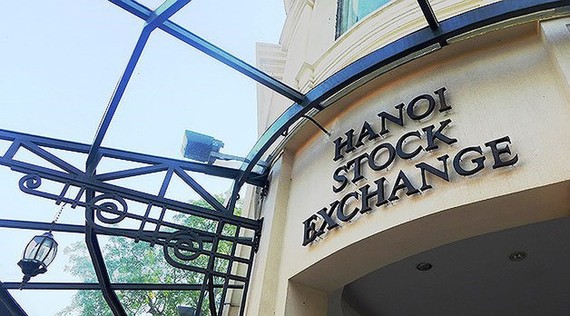
According to the Hanoi Stock Exchange (HNX), total post-tax profits of firms listed on the exchange reached VND19.93 trillion (US$858.72 million) last year, up VND2.04 trillion, or 11.4 percent compared to the previous year.
By the end of February, 360 out of 369 firms which have to release their financial statements of the fourth quarter of 2018 on the HNX have announced their financial statements of the fourth quarter of 2018. Of which, 325 firms announced to be profitable, with total profits nearly hitting VND21 trillion, up 9.7 percent year on year. Accumulated post-tax profit of four quarters of 2018 of firms listed on the HNX exceeded VND19.93 trillion, an increase of VND2.04 trillion.
Noticeably, finance industry saw a sharp increase in total profits with an increase of VND2.82 trillion, or 50 percent. Industrial firms recorded an increase of VND674 billion ($29 million) in total profits. Real estate firms’ total profits rose VND256 billion ($11 million), up 35 percent.
Firms in banking group took the majority in business results of finance industry. Meanwhile, firms in securities, construction, mining and gas and oil groups posted worse business results than the previous year.
In related news, Thang Loi Textile - Garment Joint Venture Company and Irrigation Equipment Joint Stock Company were fined VND350 million ($15,000) each by the State Securities Commission for not registering for securities trading.
Eight new traffic projects developed for connecting rural areas
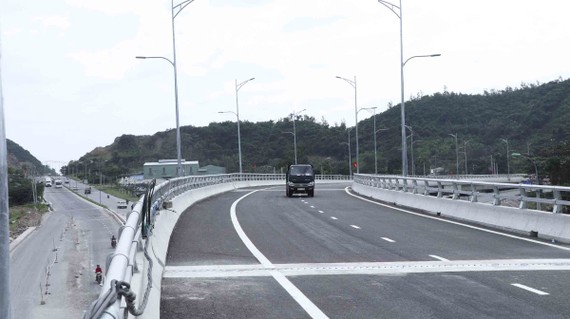
The Ministry of Transport is urgently preparing for investment of eight new traffic projects under official development assistance (ODA) loans, which were supplemented by the Vietnamese National Assembly in the medium-term public investment plan in the period of 2016-2020.
Accordingly, four large- scale ones among eight new projects are able to be implemented soon including the Northern mountain provinces' transport connection project under loan of Asian Development Bank (ADB), ODA- funded project of Long Xuyen Bypass, traffic connection project in the Central Highlands region under the World Bank’s loan and a project to upgrade National Highway 19, Tan Van - Nhon Trach road project through the Economic Development Cooperation Fund (EDCF) of South Korea.
As expected, the project of traffic connection in the Central Highlands and National Highway 19 upgrading project will be started in 2020.
Currently, the Ministry of Finance drafted a loan agreement and negotiation of the component 1A of Tan Van- Nhon Trach road, the first phase of Belt Road No. 3 project in Ho Chi Minh City. In May, the agreement is expected to be signed towards next steps.
The Ministry of Transport has approved the Long Xuyen bypass project. The Prime Minister has also prompted the Ministry to complete the procedures summiting to ADB to adjust the loan agreement.
Upgrading HCMC's Nguyen Huu Canh Street costs US$ 20 mln
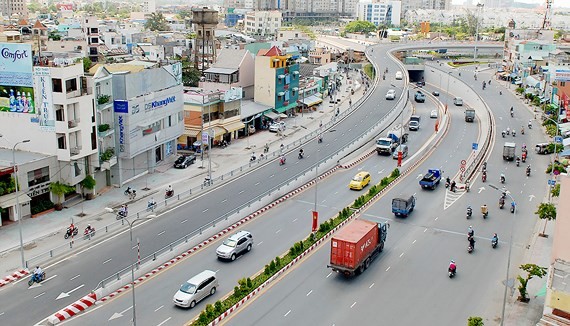
The People’s Committee of Ho Chi Minh City has just approved a proposal of the Department of Transport about upgrading 3,200 kilometer-long Nguyen Huu Canh Street in Binh Thanh District, with total investment capital of nearly VND 473 billion (around US$ 20 million) from the city’s budget.
The investment aims to repair and upgrade drainage systems, lighting systems, green trees, grass covers and technology infrastructure along the road.
The project is expected to start from June, 2019 and to be completed three months later.
Nguyen Huu Canh Street is considered as one of major routes of Ho Chi Minh City heading to District 1. There are many luxury apartment blocks and shopping malls along the road.
Additionally, this is one of the city’s flood- prone streets having to use anti-flooding pumps after several downpours.
Govt to spend over VND1 trillion widening Cho Gao Canal

Vessels are seen on Cho Gao Canal in Tien Giang Province - PHOTO: VOV
The Government has decided to allocate more than VND1 trillion (US$43.1 million) for the second phase of a project to upgrade and widen Cho Gao Canal in the Mekong Delta province of Tien Giang.
The Ministry of Transport approved an investment budget of more than VND4.2 trillion for the project in 2009. However, from 2010, the demand for cargo transport through the canal was not as high as expected due to the global economic crisis.
In 2013, the ministry revised downward the investment in the project to nearly VND2.3 trillion. Accordingly, the canal was scheduled to be expanded to only 55 meters, instead of 80 meters as in the initial plan, and will be dredged to a depth of 3.1 meters, instead of four meters.
The project was divided into two phases. The now-completed and operational first phase used VND786 billion from the State budget.
The remaining funds of nearly VND1.5 trillion were to be used in the second phase.
In July 2016, the prime minister approved the execution of the second phase under the build-operate-transfer (BOT) format due to the tight State budget.
However, after consulting with the Tien Giang government, the province’s delegation of National Assembly deputies and transport associations, the format was deemed inappropriate as it could not ensure the project’s feasibility or fairness among canal users.
As a result, the Government leader approved the Ministry of Transport’s proposal to do away with the BOT format.
On March 15, Deputy Prime Minister Trinh Dinh Dung worked with the Tien Giang government on the project. He stressed the importance of the project to upgrade Cho Gao Canal, noting that it would ease traffic along the canal, which is a critical waterway for transporting goods in the Mekong Delta.
The deputy prime minister asked the Ministries of Transport and Planning-Investment to coordinate with other relevant ministries and agencies to quickly work out a plan to execute the second phase of the project using the State budget and submit it to the prime minister and the National Assembly.
Vietnamese banks see exodus of foreign partners
The last few years have seen a number of cases of foreign partners severing ties with Vietnamese banks.
Last week Hanoi-based private bank Southeast Asia Bank (SeABank) confirmed that French strategic partner Société Générale Group (SocGen) has sold out its 20 percent stake after a 10-year collaboration.
According to a SeAbank spokesperson, the sale was part of SocGen’s recent strategy of exiting non-core markets in all of Asia to consolidate its positions in places where it is already strong.
In January 2018 the UK’s Standard Chartered Bank ended its 12-year partnership with Asia Commercial Bank, one of the largest private banks in Vietnam by assets.
It said it was under pressure to cut costs after suffering losses in emerging markets.
A month before that French bank BNP Paribas offloaded its entire 18.68 percent stake in Orient Commercial Bank, ending a 10-year alliance.
Some industry experts believe there is a clear tendency now among foreign lenders not to spread their investments thin and instead focus on markets where they have a competitive advantage.
In 2017 Hong-Kong based HSBC announced the sale of its nearly 20 percent stake in major private lender Techcombank. Securities firm Ho Chi Minh Securities Corporation called it "not surprising", saying it might partly have been due to management issues.
HSBC’s influence at Techcombank had been waning since 2012, with the security firm believing it was due to a potential conflict of interest since the two banks competed in the same market.
HSBC was licensed to open a branch in Vietnam, and Techcombank failed to pay it dividends for several years.
Speaking to VnExpress, VPBank general director Nguyen Duc Vinh expressed regret that foreign investors are seeing Vietnam only as a short-term investment destination.
But there have been instances of divestment purely for commercial reasons such as when The Australia and New Zealand Banking Group Limited (ANZ) sold its stake in Sacombank because buyers offered a good price.
Similarly, in 2013 Singaporean bank OCBC sold its nearly 15 percent stake in VPBank after over seven years when it received "an offer it could not refuse" from domestic buyers.
Singapore Business Review reported the price was 35 percent higher than what OCBC paid. This is after the bank had received a bonus issue of 14.25 percent a year earlier.
The wave of divestments began around 2011, when Vietnam’s financial system fell into a crisis. The lingering aftershock of the 2008 global financial crisis and the consequences of unregulated lending to invest in securities and real estate caused economic instability.
Foreign banks first started exploring partnerships with Vietnamese banks in 2005, starting with deals between ACB and Standard Chartered, Techcombank and HSBC and Sacombank and ANZ.
The growth of the country’s financial system, the potential of its banking sector and a stock market that was constantly rising to new peaks made Vietnamese banks very attractive targets for foreign investors. It gave the foreign investors, besides the direct commercial benefits, also the chance to enter a highly attractive market when it was still in its infancy.
Subsequently, OCB, ABBank, Vietcombank, SeABank, VIB, and state-owned VietinBank, the biggest lender in Vietnam at the time by assets, also entered partnership deals with foreign banks.
The trillions of dong ($1 = VND23,199) flowing in from these deals added resources to the banking sector, helped increase the capital of many banks and stimulated business growth.
According to a recent report by Saigon Securities Inc, the banking sector experienced a good year in 2018, with profits rising by 31.3 percent to VND68.01 trillion ($2.92 billion).
But experts believe profits peaked last year.
According to HSBC Vietnam CEO Pham Hong Hai, profits could go down this year as the State Bank of Vietnam tries to bring down credit growth, which is targeted at 14 percent.
Danang reports increased investment inflows
The central city of Danang has reported an improvement to its investment climate as inflows of domestic and foreign investment into the locality have risen since the beginning of the year.
During the first days of March, Danang issued investment permissions and decisions to a total of eight projects, valued at US$469 million in capital.
The central city also gave approval to scrutinizing the feasibility of 13 other investment projects with a combined capital of US$3.6 billion, surging by 13 times compared with the same period last year.
According to the Danang Investment Promotion Agency, foreign direct investment (FDI) inflow has rebounded since the beginning of the year with the high-tech sector enjoying a surge in investment.
Notably, Universal Alloy Corporation (UAC), a global manufacturer of aircraft components, launched a US$170 million project dedicated to manufacturing aerospace components in the Danang Hi-Tech Park, which is expected to provide a large boost to FDI inflows into the park.
Once put into operation, the UAC factory is projected to provide 4,000 aircraft components for export.
Kevin Loebbaka, currently President of UAC-Europe and Chief Operating Officer of UAC-Global, said that when Boeing and Airbus wish to promote their manufacturing operations, the UAC could act as a bridge by which to connect their future production in Danang.
This year continues to see Danang realize its target of attracting additional investment inflows. The city plans to step up its approach to strategic investment in the hope of offering lucrative spaces to projects across the fields of high-tech agriculture, education, healthcare, and information and technology.
According to Nguyen Tien Quang, head of the Vietnam Chamber of Commerce and Industry’s branch in Danang, a number of investors have encountered numerous difficulties in seeking sites to carry out their projects. Quang cited limited and fragmented land as a main cause, which makes land provision for large-scale projects unfeasible.
Municipal officials have given much thought to enabling enterprises and investors to access available land plots through stabilizing ground leases, thus helping them cut down their input costs, Tien added.
Huynh Duc Tho, chairman of the municipal People’s Committee, admitted that vague planning has created a considerable bottleneck in attracting investments, particularly from foreign firms.
Tho unveiled that the city has hired foreign consulting entities to map out the revised city master plan by 2030 and a socio-economic development strategy with a vision towards 2045.
The existing planning, which is vague and lacks transparency, has been hindering the implementation of a number of projects, the municipal chairman said.
He stressed that local authorities have been hastening the planning progress, including master planning while maximizing efforts to ease difficulties in executing the projects.
Dat Xanh Real Estate Service and Construction Corp (DXG) plans to hold an initial public offering (IPO) for its real estate services segment in late 2019 or early 2020.
The information was released by the DXG Chairman Luong Tri Thin during the company’s annual general meeting (AGM) in HCM City on Saturday.
DXG plans to list its remaining four segments, investment, construction, materials and industry, on the stock market by 2023, Thin said.
This year, DXG has a revenue target of VND5 trillion (US$2.13 million), up 7.6 per cent year-on-year. It hopes to pay dividends at the rate of 20 per cent.
Shareholders said that with this plan, the growth rate of DXG is not much higher than 2018. However, Thin said that in nearly 10 years of listing, the company had always achieved its growth plans and even exceeded them.
But this year, the company was re-structuring its operational model and preparing for a five-year plan toward greater development so DXG should be more cautious with targets, Thin said.
It is expected that in the second quarter of 2019, DXG will launch and sell projects nationwide.
The AGM also authorised the board of directors to decide on the provision of loans and credit guarantees for subsidiaries, and vice versa, with the value of each loan and credit guarantee not exceeding 20 per cent of total asset value in the nearest audited financial statements.
DXG will also issue 170 million shares for 2018 dividend payments, employee stock ownership plan (ESOP) shares issuance and share issuance to existing shareholders.
Of the estimate, DXG will issue 76.96 million shares to pay 2018 dividend at the rate of 22 per cent.
Six million shares will be issued as ESOP shares.
Some 87.45 million shares will be issued to shareholders at the issuing price of VND10,000 per share. The proceeds of VND875 billion earned from the issuance is expected to develop residential projects and resettlement housing projects of Gem Riverside project in Nam Rach Chiec area in HCM City’s District 2.
At the trading session on Friday, DXG’s share price closed at VND24,200 per share, 2.4 times higher than the expected issuance price.
At the AGM, shareholders recommended paying dividends in cash for 2019.
“As a major shareholder, I also like to receive dividend in cash, but DXG is currently in a strong development phase, needing to invest, to mobilise capital, so it is not reasonable to allocate money at this time. DXG’s market price is currently VND24,200 per share with high liquidity, so it is very beneficial for shareholders to receive dividends in shares”, Thin said at the meeting.
Technology helps create breakthrough for start-up development

To Thi Thu Huong, deputy head of the information technology department under the Ministry of Information and Communications, speaks at the summit (Photo: Forbes Vietnam)
Technology opens up new development opportunities for startup businesses by translating their ideas into products and services, experts said at the recent Tech Summit 2019 held in Ho Chi Minh City.
With a population of more than 93 million people, including many youngsters, Vietnam has the capacity to take advantage of new technology trends such as Internet of Things (IoT), Artificial Intelligence (AI) and blockchain.
Besides the Governments’ macro policies to boost corporate restructuring, entrepreneurial ideas will promote the financial ecosystem and boost leverage for business development.
Vietnam is among the 10 most attractive countries for software outsourcing in the region and the world, according to To Thi Thu Huong, deputy head of the information technology department under the Ministry of Information and Communications.
The country took top spot in the Business Process Outsourcing (BOP) Index of the global real estate adviser Cushman & Wakefield in 2016.
It is home to nearly 50,000 businesses operating in technology, a figure expected to increase to more than 100,000 in the future.
Lee Jae-woong, CEO of car-sharing app SoCar, described Vietnam as a future unicorn farm.
With a young population structure and a high rate of internet and smartphone users, Vietnam is able to set up and develop a lot of unicorn startup companies, he said.
Effective model of safe farm production
A year since its establishment, A Luoi Safe Agricultural Cooperative in Thua Thien-Hue province has been operating effectively, contributing to bringing a stable income to the people. This is a promising new direction for producers of safe agricultural products, contributing to promoting socio-economic development of local mountainous areas.
A Luoi District Safe Agricultural Cooperative was established early in the second quarter of 2018 with 11 women members. This is a complete production model with clean agricultural products being produced and marketed by the cooperative. These two stores have operated very effectively, with average monthly turnover from 20,000 to 25,000 USD per store.
A Luoi District Women's Union now plans to establish more production cooperatives, continue to build gardens and help member households participate in production of some typical products of each locality.

.svg)
