 Vietnamnet.vn

 Podcast



HDBank pre-tax profit increases by 65.7 per cent to $ 172.6 million

An HDBank branch in HCM City. — Photo courtesy of HDBank
The HCM City Development Joint Stock Commercial Bank (HDBank) has announced its results for the fourth quarter of last year and for the full financial year, achieving impressive growth and meeting ambitious targets.
Its pre-tax profit surpassed the target approved at the annual general meeting early last year.
Its return on equity and return on assets were 20.27 per cent and 1.58 per cent. HDBank’s non-performing loan ratio was tightly controlled at 0.97 per cent, the lowest level in the banking industry.
In the fourth quarter, the lender achieved a consolidated pre-tax profit of over VND1.12 trillion (US$48.3 million), up 122.1 per cent year-on-year. This included net interest earning of VND2.16 trillion ($93.1 million), up 23.9 per cent over the same period.
With a breakthrough performance in the last quarter of 2018, pre-tax profit for the whole year was worth nearly VND4.01 trillion ($172.6 million), the highest-ever and representing an increase by 65.7 per cent from 2017.
Besides, earnings from services and foreign exchange trading also grew sharply, helping increase the bank’s income by 37.8 per cent.
Services continued to be a bright spot, with the net profit from services doubling to VND438 billion.
Net earnings from foreign exchange trading also doubled to VND298 billion.
Net interest earnings topped VND7.65 trillion, an increase of 20 per cent from the previous year, though outstanding loans increased by only 18.2 per cent.
Total income grew by 25.7 per cent to VND9.44 trillion.
Assets were worth VND216.11 trillion, up 14.1 per cent from 2017.
HDBank mobilised nearly VND191.59 trillion in deposits and increased its charter capital by 14 per cent to VND16.8 trillion, making it ready to apply Basel Capital Accord II (Basel II) standards when they are adopted by the State Bank of Viet Nam.
Last year, HDBank achieved its target of opening 45 branches and transaction offices, taking the total number nationwide to 285.
The number of consumer financial transaction points increased by more than 2,300 to 13,825, enabling the bank to retain its leading position in the consumer finance industry in terms of network size.
Their large networks enable HDBank and HD Saison to efficiently serve nearly seven million customers, especially in rural areas.
The bank’s stock – code HDB – which was listed last year, has become one of the 20 largest stocks in terms of market captilisation on the HCM Stock Exchange and sees lots of buying by foreign investors.
The bank was awarded the Labour Medal, second class, on the occasion of its 28th anniversary.
Moody’s Investors Service has upgraded the baseline credit assessments and counterparty risk assessments for HDBank to B1.
HDBank was one of the 37 largest contributors to HCM City’s revenues, and was honoured for it by the city People’s Committee.
The bank won many awards last year, including for the 40 Most Valuable Brands in Viet Nam from Forbes, the “Best Companies to Work for in Asia” award from HR Asia, the “Retail Banking Award” from the Viet Nam Banks Association and the International Data Group, and the “Best Cash Management in the Asia-Pacific” award from Euromoney.
HDBank also attaches great importance to community programmes. It gave scholarships to 1,000 students, donated health insurance cards to thousands of near-poor people and funded cataract surgeries for thousands of poor patients.
The bank is also a stakeholder in the development of the country’s sports. Last year, for the eighth time it organised the HDBank Cup International Chess Tournament, which resonated in the world of chess. Last year was the largest event with 271 players taking part, including 125 from 21 countries and territories.
The second HDBank Futsal Prize (National Championship and Cup) held last year with attractive games and top-quality competition contributed to the growth of Viet Nam’s futsal in the international arena.
This year, HDBank hopes to increase its assets to VND328.59 trillion, mobilise more than VND303 trillion in deposits and generate pre-tax profits of VND5.1 trillion, have total outstanding loans of VND210.84 trillion if it falls within the credit growth limit approved by the SBV, and increase the number of transaction points to 308.
Jewellery promotions launched in HCM City for Tet
Jewellery firms in HCM City have been launching promotions and discounts as well as new collections to welcome the Year of the Pig.
According to businesses, the end of the year is a good opportunity to stimulate demand and treat customers with special offers at the year-end.
Sai Gon Jewelry Co Ltd (SJC) is offering a 10 per cent discount on most precious stones.
Phu Nhuan Jewelry Joint Stock Company is also offering a 10 per cent discount on coloured stones at its stores nationwide, and 30 per cent for PNJ silver. It has also launched its 2019 Spring Colour collection.
A PNJ representative said with the new designs and diversification of products, the new collection, which has 26 designs, would meet the demands of customers.
“We’ve also launched sets of diamonds with impressive designs to welcome 2019,” said the PNJ representative.
Dinh Duy from Binh Thanh District said he was getting married at the end of the year so he was buying gifts for his wife to celebrate their special day.
"Big firms often launch promotions at this time,” Duy said.
Canada might impose anti-dumping duties on carbon steel welded pipes from VN

Canada has decided on taxes for carbon steel welded pipes from Viet Nam. — Photo vietnambiz.vn
The Canada Border Services Agency has made a final decision on taxes for carbon steel welded pipes from Viet Nam.
Accordingly, the weighted average margin of dumping on Hoa Phat Steel Piple Company Ltd has been set at 4.9 per cent, SeAH Steel Vina Corporation 3 per cent, and State Pipe and Supply Inc 26.1 per cent, while all other exporters from Viet Nam will face a tariff of 54.2 per cent.
These three companies had lower average margin of dumping than other exporters because they responsed promptly to the querries from the investigation agency, according to the Trade Remedies Authority of Viet Nam.
The Canadian International Trade Tribunal is continuing its inquiry into the question of injury to the domestic industry and will make an order or finding by February 15.
The investigation was initiated on July 20 last year and covered July 1, 2017 to June 30, 2018. The complainant was Novamerivan Steel Inc, on behalf of its subsidiaries Nova Tube Inc and Nova Steel Inc.
According to its complaint, the dumping of carbon steel welded pipes originated from Pakistan, the Philippines, Turkey and Viet Nam caused Nova suffer injury in the form of lost sales, price undercutting and price suppression.
The volume of imported carbon steel welded pipe grew from 47,657 tonnes in 2015 to 91,739 tonnes during the period of investigation. It added the price of imports had substaintially affected the price of domestic products.
During the period of investigation, imports from Viet Nam accounted for 12 per cent of total imports of carbon steel welded pipe.
Business climate needs more work

Hung Viet Garment Joint Stock Company in Hung Yen Province. More efforts are needed to improve the country’s business climate.
The Vietnamese Government should focus on promoting electronic payments and online public services together with developing the start-up ecosystem in 2019, attendees heard at a conference by the Central Institute for Economic Management (CIEM) on Tuesday in Ha Noi.
The conference was held to review results of the Government’s Resolution No 19 on improving the business climate and enhancing national competitiveness.
CIEM’s statistics showed that the percentage of cashless payments in Viet Nam remained modest, only accounting for 11.49 per cent of total transactions. Nearly 85 per cent of transactions at ATMs were cash transactions.
The percentage of public services provided online was also modest, at only 6.89 per cent.
"Policies to leverage the development of electronic payments and the provision of online public services are needed," CIEM said.
Accordingly, the State Bank of Viet Nam should study amendments to regulations on cashless payments to promote their development in Viet Nam and eliminate the monopoly in the provision of switching services.
CIEM said that the central bank should announce the list of compulsory non-cash transactions which should include transactions like payments for water, electricity bills and high-value transactions.
In addition, CIEM proposed the national public services portal to be put into operation before September this year.
CIEM’s Director Nguyen Dinh Cung said that the key points of the Government’s Resolution No 2 this year, renaming resolution No 19, were increasing electronic payments and online public services.
The provision of online public services must go along with electronic payments to reduce face-to-face meetings between officials and citizens, he said.
In addition, focus should also be placed on promoting start-ups and entrepreneurship in terms of quality, Cung said.
Other improvements were also needed in enforcing contracts and resolving insolvency, Cung said, adding that the World Bank’s Doing Business 2019 report pointed out that these were two major bottlenecks in the process of improving the business climate in Viet Nam.
In addition, it was necessary to hasten deregulation of business prerequisites in terms of quality, Cung stressed.
“Viet Nam needs to continue speed up business climate reforms to promote the foundation of new firms and reduce the number of firms halting operations and reduce costs for businesses,” Cung said.
According to Dau Anh Tuan, head of the Viet Nam Chamber of Commerce and Industry’s Legal Department, the simplification and removal of business prerequisites must focus on quality.
Tuan added that the issuance of new business prerequisites must be put under tight control to prevent new barriers.
According to CIEM, Viet Nam’s business climate improved significantly after five years of implementing Resolution No 19, ranking 69th out of 190 economies, moving up 21 spots compared to 2015.
Out of the ten indicators on the World Bank’s Doing Business report, Viet Nam in the five-year period made improvements in getting electricity, paying taxes, protecting minority investors, starting a business, getting credit and dealing with construction permits.
However, the country moved down in registering property, trading across borders, enforcing contracts and resolving insolvency.
Easy Credit expands business to Mekong Delta

Staff from Easy Credit help customers follow procedures to apply for a loan.
Easy Credit, a brand name under the consumer credit division of EVN Finance, is expanding its business network to provinces in the Mekong Delta and Southeastern region, three months after its official launch in early October.
The company began offering services early this month to nearly 20 cities and provinces and expanded cash loan services in the Mekong Delta and southeastern regions, especially in rural areas.
The move is part of the company’s plan to expand its business to the entire country.
In the second quarter, Easy Credit expects to launch its business in Ha Noi and northern provinces and will continue to expand its nationwide service network until the end of this year.
Easy Credit is now offering cash loan packages that do not require customers to visit designated locations.
After completing an online loan application via the company’s website or filling in a loan application form over the phone with the support of staff, customers only need to set up an appointment with representatives from Easy Credit at the most convenient location for them. Representatives from Easy Credit help customers complete their documents.
According to the latest figures from Easy Credit, nearly 90 per cent of customers received approval within 24 hours after submitting online forms on the company website.
The number of Easy Credit’s monthly loan applications is growing over 150 per cent per month on average. Based on statistics in December, the current average cash loan of customers was around VND25 million (US$1,200) with an average loan term of 27 months.
Nguyen Mai Long, the company’s general director, said: “I think consumer finance demand in Viet Nam will keep rising in 2019.”
Last year, the average GDP per capita in Viet Nam was $2,540, which is still far from the target of $3,500 for 2020, according to statistics by the Ministry of Planning and Investment. But consumer demand continues to rise thanks to demand from the retail enterprise community.
Although Easy Credit just launched in early October, it has received positive consumer feedback for its consumer loan services.
“We’re trying our utmost to expand the business so that cash loan packages can reach residents in the western region, offering them loan packages when needed, and helping them get rid of traps from loan sharks and illegal money lending, based on recent recommendations by the State Bank,” Long said.
EVN Finance Joint Stock Company (EVN Finance) was established on September 1 last year.
EVN Finance provides credit to enterprises in various industries with priority given to enterprises and partners in the electric power sectors.
The company also provides useful financial services to customers, including capital consultancy and arrangement, corporate bond issuance consultancy, and clean development consultancy, especially focusing on renewable power and energy projects.
Shipping giant VIMC aims to double profit this year
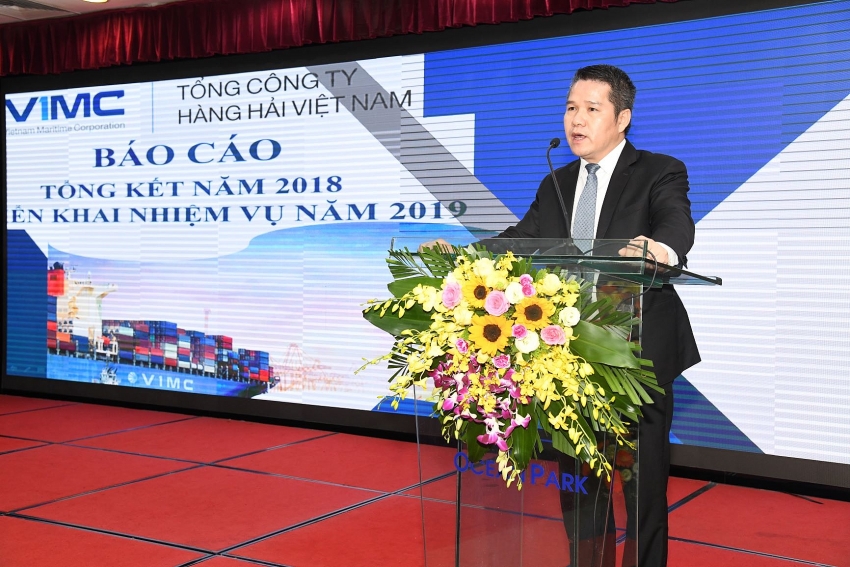
Nguyen Canh Tinh, acting CEO of VIMC, addressing the meeting to review 2018
After reporting better performance in 2018, Vietnamese shipping giant Vietnam Maritime Corporation (VIMC) has set higher targets for this year.
VIMC on January 15 held a meeting to review its 2018 performance and set tasks for 2019, with higher targets in profit and volume of goods shipped.
According to Nguyen Canh Tinh, acting CEO of VIMC (previously Vinalines), the company aims to make a profit of VND711 billion ($30.9 million), up nearly 95 per cent from 2018, while the volume of goods shipped via ports will reach 107.8 million tonnes, up 11.6 per cent on-year.
The giant, however, lowered the targets for revenue to VND12.71 trillion ($552.6 million), and the volume of the shipping business to 17.6 million tonnes amidst the difficulties forecast in the shipping market and unpredictable global market changes.
VIMC aims to expand its target customer base with members of the top ten shipping lines, as well as Vietnam and the region’s biggest groups.
Last year, the giant made a revenue of nearly VND14 trillion ($608.7 million), up 2.6 per cent on-year. Its total profit reached VND365 billion ($15.87 million).
During the year, its shipping volume reached 26.7 million tonnes, up 24.5 per cent against the full-year target, while the volume of goods shipped via VIMC ports rose by 9.4 per cent on-year to 96.6 million tonnes, making up 18.3 per cent of the country’s total volume.
As of December 2018, VIMC had 15 port operators, including four joint venture ports with foreign partners. It had 72 piers with the total length of 12,591 metres, making up 26.4 and 20 per cent of the country’s total number of piers and length, respectively.
Regarding investment activities, Tinh said that the corporation completed the investment and put into operation several ports, including the second phase of the Tien Sa Port project, Vinalines Hau Giang Port, and others.
The giant is developing other projects, including Vinalines Dinh Vu Port, Saigon-Hiep Phuoc Port, and container terminals No.3 and No.4 at the Lach Huyen International Gateway Port project.
In 2018, the company also fast-tracked the divestment of loss-making units and boosted international cooperation with foreign shipping lines, including Maersk, MSC, CMA-CGM, Sojit, SM Lines, Cargill, and SCG.
International expert hails Vietnam’s contributions to WEF

Dr. Pierre Groning, Director Advocacy of Amfori – a Belgium-based global business association – has applauded Vietnam’s increasingly important contributions to the World Economic Forum (WEF).
In an interview with a Vietnam News Agency’s correspondent in Brussels, Belgium, Groning said Vietnam was demonstrating itself as a country that protects and promotes multilateral order.
Vietnam relies much on external trade and the country’s trade as the percentage of gross domestic product (GDP) exceeds 200 percent, he said, adding Vietnam should maintain cooperation with foreign partners to show local businesses are operating in the best conditions.
Meanwhile, Pascal Kerneis, Managing Director of the European Services Forum (ESF), highlighted Vietnam’s achievements in the fourth Industrial Revolution over recent years.
Vietnam joining the Comprehensive and Progressive Agreements for Trans-Pacific Partnership (CPTPP) and the EU-Vietnam Free Trade Agreement (EVFTA) signaled it wants to participate in the globalisation process and the fourth Industrial Revolution, he said.
Kerneis voiced his support for Vietnam’s efforts to engage in global supply chains.
Vietnam forms part of the production network that churns out products for the world and this is one of the reasons why the country has become an attractive destination for investors, he said.
However, the country should work to maintain investors’ confidence as they may turn to other destinations like Bhutan, Nepal and African countries when labour costs increase in the Southeast Asian nation.
According to Kerneis, Vietnam’s target of a digital economy would be realised thanks to its contingent of creative youths.
Forum on agricultural product consumption to be held for first time

A honeydew melon farm of the 3T Plus Green Farm Co. Ltd in Lang Lon commune of Chau Duc district, Ba Ria-Vung Tau province
A forum on agricultural production and consumption promotion will be held in Hanoi for the first time, according to the Ministry of Agriculture and Rural Development.
The forum will review Vietnam’s agricultural production, including farm produce processing and consumption, and discuss solutions to boost and expand the country’s farm produce market and raise Vietnamese agricultural products’ competitiveness, thereby attracting international organisations and businesses to invest in agriculture.
It is also a chance for producers to connect with localities, professional associations, enterprises and investors in processing and consuming agricultural products.
The forum will be held annually, Nguyen Quoc Toan, Acting Director of the ministry’s Department of Agro-product Processing and Market Development, said at a press conference in Hanoi on January 22.
This year’s event will take place in Hanoi on February 22 with the participation of the Ministry of Industry and Trade’s representatives who will present the role of counsellors in bringing agricultural products to foreign markets, he added.
Information on developing brand names for Vietnam’s farm produce will be provided by the Institute for Strategy and Competitiveness at the forum along with presentations on building infrastructure to improve the country’s agricultural products’ competitiveness by foreign experts.
Groups like Vingroup, Massan, Aeon and Big C are expected to attend the forum to discuss measures to boost consumption of agricultural products.
Hanoi city targets 7.4-7.6% economic growth in 2019

Traffic in Hanoi. The city’s GRDP increased 7.61 percent, the highest in the last three years, and exports grew 21.6 percent in 2018
The Hanoi People’s Committee has set 22 targets for socio-economic development in 2019, focusing on State budget restructuring, improvement of its investment and business environment and promotion of the innovation and startup ecosystem.
The capital city’s gross regional domestic product (GRDP) is expected to reach 7.4-7.6 percent in 2019 and export growth is projected at 7.5-8 percent.
These targets are set in the city’s action programme No 12/Ctr-UBND on the socio-economic development and State budget estimation in 2019, signed recently by Chairman of the municipal People’s Committee Nguyen Duc Chung.
In 2018, the capital city accomplished all 20 socio-economic development targets. Its GRDP increased 7.61 percent, highest in the last three years, and export grew 21.6 percent, much higher than its initial target of 7.5-8 percent. The city’s attraction of foreign investment topped the country for the first time after more than 30 years, expected at 5.6 billion USD.
According to the programme, this year is a turning point to complete the five-year plan for 2016-2020. This has great importance in the context of complicated and unpredictable developments in the region and the world.
Hanoi’s exports may be affected by protectionist trade and exchange rate policies by some countries, especially the Chinese renminbi could be deeply devalued due to the US-China trade war.
Foreign capital inflows into the city may also be impinged by the adjustment of US tax policy. Besides, unpredictable movements of global oil prices will significantly affect the prices of domestic commodities.
The report also said the 10-year cycle of economic crises, though not expected now, should be regularly monitored to ensure a timely response. The fast-moving Fourth Industrial Revolution (Industry 4.0) brings both opportunities and challenges.
In the country, productivity, efficiency and competitiveness of the economy are not high which may create disadvantages for domestic enterprises competing with foreign partners.
However, besides challenges, the domestic economy is expected to maintain its high growth while Vietnam’s participation in new-generation trade agreements such as the CPTPP and EU-Vietnam Free Trade Agreement (EVFTA) will be an important factor to promote the country’s trade and investment.
The programme focuses on nine tasks and solutions. Among them is the priority to improve the quality of the city’s investment and business environment, encourage and promote innovation and startups will also be more practical.
Enterprises in the city will be developed in both quantity and quality.
The city will continue its economic restructuring in association with a changing growth model and improving productivity, efficiency and competitiveness.
The programme emphasises the task of restructuring the State budget, focusing on efficient tax collection, fight revenue losses, especially having measures to collect tax arrears, detect and handle price transfer actions, and closely monitor movements on the forex market to ensure the implementation of business and import-export plans.
Other priorities include urban planning and development, application of information technology in administration and management, stepping up administrative reform, downsising payrolls, drastic anti-corruption and wastefulness, development of education, healthcare services and culture, ensuring national defence and social order, as well as improving the efficiency of foreign affairs and international integration.
Japanese firms eye up investment in Ha Nam

Vice Chairman of the Ha Nam People’s Committee Truong Minh Hien (standing) speaks at the working session with Japanese firms
Many Japanese businesses have expressed interest in investing in Vietnam’s northern province of Ha Nam to supply top quality products for the Southeast Asian market and others in the region, said Tsunemasa Teramoto, a representative from Japan’s Ministry of Agriculture, Forestry, and Fisheries.
Teramoto, who led a delegation of Japanese firms operating in the fields of manufacturing and processing farm produce, forestry, and seafood, and cargo transportation, made the statement at a working session with the provincial People’s Committee on January 22.
With their strengths in technology, Japanese businesses also want to cooperate with local partners to develop agriculture in Ha Nam towards modernity and sustainability, he said.
Vice Chairman of the provincial People’s Committee Truong Minh Hien introduced the advantages and potential of the province in terms of economic development and investment attraction policies.
He said the locality prioritises high-tech and support industries, adding that Ha Nam has reserved Dong Van III Industrial Park – which features a favourable location and synchronous infrastructure – for Japanese businesses looking to operate in the province.
With regards to agricultural policy, the province is looking to draw businesses to its high-tech agricultural zones, as well as its safe, clean agricultural production.
While investing in the province, businesses will be supported with electricity, water, transportation, labour recruitment, and public order security, Hien said.
He noted that Japan is now ranked the second largest foreign investor in Ha Nam with over 70 projects.
The province highly appreciates the capacity from Japanese investors and hopes more enterprises from Japan will carry out investment projects in the locality.
At the session, participants discussed other issues such as land rent, project schedules, human resources, supply of production materials, and infrastructure support mechanisms.
The same day, the Japanese business delegation made a fact-finding tour to a high-tech agricultural zone in Nhan Khang commune, Ly Nhan district.
Mekong Delta farmers reap high profits from breeding giant river prawn

Farmers harvest giant river prawn bred in a rice field in Ca Mau province’s Thoi Binh district.
Farmers in the Mekong Delta have had a bumper harvest of giant river prawns at good prices because of favourable weather conditions and high market demand.
Under a special cultivation model, farmers breed the giant prawn and grow rice on the same field without using chemicals. The prawns eat natural food in the rice fields.
In Soc Trang province, shrimp–rice farmers are now entering the peak harvest season.
Le Viet Thang, who has a one-hectare rice field in Soc Trang’s Phuoc Long District, said he had a rice yield of seven tonnes per hectare, higher than in the past.
The profit from harvesting prawn and rice this year was about 50 million VND (2,150 USD) per hectare, he said.
Tran Van An, Deputy Chairman of the Phuoc Long district People’s Committee, said the rainy season ended late, so there was enough freshwater for the rice fields.
Local farmers used quality seeds and followed proper plant scheduling, which helped to increase yields.
The environmentally friendly shrimp – rice model reduces production costs, increases yield and profit.
In the rainy season, Bac Lieu has nearly 36,000ha of fields allocated for the shrimp – rice farming model, up nearly 3,000ha against the previous rainy season.
Of the figure, farmers have harvested more than 20,000ha so far.
The cultivation model has an average prawn yield of 250 – 300kg per hectare per crop and 4 – 4.5 tonnes of rice per hectare per crop, according to Bac Lieu authorities.
In Ca Mau province, farmers in Thoi Binh district, which is the province’s largest giant river prawn producer, has about 12,000ha of giant river prawn – rice farming fields.
Nguyen Huu Canh, who lives in Tan Bang commune’s Kenh 6 hamlet in Thoi Binh, has harvested giant river prawns in his one-hectare rice field and earned a profit of 20 million VND (862 USD).
He began to release about 20,000 giant river prawn fry into rice fields in June this year and harvested about 250kg of giant river prawns after breeding for six months, he said.
Huynh Van Dung, head of the Kenh 6 Hamlet Farmers Association, said: “The model has high economic efficiency, is easy to implement and is sustainable, so many farmers have done it.”
Farmers buy giant river prawn fry in Ca Mau and other provinces such as An Giang province and Can Tho city for breeding, he said.
Traders buy the market-size giant river prawns at a price of 100,000 – 130,000 VND (4.3 – 5.6 USD) a kilogramme.
The price may increase significantly near Tet (Lunar New Year), which falls on February 5 this year, according to traders.
In Tra Vinh province, farmers began harvesting giant river prawns in rice fields early this month.
Chau Thanh, Cau Ngang, Tra Cu and Duyen Hai districts and Duyen Hai town are Tra Vinh’s major giant river prawn breeding areas.
Chau Thanh has more than 1,100ha of rice fields in which farmers breed all male giant river prawns, the largest in the province.
Nguyen Thanh Thuong, Deputy Chairman of the Long Hoa communal People’s Committee in Chau Thanh, said this is the sixth year that many farmers in the commune have bred giant river prawn and organic rice on one field.
Many aquaculture farmers have also switched from breeding two black-tiger shrimp crops a year to one black-tiger shrimp crop and one giant river prawn crop a year, he said.
Investors who produce shrimp seeds, including male giant river prawn seeds, can take advantage of the province’s preferential policies.
The model of breeding all male giant river prawns yields a higher profit than that of breeding mixed gender giant river prawns. The former has a higher survival and growth rate.
State-owned paper producer surpasses yearly revenue target

The Vietnam Paper Corporation (Vinapaco) earned nearly 2.6 trillion VND (111.8 million USD) in revenue in 2018, exceeding the yearly target by 19 percent and recording an annual increase of 15 percent.
The figures were released at a conference to review the company’s performance last year and set out tasks for 2019, which took place in the northern province of Phu Tho on January 22.
Accordingly, in 2018, Vinapaco’s paper output surpassed 120,000 tonnes, of which over 113,000 tonnes were consumed. It exploited 160,000 cubic metres of timber and planted new forests spanning more than 2,300 hectares.
The company’s contribution to the State budget and profit reached 131 billion VND (5.63 million USD) and 70 billion VND (3.01 million USD), respectively.
Speaking at the conference, Chairman of the Vinapaco Members’ Council Hoang Quoc Lam said that in 2019, Vinapaco will focus on restructuring its apparatus, finances, development investment, and production; while carrying out a price assessment to sell its Phuong Nam wood pulp mill in the Mekong Delta province of Long An.
The corporation also plans to restructure its southern paper material single-member limited liability company and build a 135-billion-VND (5.8 million USD) wood pellet manufacturing plant in the Central Highlands province of Kon Tum, he unveiled.
This year, it expects to reel in over 2.6 trillion VND, contribute 121 billion VND (5.2 million USD) to the State budget, exploit more than 130,000 cubic metres of timber, and plant close to 2,000 hectares of forests.
SSC to strengthen handling of stock manipulation

Pham Hong Son, SSC vice-chairman, said one to two cases of manipulation and insider trading would be prosecuted after the Tet (Lunar New Year) holiday. (Photo: ndh.vn)
The State Securities Commission of Vietnam (SSC) will strengthen cooperation with the Ministry of Public Security to bolster the inspection and handling of manipulation and insider trading on the stock market.
The statement was made by SSC Vice Chairman Pham Hong Son at a brief meeting held earlier this week in Hanoi.
“One to two cases of manipulation and insider trading will be prosecuted after the Tet (Lunar New Year) holiday,” Son said.
“These practices cause damage to the market and listed companies and should be strictly punished.”
“The move is a deterrent to preventing the increasing number of violations of market regulations in the stock market,” Son said.
He added that the SSC could only deliver administrative sanctions so it had to cooperate closely with the Ministry of Public Security to handle cases that must face criminal charges.
“In the future, we will coordinate more closely to rigorously handle violations so that the market operates with transparency and efficiency," Son said.
When handling the cases, the SSC will also consider the responsibility of brokers and securities companies regarding their relationships with individuals and organisations that adopt price manipulation practices.
Any record that shows signs of a criminal offense would be immediately transferred to the police, Son said.
Last year, the SSC imposed administrative sanctions on 397 cases of manipulation with fines totalling 21 billion VND. Nine individuals were detected as having manipulated stock prices, creating false supply and demand.
Regarding criminal cases, the Hanoi People’s Court in October last year opened the first-ever trial in the case of 15 people who were charged with the falsification of stock trading documents, stock price manipulation and fraudulent asset transfers.
The accused included 35-year-old Tran Huu Tiep – former management board chairman of the Central Mining and Mineral Import Export JSC (MTM), 53-year-old Nguyen Van Dinh – former director of the mining firm Nari Hamico, and former officials of the Bank for Investment and Development of Vietnam (BIDV) and Tien Phong Bank (TPBank).
The defendants were reported to have falsified trading documents of MTM shares on the Unlisted Public Company Market (UPCoM), manipulated MTM share prices and fraudulently transferred MTM stocks on the market.
This is one of three criminal cases that were discovered and prosecuted.
The unification of the two existing bourses, approved by the Prime Minister recently, to establish the Vietnam Stock Exchange would help ease disadvantages of the current separate operating models, said Ta Thanh Binh, head of the market development department at SSC at the meeting.
Under the merger, the Hanoi-based Vietnam Stock Exchange would operate as a parent company for the Hanoi Stock Exchange and Ho Chi Minh Stock Exchange.
The exchange would be in charge of developing operational plans and strategies, issuing regulations about stock listings and trading, and supervising the operation of the two subsidiary exchanges.
The current separate trading systems of the two exchanges were independent and different, causing waste in social resources and costs for investors.
In addition, many departments of the two bourses, such as the research and development department, administrative department and international co-operation department, were doing the same tasks, leading to overlaps, Binh said.
According to Binh, the current trend of the world market is unification and merger of bourses into one, to increase market size and international competitiveness and reduce costs for investors.
The merger of the two stock exchanges will create maximum conditions for in-depth development.
Vietjet to add 2,500 flights during Tet

Local budget carrier Vietjet has announced plans to add 2,500 flights to its schedule, offering over 500,000 tickets to serve the surging demand for travel during the upcoming Tet holiday.
A Vietjet aircraft parks at HCMC-based Tan Son Nhat International Airport in this file photo. The local budget carrier plans to add 2,500 flights to serve the rising number of customers during the Tet holiday
The carrier plans to operate more than 12,500 flights in total between January 20 and February 19, including over 4,000 international flights, up 20% year-on-year.
Regarding airway safety, Vietjet and the Civil Aviation Authority of Vietnam have completed the necessary supervision tasks to ensure the safety of passengers, following several incidents involving safety issues recently.
The local low-cost carrier confirmed that it will continue investing in convenient services and raising the number of flights to satisfy the needs of customers.
Vietjet currently operates 60 A320 and A321 aircraft with over 385 daily flights. Its network of 105 air routes helps transport passengers between destinations in Vietnam and other locations across the world, such as Japan, Hong Kong, Singapore and South Korea.
Vietnams requires greater judicial effectiveness to earn market economy recognition: CIEM

It would prove a safe business environment and effective legal system in place to protect investors rights.
Vietnam requires greater judicial effectiveness to boost the “marketness” level of the economy, according to Nguyen Dinh Cung, director of the Central Institute for Economic Management (CIEM).
“Of the World Bank’s ten Doing Business indicators, “Resolving insolvency” and “Protecting minority investors” are key for Vietnam to be recognized as a market economy,” Cung said at a conference discussing the outlook of Vietnam’s business environment held on January 22.
Vietnam current stands at 133th out of 190 economies in terms of “Resolving insolvency” and 89th in “Protecting minority investors” in the World Bank’s 2019 Ease of Doing Business ranking, while its overall ranking has moved down one notch from the 68th to 69th.
Cung also expressed concern that Vietnam’s economic freedom score is 53.1, making its economy the 141st freest in global and 35th in regional rank in the 2018 Index released by the US-based Heritage Foundation.
According to Cung, a company’s bankruptcy must be swiftly processed by authorities so the related assets and business opportunities are transferred to others. Similarly, the court must settle a contractual dispute in a fair and timely manner so that all parties could move on.
“These are the required characteristics for a fully operational market economy. Unfortunately, contractual dispute and bankruptcy procedures are among Vietnamese enterprises top concerns,” Cung said.
This is increasingly important for Vietnam as the number of enterprises temporarily ceasing operation in 2018 reached the five-year high of 90,651, up nearly 50% year-on-year, he continued.
In 2014, the Vietnamese government introduced the first Resolution No.19, which later was issued annually, as a bid for Vietnam to become one of the top four business-friendly countries in ASEAN, which incorporates international standards on evaluating business environments, including the Doing Business Indicators of the World Bank.
However, “Vietnam is unlikely to reach its ASEAN-4 target, unless there are significant improvements in those two indicators, requiring a major efforts from Vietnam’s judicial system to be supportive to the business community,” Cung warned.
Cung added that these are important factors for not only locals but also for foreign investors, as they prove to be components of a safe business environment and effective legal system in place to protect their rights.
As a result, there must be a stronger pressure from the government for substantial changes in Vietnam judicial system.
Starting 2019, the government released Resolution No.02 in replacement of Resolution No.19 targeting 5 – 7 places higher in World Bank’s ranking in 2019 and 15 – 20 places higher in the next three years.
A key change in Resolution No.2 is a push for e-payment and e-public services, Cung said, adding that this would minimize the contact between citizens and public servants, and in turn reduce potential bribery and bureaucracy.
At the conference, Dau Anh Tuan, director of the Legal Department under the Vietnam Chamber of Commerce and Industry (VCCI), said most ministries have attained positive results in removing and simplifying business conditions in 2018 through the issuance of 25 decrees and the revision of other 80.
The move was in response to the government's request of removing 50% of total business conditions at all ministries and ministerial-level agencies before October 31, 2018.
However, there must be a stronger supervision mechanism to prevent the introduction of new business conditions.
In 2019, the government continues to set target of removing 50% business conditions.
In a directive issued last July, Prime Minister Nguyen Xuan Phuc strictly prohibited government agencies and ministries from creating new business conditions or abusing specialized inspection.
According to the PM, business condition removal is one of the key measures for economic growth and efficiency, requiring strong efforts from government leaders and ministers.
.svg)
