 Vietnamnet.vn

 Podcast


Apple fans have reason to be disappointed after waiting seven years for the company to enter the foldable smartphone market. More troublingly, its first foldable device, the iPhone Duo, may have triggered a screen durability controversy that the technology community has dubbed "Crackgate".
Crackgate: A durability nightmare for iPhone Duo
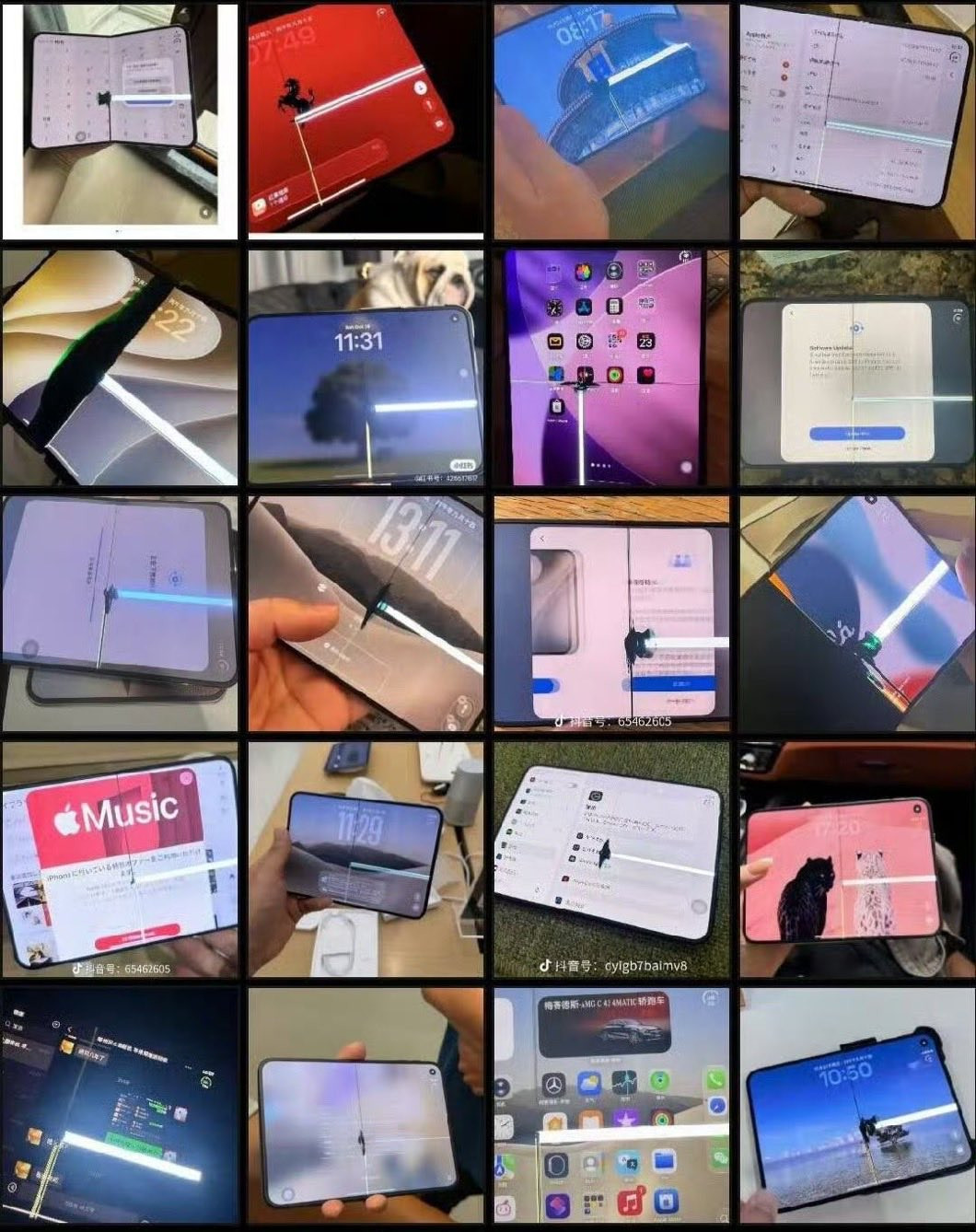
Numerous users have reported screen problems with the iPhone Duo. Photo: X
It may still be premature to call the controversy "Crackgate", as Apple has not disclosed exactly how many iPhone Duo devices have been affected. The number could be a few hundred or more. However, the reported problems no longer appear to be isolated incidents involving just three, four or even ten unlucky users.
Complaints about the iPhone Duo have been appearing frequently on social media. One of the most commonly reported problems involves cracks or damage in the lower-right corner of the display, often accompanied by a thick, highly visible line across the screen.
Videos documenting the defects, complaints from users and comments from technology reviewers have circulated widely online.
Notably, some buyers reportedly saved for months to afford the device, which starts at $2,000, only to encounter problems shortly after purchasing it.
Technology reviewers have also expressed surprise at the durability issues, while Apple critics have seized on the controversy to ridicule the product.
The iPhone Duo has even become the subject of numerous internet memes, highlighting the difficult launch faced by a device once expected to mark a turning point for Apple.
However, the more important question is not necessarily how much damage the controversy has caused to Apple's brand.
As one of the world's three most valuable companies, Apple is arguably less concerned about winning universal approval. A corporation of its size is capable of weathering waves of negative publicity.
The greater concern is the future of the foldable smartphone market.
Consumers need foldable phones that are increasingly capable, more affordable, equipped with better cameras and durable enough for long-term use.
Apple's entry into the segment was expected to accelerate innovation across the industry. However, serious quality problems with its first product could undermine that positive momentum.
Recent reports have suggested that the iPhone Duo's screen cracking problems may stem from Apple's decision to rush the device to market.
That assessment may be accurate, but it is also worth considering that Apple had little choice but to launch the iPhone Duo in 2026.
Why 2027 will be the decisive year
The iPhone Duo's troubled debut is clearly not the beginning Apple would have wanted for an entirely new product line.
However, the following year, 2027, marks the 20th anniversary of the original iPhone.
In 2007, Steve Jobs unveiled the first-generation iPhone, sparking a revolution in the mobile phone industry.
Two decades later, Apple needs a product capable of making a similarly significant impact to commemorate that milestone.
This helps explain why the company could not continue delaying the iPhone Duo.
A first-generation foldable iPhone plagued by recurring durability problems is hardly the image Apple would want associated with the iPhone's 20th anniversary.
The iPhone Duo 2 will therefore face an exceptionally difficult challenge.
It must not only address the shortcomings of its predecessor but also introduce substantial hardware improvements that persuade consumers to look beyond the current controversy.
A larger battery, improved camera system and more durable hinge could all be important upgrades. However, improving a handful of specifications would not be enough.
If the iPhone Duo 2 is simply a reinforced version of its predecessor that no longer suffers from screen cracks, Apple may struggle to convince consumers that it represents a meaningful technological advance.
With a starting price of $1,999, expectations for a premium foldable iPhone extend well beyond basic reliability.
Consumers want a refined product that delivers a distinctive user experience, cameras worthy of its premium price and sufficient durability to last for years.
Apple must demonstrate that it can do more than simply manufacture a foldable smartphone. It needs to prove that it can deliver a better product than competitors with years of experience in the segment.
The company now has roughly a year to identify the underlying causes of the iPhone Duo's reported problems and refine its successor.
Time is running short, and the pressure on Apple is intensifying.
If the iPhone Duo 2 launches in 2027 as expected, it will represent much more than a routine product upgrade.
It will also be an opportunity for Apple to restore consumer confidence, demonstrate its engineering capabilities and establish its position in a market segment it entered relatively late.
If successful, Apple could turn its early setbacks into a foundation for a more mature generation of foldable devices.
However, if the iPhone Duo 2 continues to experience durability problems, lacks meaningful upgrades or fails to deliver a superior user experience, Apple could face a much bigger question: whether continuing to pursue the foldable smartphone market is worthwhile.
Hai Phong

