 Vietnamnet.vn

 Podcast



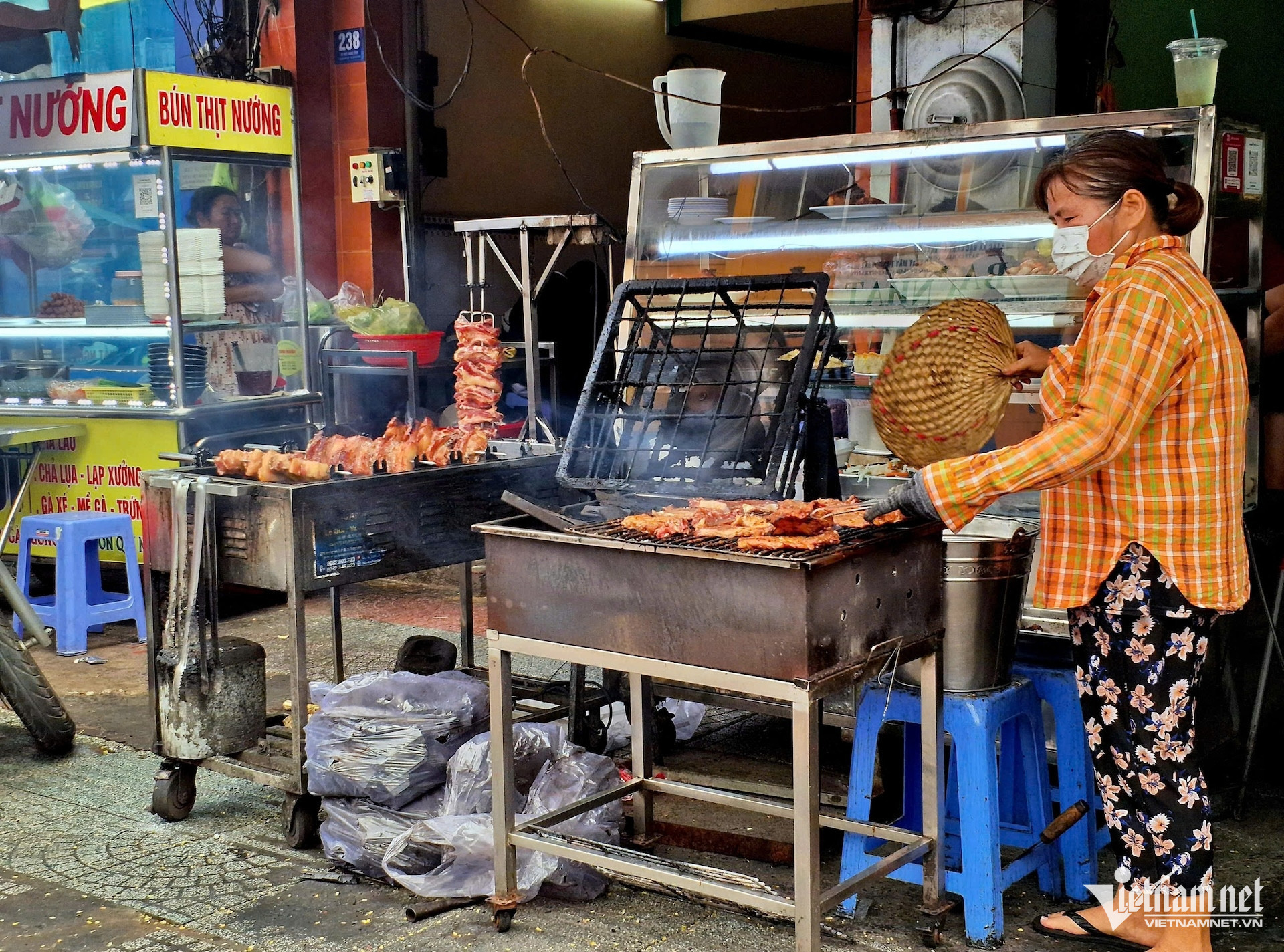
Around 11am every day, residents living along Nguyen Gia Tri street (HCMC) have to endure smoke from meat-grilling stoves in the middle of the city. To attract diners, many eateries place their outdoor grills on the sidewalk, fanning smoke into the shared space.
This image appears on many other streets of the city such as Xo Viet Nghe Tinh, Phan Xich Long and Do Xuan Hop.
Food stalls and street vendors take advantage of sidewalks, turning public space into their own private business areas. For example, the Dien Bien Phu stretch from HCMC University of Technology to Hong Bang University and University of Economics and Finance is always messy, with trash dumped indiscriminately and sidewalks completely occupied by food vendors.
Nguyen Van Hung from the Vietnam Association of Realtors (VARS) in HCMC said such business activities negatively affect shared urban space.
First, environmental hygiene has emerged as a major concern. Waste from eateries is often disposed of improperly, leading to pollution and even the risk of disease outbreaks in urban areas.
Second, public space is being severely narrowed. In particular, sidewalk encroachment has become widespread around traditional markets, leading to the formation of so-called “street markets”, or disorderly trading areas.
At major markets such as Tan Binh Market, Ba Chieu Market, and many others, the rampant sale of fresh food and the opening of eateries have turned public space into private zones, causing urban chaos.
“Vietnamese cities already face high population pressure. Now they are being ‘uglified’ by disorder and a lack of planning. If not controlled, this situation could reduce investment and tourism,” Hung said.
A livable place
To solve this urban "pathology," according to Architect Khuong Van Muoi, developing living spaces in other areas to attract people is what needs to be done. In those living spaces, if people have jobs, medical facilities, or entertainment venues, they will limit their movement to the city center.
In new urban projects, investors' compliance with regulations on living area and greenery density also helps ensure the living space of residents.
"The formation of Phu My Hung urban area helped develop the southern part of the city, reducing population pressure on the center. At the same time, opening roads connecting districts 4, 6, and 8 (former name) also increased traffic connectivity," he cited as an example.
The representative from VARS said large and modern urban areas have proven effective with designs that integrate parks, wide walkways, and separate business areas, avoiding sidewalk encroachment.
In a society aiming for sustainable civilization, the formation of such urban areas becomes very necessary. These are places that integrate amenities such as supermarkets, schools, hospitals, and playgrounds, while ensuring fresh air thanks to advanced waste treatment systems and specifically planned green patches.
Professor Nguyen Quang Trung from RMIT University Vietnam believes that the Transit-Oriented Development (TOD) model is expected to restructure urban space.
In HCMC, by 2035, about 355km of urban railways are expected to connect the city center with satellite towns.
Investment in infrastructure and population deconcentration is seen as a fundamental solution to help reduce pressure on the city center.
Duong Thuy Dung of CBRE Vietnam said, after the merger, the city's infrastructure has increasingly developed. Expansion and population deconcentration are effective steps to create more housing supply and real estate with diverse choices for buyers. Increased supply will also contribute to reducing house price levels in the market
Cao Thi Thanh Huong from Savills Vietnam said that instead of directly intervening in the pricing strategy of real estate businesses, the State should act by removing legal obstacles, planning new economic zones, and investing in infrastructure to promote more even urbanization to draw people away from the center.
"This is a lesson for many countries. To successfully deconcentrate the population, one must start with infrastructure and urbanization," Huong said, adding that expanding urban space toward regional connectivity not only helps redistribute population density but also creates development room for segments suitable for real-stay buyers.
Tran Chung
.svg)
