 Vietnamnet.vn

 Podcast



Deputy Prime Minister Ho Quoc Dung, government officials, representatives of the Ministry of Science and Technology and CMC Technology Group officially launch the Clex legal AI platform.
CMC Technology Group officially launched Clex, a Make in Vietnam artificial intelligence (AI) platform specializing in legal services, in Hanoi on November 25.
Under the theme "Mastering Legal Knowledge - Building a Civilized Society," the launch marks a significant step in Vietnamese enterprises' efforts to master specialized AI technologies and address practical challenges in law, governance and public service delivery.
The ceremony was attended by Deputy Prime Minister Ho Quoc Dung, Deputy Minister and Chairman of the Government Office Tran Anh Tien, Deputy Minister of Science and Technology Tran Trung Tinh, and Gum Ki Ho, CEO of Samsung SDS Vietnam & APAC.
Representatives of central ministries and agencies, experts, scientists and members of the business community also attended the event.
Representing CMC were Nguyen Trung Chinh, Chairman of the Board of Directors and Executive Chairman of CMC Technology Group, alongside the group's leadership, member companies and product development teams.
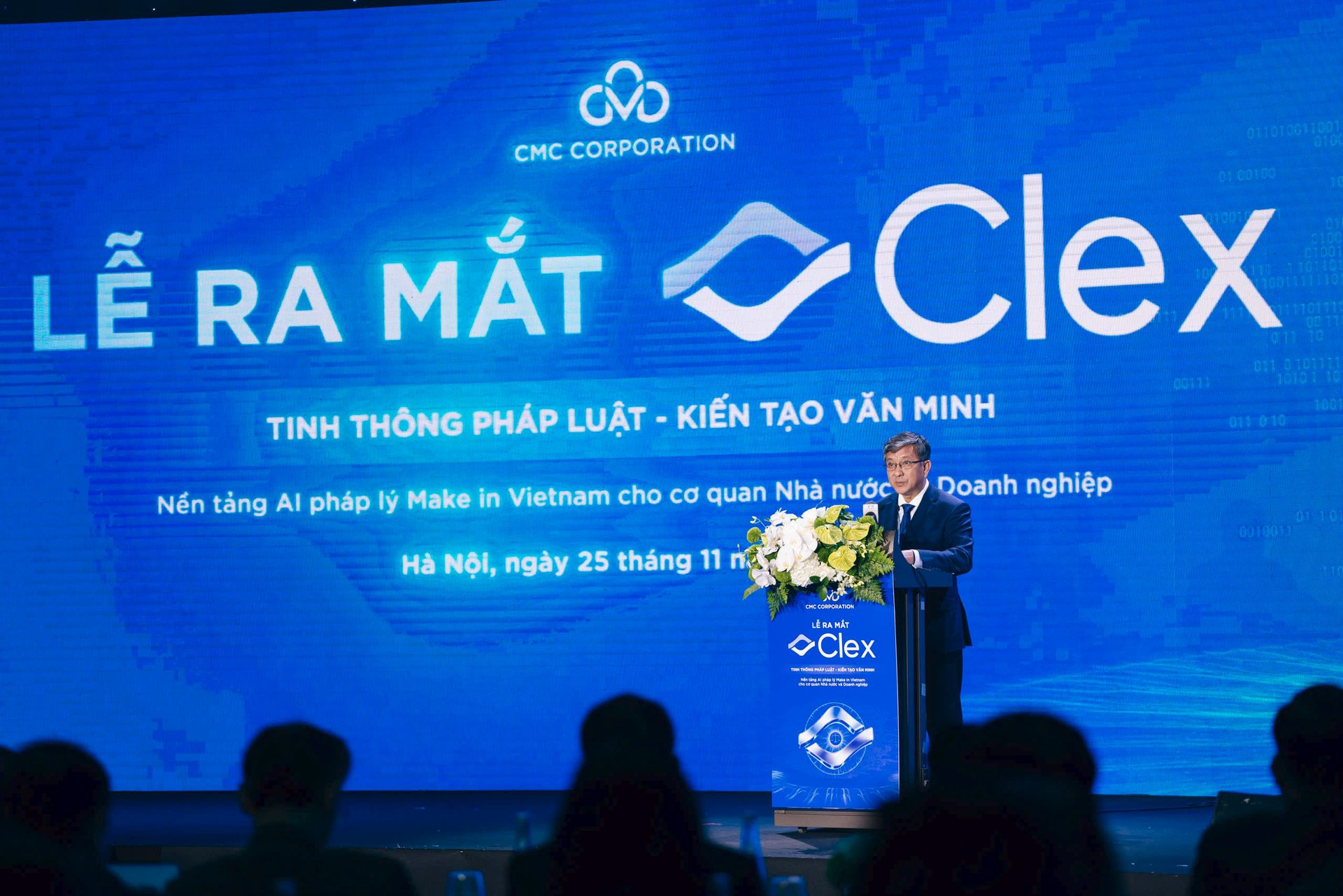
Deputy Minister of Science and Technology Tran Trung Tinh speaks at the launch ceremony.
Applying AI to legal services and public administration
As legal systems become increasingly complex and regulations are frequently updated, the need to accurately search, cross-reference and apply legal documents is placing considerable pressure on government agencies, public officials and businesses.
AI applications in the legal sector offer new ways to access and utilize legal knowledge, enabling faster and more efficient workflows.
Developed by CMC, Clex is powered by a large language model (LLM) specializing in Vietnamese law, trained and fine-tuned on a knowledge base of more than two million legal documents.
Beyond conventional search and question-and-answer functions, the platform can understand context, perform legal reasoning and provide source references for users to independently verify its responses.
Clex comprises two product lines: Clex GOV for government agencies and Clex ENTERPRISE for businesses.
For government agencies, the platform supports legal research, information synthesis, document drafting, comparison and appraisal, while helping identify inconsistencies and overlapping regulations.
It also assists public officials in preparing recommendations, processing administrative dossiers and handling administrative procedures.
For businesses, Clex can integrate internal documents and support legal research, contract reviews, regulatory change monitoring, impact assessments and the identification of compliance obligations.
At the launch ceremony, delegates experienced the platform's key features firsthand through practical demonstrations covering legal research, knowledge extraction, document processing and review.
The demonstrations also highlighted Clex's ability to cite legal grounds, allowing users to verify its outputs.

Dang Van Tu, CEO of CMC AIX, introduces Clex's development journey and practical applications.
Government emphasizes accuracy, effectiveness and security
Speaking at the event, Deputy Minister of Science and Technology Tran Trung Tinh said researching regulations, cross-referencing legal provisions, reviewing documents and preparing dossiers are among the daily responsibilities of public officials and civil servants.
AI can help them perform these tasks more quickly and accurately, contributing to consistent law enforcement.
Tinh welcomed the approach of mobilizing private-sector resources to develop AI platforms supporting public services, rather than relying entirely on state investment or appointing a single technology provider.
The Ministry of Science and Technology has established evaluation criteria and a 31-member evaluation council comprising representatives of four ministries and agencies, along with independent experts.
Businesses voluntarily submit their products for evaluation, with qualifying platforms subsequently approved for deployment.
The approach helps reduce public expenditure, avoid overlapping investments and leverage domestic technological capabilities.
Following the evaluation process, two platforms, including Clex, were found to meet the requirements. Both were developed by Vietnamese enterprises that own and control their AI models and operate them on infrastructure located in Vietnam.
To ensure effective deployment, Tinh urged CMC to focus on three priorities: information accuracy, practical effectiveness and information security.
Legal data must be updated promptly, while AI-generated responses must clearly identify their legal grounds and the validity of relevant documents. Where sufficient legal grounds are unavailable, the system must explicitly acknowledge this limitation.
CMC should also maintain independent evaluations, collect user feedback and promptly address errors.
Regarding practical effectiveness, the company was encouraged to coordinate with relevant agencies to identify tasks requiring AI assistance, provide training and monitor indicators such as processing times, dossier quality and frequency of use.
The platform must also be accessible and suitable for working conditions at the grassroots level.
On information security, Tinh called for strict controls over data access and user permissions.
He stressed that AI remains a supporting tool. Public officials and civil servants must independently verify its outputs and remain accountable for their recommendations and decisions.
In the longer term, CMC should continue investing in research personnel and collaborating with legal experts to improve product quality.
The platform's success should ultimately be measured by its practical effectiveness and the tangible benefits it delivers to public administration.
As of November 20, the shared AI platform supporting public services, which includes Clex and AI Luat, was providing hundreds of thousands of active accounts across 17 central-level ministries and agencies and all 34 provinces and centrally governed cities.

Nguyen Trung Chinh, Chairman of the Board of Directors and Executive Chairman of CMC Technology Group, speaks at the event.
Turning legal knowledge into a competitive advantage
Dang Van Tu, CEO of CMC AIX, said Clex was developed around an understanding of three fundamental elements: users, the legal system and technology.
Through AI training programs for officials at the Government Office, ministries, departments and commune- and ward-level administrations, CMC gained firsthand insights into the practical challenges facing users.
These include identifying applicable regulations, determining whether legal documents remain valid, monitoring policy changes and establishing clear legal grounds for administrative decisions.
To address these challenges, CMC developed large language models and vision-language models (VLMs) specifically tailored to Vietnamese law.
The models were trained by CMC engineers and validated using the V-LegalBench evaluation benchmark.
Clex has been selected by the Ministry of Science and Technology for pilot deployment as part of the AI platform supporting public services.
The Ministry of Justice has also selected Clex to participate in a comprehensive review of legal normative documents and to be featured on the National Legal Portal.
Tu outlined five core values underpinning the platform: understanding, visibility, comprehension, convenience and advantage.
Clex can synthesize relevant regulations, provide comprehensive legal grounds and cite original documents for verification.
It also supports document reviews, identifies potential inconsistencies and overlaps within the legal system, and helps government officials and businesses better understand applicable regulations.
The platform integrates with familiar working tools, including Microsoft Word, Hanoiwork in Hanoi and software systems currently used in Hai Phong.
As of November 2026, Clex had been deployed across all 34 provinces and centrally governed cities, 17 ministries and ministerial-level agencies, and the Office of the National Assembly.
According to Tu, this demonstrates growing demand for legal AI applications and provides a foundation for expanding access to the technology among government agencies, organizations and businesses of different sizes.
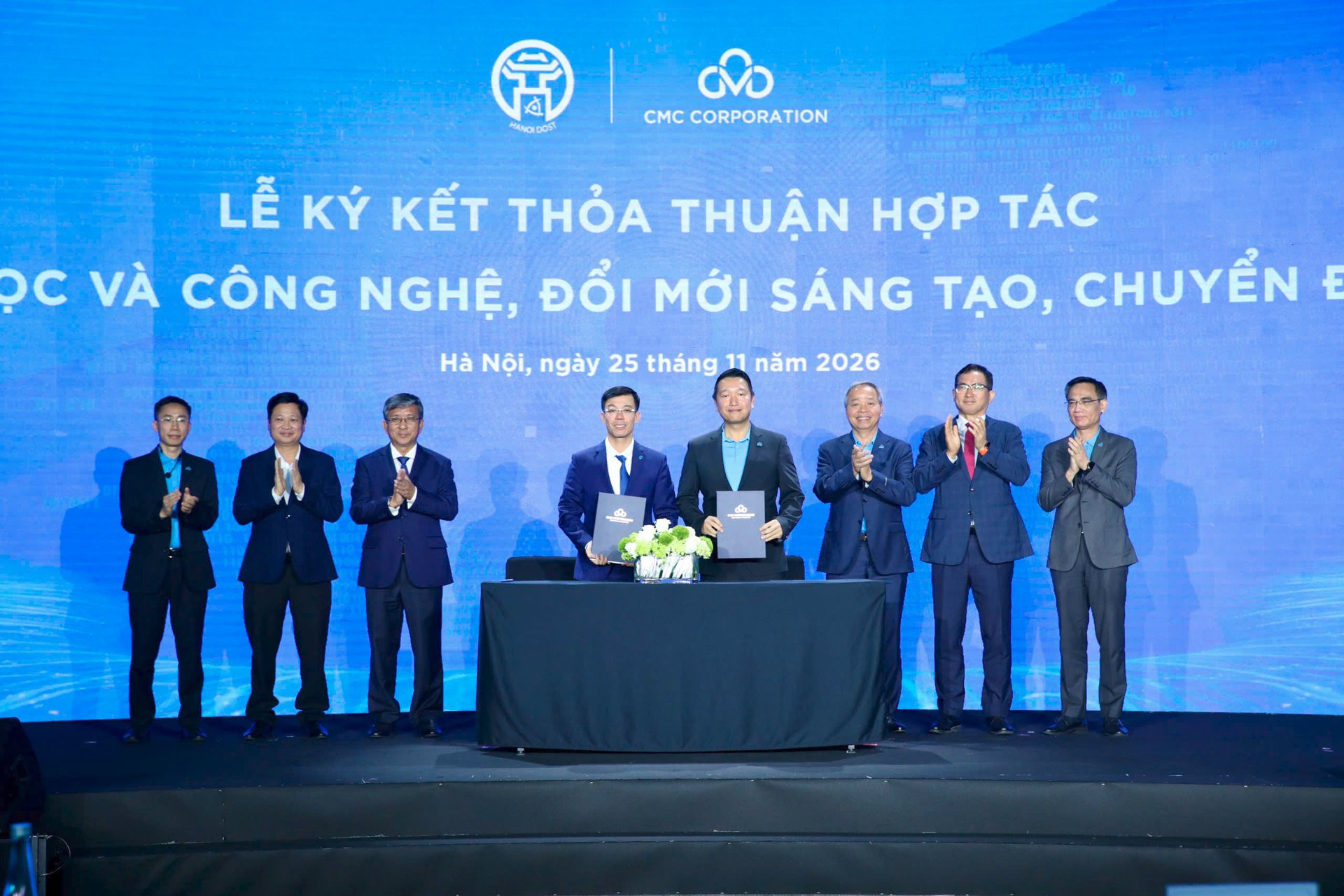
Dang Tung Son, EVP/CEO of CMC Technology Group, and Cu Ngoc Trang, Director of the Hanoi Department of Science and Technology, sign a cooperation agreement to promote Clex and Vietnamese-developed AI solutions.
CMC commits to mastering core AI technologies
Nguyen Trung Chinh, Chairman of the Board of Directors and Executive Chairman of CMC Technology Group, expressed appreciation for the government's recognition and support of the company's research and development efforts.
He emphasized that the commercial launch of Clex marks only the beginning of its development journey.
The true value of a technology product, he said, lies not in its advanced features but in the practical benefits it brings to people and society.
CMC has committed to continuing investment in core technologies while improving Clex's accuracy, reliability, security and accessibility, with citizens and users at the center of its development strategy.
The group aims to make the platform available to public officials and civil servants to improve public service delivery, help businesses reduce compliance costs and strengthen governance, and enable citizens to access and understand the law more conveniently and equitably.
CMC will also strengthen cooperation with government agencies, research institutions and the business community to further improve the platform and deliver practical benefits.
Expanding partnerships to accelerate AI adoption
As part of the launch event, CMC signed cooperation agreements on science, technology and innovation with the Hanoi Department of Science and Technology.
The agreements aim to promote research and deployment of Clex and other Make in Vietnam AI solutions in public administration, digital transformation and legal support for businesses and citizens.
The partnership represents a further step toward expanding the application ecosystem for Vietnamese-developed AI technologies and addressing the practical needs of individual agencies and organizations.
By mastering infrastructure, data and AI models while developing specialized applications, CMC aims to deliver reliable technology solutions that serve government agencies, businesses and citizens.
The initiative is also expected to accelerate AI adoption in governance and law enforcement, strengthen respect for the rule of law and contribute to sustainable social development.

