 Vietnamnet.vn

 Podcast



Big strikes are on the horizon until the year’s end as economic woes bite hard.
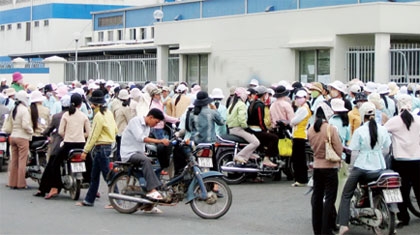
Minister of Planning and Investment Bui Quang Vinh said that now was the
time for enterprises to give more incentives to workers and shun
potential strikes.
“Strikes are often seen in enterprises offering low salaries and
allowances, especially amid many enterprises trying to cut production
costs,” Vinh said.
On July 20, nearly 1,000 workers from Taiwanese-backed footwear maker
Cu Bach Company in northern Haiphong port city launched a strike
demanding a pay rise and removal of severe working conditions. After the
strike, the company’s leaders vowed to meet the workers’ demand.
In another case, hundreds of workers from British-backed jewellery
presentation box maker Hanoi International Packaging Corporation in
Hanoi’s Ha Dong town launched a two-day strike in mid-July. The strike
came after one female worker fell ill, but the company’s leaders did not
allow a rest. Also workers enjoyed no allowances and meager salaries.
Also, on June 7 workers fromCanon Vietnam Company in Hanoi’s Thang Long
Industrial Park demanded a bigger pay rise and a reduction in working
hours. As a result, workers’ some requirements were met, with the
monthly salary raised from VND2.45 million ($117.7) to VND2.7 million
($129.8) and allowance tripled from VND50,000 ($2.4) per month.
On June 6, hundreds of workers from Vietnam-Britain Dacotex Garment
Export factory in central Quang Nam province’s Chu Lai Economic Zone
went on strike to protest the factory’s salary reductions. Meanwhile,
workers had to work overtime with low salary and without social
insurance packages.
“Strikes can happen at any time, especially at a time enterprises are
trying to pare down operational costs and workers’ allowances,” said
Quach Thi Nhung, head of South Korean-backed garment maker K.J Vina
company’s Human Resources Division. “K.J Vina has had to raise
allowances and salaries for workers,” she told VIR.
She said in Binh Duong, a hotspot for strikes, if workers saw others
going on strike, they would launch copy cat strikes, though they had
inked labour contracts.
According to Ho Chi Minh City Department of Labour, Invalids and Social
Affairs, the city witnessed 45 strikes during this year’s first five
months involving over 25,000 workers. Some 32 strikes were in such
labour intensive sectors as garments and textiles, footwear and wood
processing mostly in South Korea and Taiwan - invested firms.
The Ministry of Labour, Invalids and Social Affairs reported that this
year’s first five months saw 228 strikes in 25 cities and provinces
nationwide, down nearly 5 per cent against 2011’s first half.
VIR
.svg)
