 Vietnamnet.vn

 Podcast



President of the European Council Antonio Costa arrived in Hanoi on January 28, beginning his official visit to Vietnam at the invitation of President Luong Cuong. The two-day visit, from January 28 to 29, is set to reinforce the growing strategic partnership between Vietnam and the European Union.
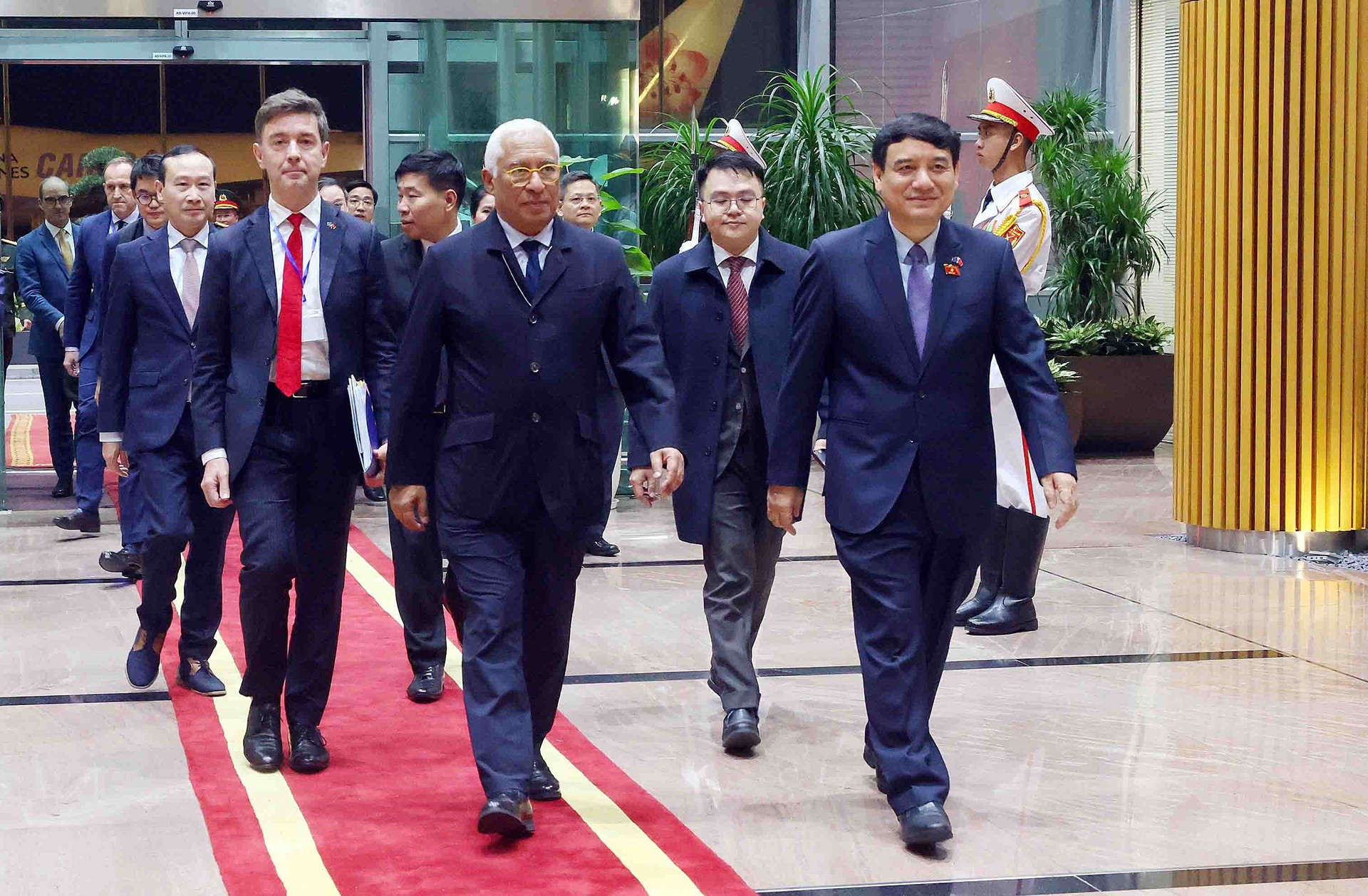
At Noi Bai International Airport, Costa and his delegation were welcomed by Nguyen Dac Vinh, Chairman of the National Assembly’s Committee for Culture and Social Affairs; Deputy Minister of Foreign Affairs Nguyen Manh Cuong; Ambassador Nguyen Van Thao, Head of Vietnam’s Mission to the EU; and Julien Guerrier, Ambassador of the EU to Vietnam.
Costa is accompanied by senior officials including Anna-Maria Boura, Chief Foreign Affairs Advisor; Veronika Şentürk Musilová, Foreign Policy Advisor; and Maria Tomasik, Spokesperson.
On January 29, Costa will meet with key Vietnamese leaders and participate in several official events in Hanoi.
A visit amid global uncertainty - and opportunity
Ahead of his arrival, Costa described the visit as a landmark moment occurring during “a time of uncertainty.” In a world where mutual trust between nations can no longer be taken for granted, he emphasized the importance of reliable and predictable partnerships.
“In a world that is increasingly multipolar, multilateral cooperation must be grounded in trusted, stable relationships,” he said.
Costa’s visit coincides with a significant transition in Vietnam’s political landscape, as the 14th National Party Congress recently outlined the country’s long-term development strategy.
Vietnam is one of the EU’s most important partners in the Indo-Pacific region. Since establishing diplomatic relations in 1990, the two sides have built one of the EU’s most dynamic and wide-ranging partnerships in Asia, spanning trade, sustainable development, innovation, governance, security, and people-to-people exchange.
A prime example of this progress is the EU-Vietnam Free Trade Agreement (EVFTA). In effect since 2020, the agreement has boosted two-way trade by approximately 40% in just five years.
“Our relationship has outgrown its current framework,” Costa said. “It is time to elevate our partnership.”
He added that this upgrade would reflect the reality of the growing EU-Vietnam relationship and provide a solid foundation for deeper collaboration in key areas such as green energy, advanced technology, workforce skills, and security.
Vietnam’s growing global role
Costa emphasized that for the EU, upgrading the relationship signals recognition of Vietnam not just as a fast-growing economy but as a strategic partner with a vital role in regional stability and global connectivity.
EU Ambassador to Vietnam Julien Guerrier noted that the timing of the visit - immediately following Vietnam’s 14th Party Congress - demonstrates how highly the EU values its relationship with Hanoi. Over the past 35 years, the relationship has evolved from early humanitarian support to a multi-faceted, deep strategic engagement.
Guerrier expressed optimism that the visit could usher in “a new era” for EU–Vietnam relations. This new chapter, he said, would be symbolized by a shared ambition to elevate the partnership.
Three key pillars - and bold new fronts
The EU seeks to reinforce three existing pillars of cooperation: trade, green transition, and peace and security.
EVFTA has already delivered a 40% increase in bilateral trade over five years. The EU is eager to build on that success, especially at a time when global trade is facing headwinds.
In the green transition, the EU plans to deepen support for Vietnam’s renewable energy goals, helping the country enhance its energy independence and security - aligning with policy directions set at the 14th Party Congress.
In terms of peace and security, the EU aims to move beyond peacekeeping cooperation into broader areas such as maritime security, crisis management, and the promotion of international law, including in the East Sea.
Beyond these core areas, the EU is also keen to explore new sectors of collaboration, including digital transformation, innovation, and cutting-edge technologies such as semiconductors, artificial intelligence, and critical raw materials.
With shared aspirations and mutual trust, both sides appear ready to move their relationship to a higher strategic level - one that not only reflects past achievements but also prepares for future challenges and opportunities.
Tran Thuong
.svg)
