 Vietnamnet.vn

 Podcast



Exports were a surprise good news story for Vietnam’s economy in 2011, but
this year looks set to be a whole lot tougher.
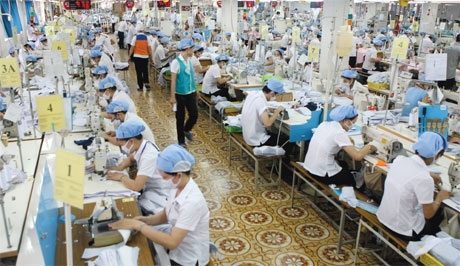
Textile makers are in the same boat as many other local
exporters in expecting a turbulent 2012
The Ministry of Industry and Trade (MoIT) has forecasted that Vietnam’s total
export revenues for 2011 could hit a record-high $96 billion, a figure which
would also mean a on-year increase of 33 per cent.
This number is also a
23 per cent rise on the annual target set by the National Assembly.
The
ministry estimated that the country’s total import-export revenues would exceed
$200 billion in 2011 or almost doubling 2010’s GDP.
Vietnam has also
taken over from the Philippines as the fifth largest importer and exporter in
South East Asia, after Singapore, Thailand, Indonesia and Malaysia. In 2011,
Vietnam’s export activities defied market difficulties and trade barriers with
major export products managing to chalk up high export turnover which exceeded
initial set targets.
Textile and garments topped the table with total
export turnover of $14.2 billion, a on-year rise of 26.7 per cent. In 2011,
leather exporters earned $6.4 billion while shippers of aquatic products raked
in $6.2 billion, making year-on-year increases of 15.6 per cent and 19 per cent,
respectively.
“In 2011, Vietnam’s textile and garment sector surpassed export
targets by $500 million,” said Le Tien Truong, deputy general director of
state-run Vinatex.
The MoIT report also found that the country’s export
of mobile phones reached $7.5 billion, mostly from Samsung Electronic Vietnam,
giving this item the second place in Vietnam’s table of export products in
2011.
Prices of Vietnam’s major export products saw a sharp increase that
boosted the country’s export revenues by $7.2 billion during the year. Rubber
prices, for example, were up 51.6 per cent year-on-year, coffee prices rose 51.4
per cent, while coal prices were up 17 per cent.
Estimates have Vietnam
incurring a trade deficit of more than $9.5 billion in 2011, but down 25 per
cent from 2010 and accounting for 9.9 per cent the country’s export revenue,
lower than the set 16 per cent target, according to the General Statistics
Office (GSO). The GSO also said that foreign invested enterprises in Vietnam
contributed a major part of 56.6 per cent of the country’s 2011 total export
earnings.
The MoIT said in 2011 exports were a bright spot for Vietnam’s
economy, but the on-going world economic crisis was set to make global demand
for goods and services sharply fall. Meanwhile, Vietnam’s key trade partners
including the US and the EU, both of which have accounted for about 70 per cent
of Vietnam’s total exports, are more deeply falling into recession.
The
head of Vietnam Economics Institute Tran Dinh Thien warned that Vietnam’s
import-export activities would face a tougher year in 2012 because of the global
economic crisis.
The International Monetary Fund forecasts have global
growth for 2012 at 4 per cent against 4.3 per cent last year. Citigroup is
cutting its global growth forecast to 2.9 per cent, while Goldman Sachs said
2012 global growth forecast would be 3.5 per cent.
Vo Tri Thanh, deputy
chief of the Central Institute for Economic Management, said the current debt
crisis in Europe and the global economy made things very challenging.
Truong said the fall in demand in the US and the EU, which account for
51 and 17 per cent, respectively of Vietnam’s textile and garment export market
would rock domestic garment and textile production in 2012. This sector
accounted for more than 16 per cent of Vietnam’s total export turnover for last
year.
Cao Sy Kiem, chairman of the Vietnam Association of Small and
Medium-sized Enterprises (SMEs), feared that domestic enterprises would struggle
to hit their targets in 2012 in the context of rising production costs and
lacking investment capital as a result of the government’s continual monetary
tightening policies.
The Vietnamese government plans 2012 export growth
of 12-13 per cent rate, far lower than 2011’s. Meanwhile, import turnover for
2012 is projected to rise by 14 per cent, far lower than 2011’s 23.8 per
cent.
MoIT Deputy Minister Nguyen Thanh Bien said the ministry would work
closely with the business community to promote exports of several key
manufacturing products to offset the anticipated falls in export revenues of the
country’s crucial agricultural products.
Bien was optimistic, saying the
problem for the Vietnamese exports would not be a decrease in demand from
foreign clients, since the country’s exports were largely served the people’s
mostly essential items. The problem however would be a tumble in prices of
export items, particularly key agricultural produce such as rubber, coffee and
rice.
The export turnover for made-in-Vietnam agricultural and aquatic
products in 2012 is targeted to rise 3.6 per cent on-year to $20.2 billion. Rice
export is expected to reach $3.5 billion with seven million tonnes being shipped
abroad.
The targets are $16.5 billion for textile and garments, up 16 per
cent and $7.3 billion for shoes, up 14 per cent. Meanwhile, electronics and
components exports are expected to hit $5 billion in 2012 as Intel Vietnam
Company comes online.
VIR
.svg)
