 Vietnamnet.vn

 Podcast



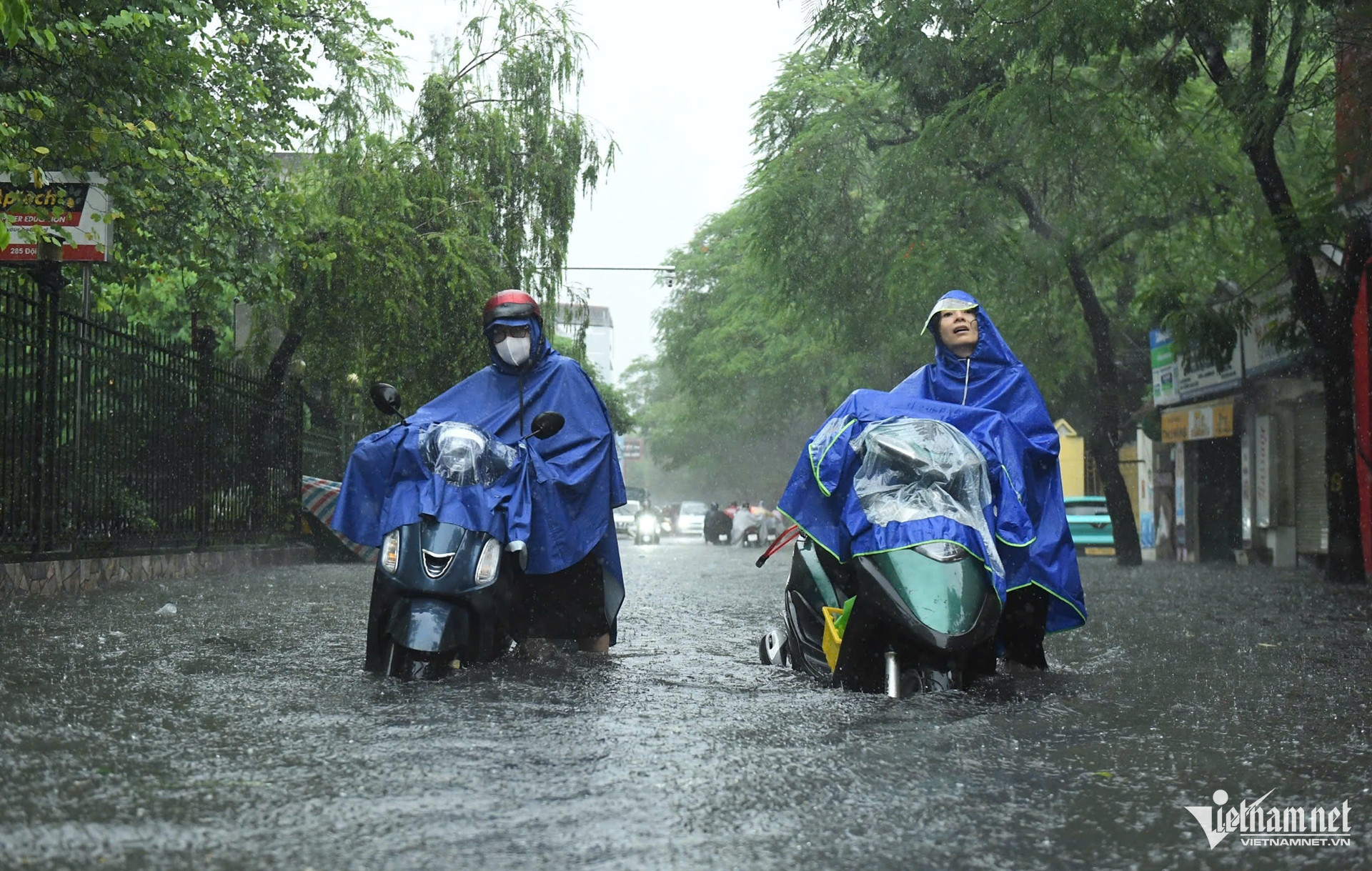
According to Mai Van Khiem, Director of the National Center for Hydro-Meteorological Forecasting, the process of producing weather forecasts - covering meteorology, hydrology and marine conditions - is carried out under both normal and hazardous scenarios. All forecasts follow a standardized eight-step professional procedure.
Nguyen Van Huong, Head of Weather Forecasting, explained that the atmosphere is inherently chaotic, meaning forecasting models always carry a degree of uncertainty. Forecasters do not rely mechanically on any single model but instead follow a rigorous process, combining multiple data sources with practical observation and experience.
Quantifying rainfall for a single event, especially over a small area, remains particularly difficult.
Huong noted that forecasting localized heavy rain, flash floods or landslides is extremely challenging due to their small spatial scale and rapid development. Flash floods often occur in confined areas and can develop within minutes to hours after rainfall begins, leaving very little time for early warning.
Terrain and geological complexity add further difficulty. Each mountain slope has a different capacity to absorb water, so determining when soil becomes saturated enough to trigger landslides requires detailed data on slope gradients, soil types and vegetation at specific locations.
In addition, estimating rainfall amounts for small areas - such as a province, district or commune - is highly complex. Current warnings for flash floods and landslides are therefore typically issued in terms of risk levels, such as very high, high or moderate, rather than precise predictions.
Phung Tien Dung, Head of Hydrological Forecasting, emphasized that modern forecasters are not only responsible for predicting weather but also for assessing risks and communicating information clearly. This helps authorities and the public take proactive measures.
“Each forecast bulletin is both a professional product and a social responsibility, aimed at protecting lives, property and livelihoods,” Dung said.
The role of AI in forecasting
The National Center for Hydro-Meteorological Forecasting is currently using AI as a “digital assistant,” supporting forecasters in both technical and operational tasks. AI helps reduce repetitive work and minimize technical errors, allowing experts to focus on analyzing complex and high-risk situations.
Huong stressed that AI is unlikely to replace human forecasters in the near or medium term. While AI excels at processing large volumes of data, analyzing information from models, satellites and radar, and identifying patterns, it still has limitations.
Meteorology is characterized by high uncertainty, and climate change is producing unprecedented extreme events that go beyond historical data - the very foundation on which AI systems rely. In unusual or “non-typical” situations, AI may fail to fully recognize emerging risks, whereas human forecasters can draw on experience, intuition and local knowledge to make informed decisions.
“Forecasting is not just about reading data. It involves evaluating, questioning, verifying against observations and selecting the most appropriate scenario,” Huong said.
Forecasters also advise authorities on critical decisions such as evacuations, reservoir operations and port closures, while explaining developments to the media and updating forecasts as conditions evolve - responsibilities that require practical understanding and accountability beyond AI capabilities.
Huong emphasized that AI is becoming increasingly important in hydro-meteorology, improving speed and accuracy. However, it is not a replacement for humans. The most effective model for the future will be a combination of “AI and human forecasters,” where technology supports decision-making, but humans remain the final authority.
The eight-step process for producing a weather forecast bulletin includes collecting and processing data; analyzing current conditions; developing forecast and warning scenarios; conducting discussions; compiling forecast bulletins; disseminating information; updating forecasts; and evaluating forecast quality.
Bao Anh
.svg)
