 Vietnamnet.vn

 Podcast



Guided by a Chinese national, Le Van Tuan and his accomplices withdrew more than VND8 billion (US$326,000) from multiple Visa cards belonging to other individuals, using the money for personal spending.
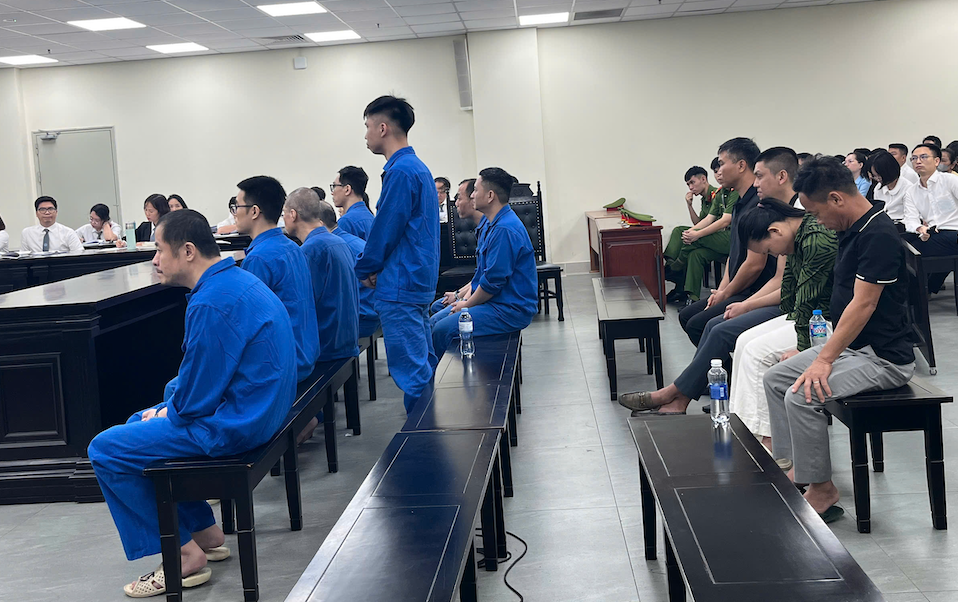
On April 8, the Hanoi People’s Court brought 13 defendants to trial in a first-instance hearing on charges of using computer networks and electronic devices to appropriate assets, as well as money laundering.
According to the indictment, in late 2021, Le Van Tuan (born 1989, residing in Ha Dong ward, Hanoi) became acquainted with Tang Weidong, also known as A Tang, a Chinese national.
By the end of 2022, A Tang contacted Tuan via WeChat, claiming access to compromised international Visa card data. He sought Vietnamese bank accounts linked to the “Tap to Phone” application and POS machines to process fraudulent transactions, allowing them to withdraw funds from cardholders’ accounts and split the proceeds.
After agreeing to participate, Tuan was instructed on how to extract money from Visa cards using smartphones such as iPhones or Samsung devices equipped with contactless payment functions. He logged into iCloud accounts and entered the stolen card details provided by A Tang into the phones.
In early 2023, Tuan purchased multiple such devices and began executing the scheme.
He acquired iCloud accounts from an individual named Hieu (whose identity remains unknown) and installed them on the phones. A Tang would then initiate video calls to read out Visa card details for Tuan to input. When one-time passwords (OTPs) were required, A Tang supplied them in real time.
Once the cards were successfully added, Tuan used the phones to process payments through rented POS machines under A Tang’s supervision.
If a transaction succeeded, Tuan collected cash from the POS machine owners, transferred the funds into bank accounts registered under his name or those of accomplices, then used the money to purchase USDT. He sent 70% of the equivalent amount in USDT to A Tang, paid 10-25% to POS machine providers, and kept the remainder.
Using this method between February and October 2023, Tuan and his co-defendants appropriated more than VND6.2 billion (US$253,000). The indictment further states that, in addition to A Tang, Tuan collaborated with other unidentified foreign individuals using similar tactics to steal an additional VND2.3 billion (US$94,000).
After obtaining the illicit funds, Tuan used over VND375 million (US$15,000) to have co-defendant Hoang Manh Son purchase USDT for transfer to A Tang.
Business owner involved in the scheme
Among those tried alongside Tuan was Chu Thi Thu Huong (born 1995, from Thai Nguyen). Huong established VTN Vietnam Import-Export Joint Stock Company, specializing in durian trading, and was eligible to register for a “Tap to Phone” account.
In early 2023, Huong was living with her boyfriend, Vu Dinh Dinh (born 1987, from Hung Yen). At that time, Tuan approached Dinh seeking access to “Tap to Phone” accounts to process fraudulent transactions and withdraw money from victims’ accounts.
Dinh discussed the proposal with Huong, and they agreed that Huong would register the account in exchange for 12-15% of the total amount withdrawn.
Prosecutors stated that although Huong’s company conducted no legitimate business through the “Tap to Phone” account and she was fully aware that the transactions were fabricated, she was driven by the promise of profit and agreed to participate.
Between February 8 and March 18, 2023, VTN Vietnam Import-Export Joint Stock Company carried out 444 card transactions using Visa cards issued by foreign banks. Of these, 113 transactions were successful, totaling more than VND1 billion (US$41,000). Under their agreement, Huong transferred VND834 million (US$34,000) to Tuan, retaining 15% as profit shared between her and Dinh.
After deliberation, the trial panel on the afternoon of April 8 sentenced Tuan to 17 years in prison. Huong and Dinh received sentences of 8 and 12 years respectively. The remaining defendants were handed prison terms ranging from 2 years and 6 months to 12 years.
T. Nhung
.svg)
