 Vietnamnet.vn

 Podcast



Starting July 1, Ho Chi Minh City will waive fares on 134 intra-city bus routes. The policy is expected to provide a major boost for public transport by encouraging more residents to switch from private vehicles to buses.
This marks the first time the city has introduced a large-scale fare-free bus program. Authorities expect the initiative to attract more passengers, gradually change travel habits and lay the foundation for a modern public transport system.
Beyond reducing travel costs, the policy also supports the city's roadmap for transitioning to green buses, expanding the use of technology and strengthening future connections with the metro network.
Improved infrastructure, technology and electric buses enhance public transport
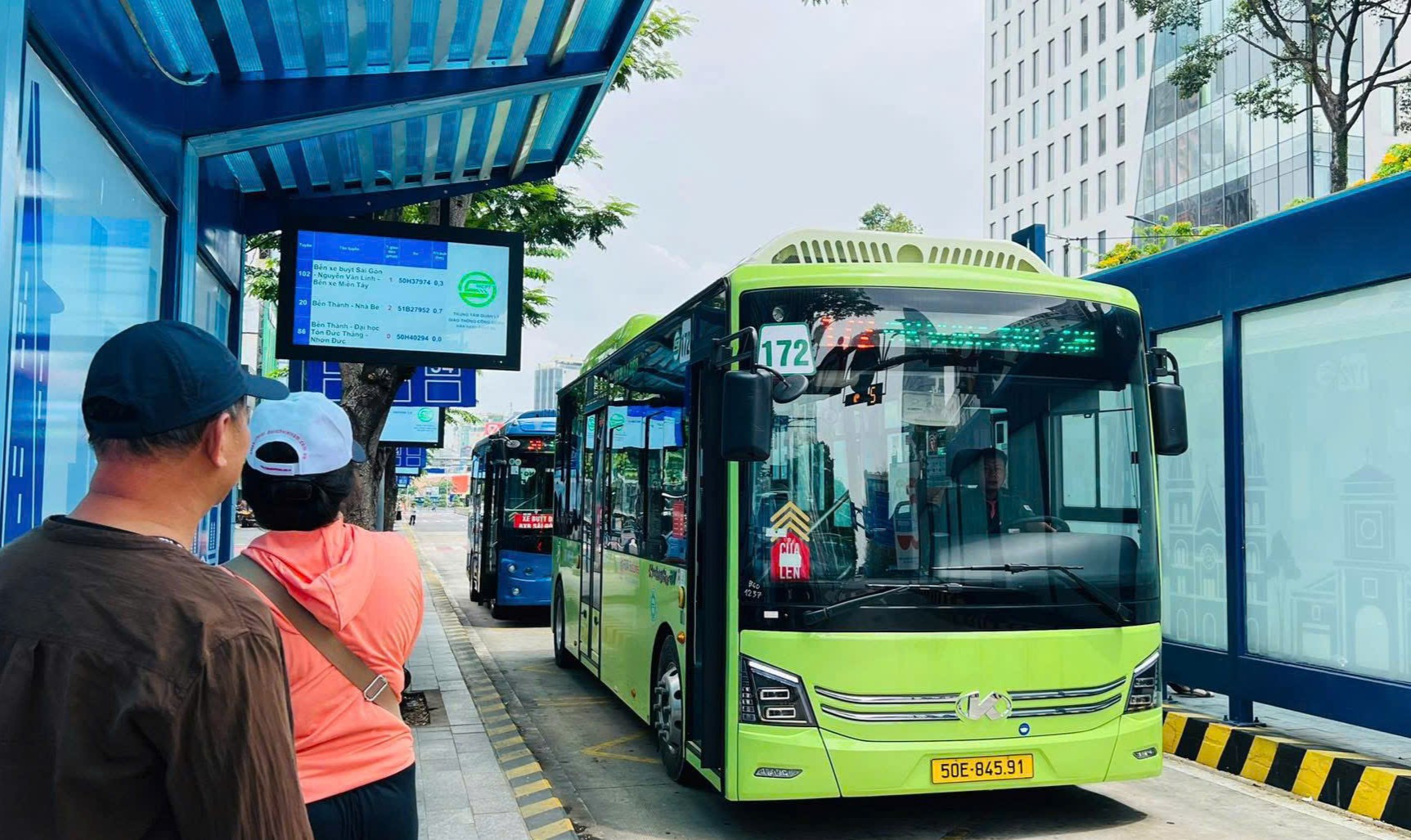
On a Monday morning, Hoang Nam, a resident of Dong Hung Thuan Ward, boarded Electric Bus Route No. 4 between Ben Thanh and An Suong. After tapping his bank card to pay, he opened the MultiGo application to monitor the journey.
According to Nam, traveling has become much more convenient since the route switched to electric buses, leading him to leave his motorbike at home more often.
"The buses run quietly, the stops are close to my home, and arrival times are quite accurate thanks to the tracking app. I no longer have to ride through traffic and pollution or worry about finding parking," he said.
Similar improvements can be seen at Saigon Bus Station, where facilities have been upgraded with covered waiting areas, electronic information boards, landscaped greenery and improved passenger amenities.
Minh Khanh, 62, said finding bus routes is now easier than before, while the waiting areas are cleaner and more convenient for older passengers.
"The information boards are clear, and the restrooms are clean, so waiting for the bus is much more comfortable," she said.
According to transport experts, fare-free travel may encourage people to try buses, but retaining passengers over the long term will depend primarily on service quality, convenient route connections and reliable travel times.
VND665 billion allocated for the program
Under the plan, Ho Chi Minh City will allocate around VND665 billion from its budget during the second half of 2026 to fund free fares across 134 intra-city bus routes.
The program will be implemented in two phases. From July 1 through September 30, all passengers can travel free of charge. From October 1 through the end of the year, passengers will be required to verify their identity using a citizen identification card, a VNeID account or the MultiGo application when using the service. The data will support management, operations and evaluation of the program's effectiveness.
Tran Quang Lam, Director of the Ho Chi Minh City Department of Construction, said the fare-free policy is one of several measures designed to encourage greater use of public transport and gradually reduce dependence on private vehicles.
Ho Chi Minh City currently operates around 180 bus routes with more than 2,432 buses. Of these, approximately 1,649 vehicles use electricity or environmentally friendly fuels, accounting for nearly 70% of the fleet.
Under the city's transition roadmap, all intra-city buses will operate on electricity or clean energy from January 1, 2027. During 2027-2028, buses powered by compressed natural gas (CNG) will also be replaced with electric buses, with the goal of having all intra-city and inter-provincial buses fully electrified by early 2029.
The Con Dao Special Zone and the communes of Binh Khanh, An Thoi Dong, Can Gio and Thanh An have been prioritized for the early rollout of this transition.
Free fares are only the first step
According to officials from the Ho Chi Minh City Department of Construction, developing urban public transport requires simultaneous improvements in bus quality, infrastructure, technology and measures to gradually reduce reliance on private vehicles.
Under the city's long-term strategy, buses will serve as feeder services connecting passengers to the urban railway network.
Under targets set by the Politburo, Ho Chi Minh City aims to develop approximately 200 kilometers of urban railway by 2030. Once the metro and bus networks are fully integrated, authorities expect public transport usage to increase significantly, helping reduce congestion, lower emissions and support more sustainable urban development.
The fare-free bus policy is therefore viewed as the starting point of a broader strategy to build a modern public transport system rather than simply a measure to reduce commuting costs for residents.
Tuan Kiet
.svg)
