 Vietnamnet.vn

 Podcast



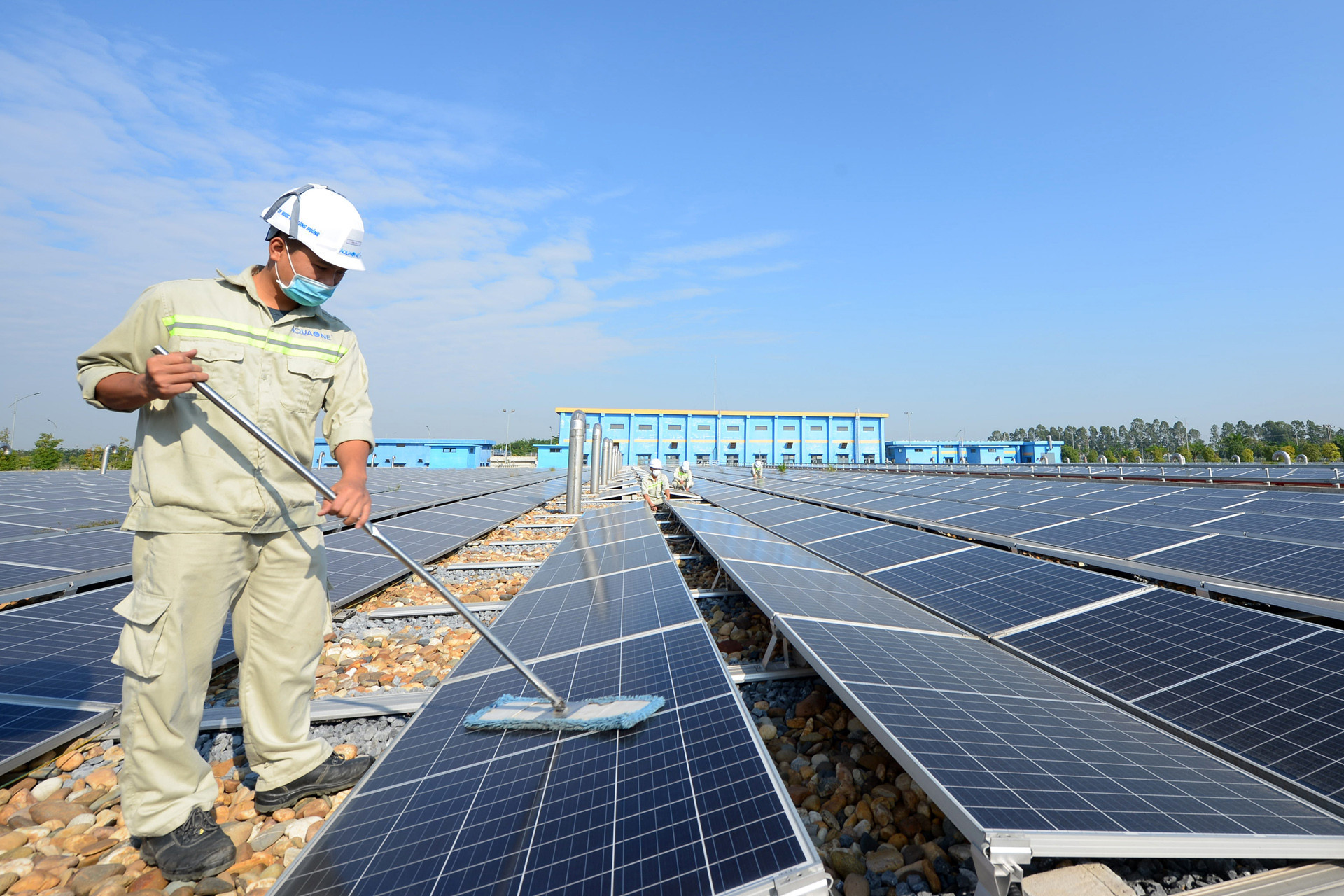
Solar panels cover the rooftops of many houses in HCMC. A homeowner said installing the system cost about VND200 million, but each month the solar output helps the family save around VND4 million on electricity bills. For the family, it is not just about saving money, but a profitable investment with visible monthly payback.
That one rooftop in HCMC reflects the broader power challenge of the entire economy. At the national scale, rooftop solar output reached 50.8 million kWh on April 7, accounting for 4.7 percent of total electricity generated that day, officially surpassing wind and biomass to become Vietnam’s fifth-largest power source.
The power system is still relying on traditional pillars: coal-fired power 626.6 million kWh (58.1 percent), hydropower 187.5 million kWh (17.4 percent), and gas turbines 102.9 million kWh (9.6 percent). Wind power generated only 38.3 million kWh (3.6 percent), biomass 5.2 million kWh (0.5 percent), and solar power 56.9 million kWh (5.3 percent).
This shows that traditional sources are still carrying most of the economy’s electricity growth.
What is worth noting is that when households invest their own money to cover rooftops with solar panels, they are not only calculating their family’s electricity bills. In a broader sense, people have begun to provide part of their own electricity before planning can catch up.
That is also why the story of electricity in the 2026–2030 period is no longer just about EVN or a few large energy corporations. It has become the capital problem for the entire economy.
At present, the country's peak electricity consumption capacity is 54,500 MW. With this elasticity coefficient, the system must add about 6,500–8,200 MW each year, equivalent to several gas-fired power plants like Nhon Trach 3–4.
That steep demand curve explains why the Plan 8 gives a very large figure: $136.3 billion for the 2026–2030 period, equivalent to about VND3.54 quadrillion for the development of sources and transmission grids.
Besides, from the source capacity scale of about 87,600 MW today, Vietnam must reach about 183,000 MW by 2030. This means the system must add nearly 95,400 MW in less than five years, a volume of construction almost unprecedented in the history of the electricity industry.
In the past five years, EVN has invested nearly VND500 trillion; specifically, in 2024 it disbursed VND112,892 billion, and in 2025 reached VND125,778 billion. Assuming that in the next four years EVN continues to maintain a pace of about VND125 trillion each year, the total capital this corporation can carry would be around VND500 trillion.
In other words, after subtracting the part of capital EVN can handle, the economy still must mobilize more than VND3 quadrillion for electricity in the next four years.
Next four years
Three quadrillion VND is a figure that is very difficult to imagine if it stands alone. But placed next to a more familiar image, the scale becomes very clear: the amount of capital that still must be spent on electricity in the next four years is about three times larger than the national highway "mega-construction site," from VND900 trillion to VND1 quadrillion over many years.
Three quadrillion VND for electricity is not just to avoid domestic power shortages. It is the energy foundation for the dream of double-digit growth, for semiconductor chips, data centers, AI, digital transformation, green transformation, and high-speed rail in the coming decade.
Looking from the rooftops covered with solar panels in HCMC, it can be seen that society has begun to take a step ahead on its own.
The rest now no longer lies on the rooftops of the people, but in the speed of institutional reform, opening up transmission, and building trust for social capital to flow into electricity.
Tam An
.svg)
