 Vietnamnet.vn

 Podcast



One is Samsung’s most advanced device unveiled at Unpacked, the other is Apple’s most expensive iPhone to date. Both rank among the best phones on the market, yet differences in design philosophy, display technology, performance and camera systems will ultimately shape user choice.
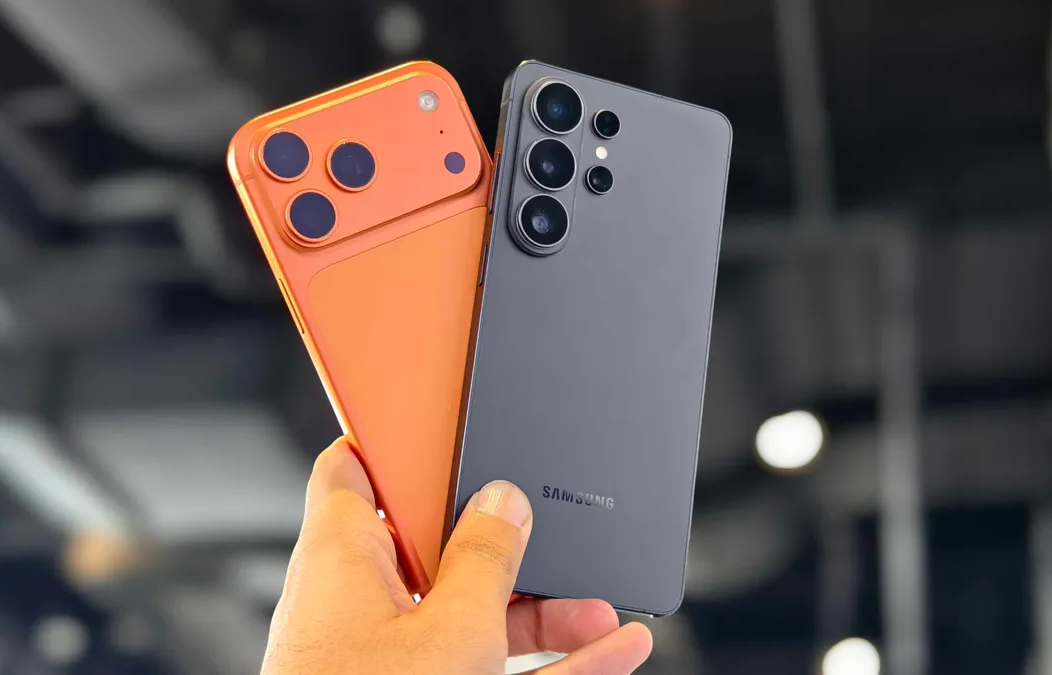
Galaxy S26 Ultra and iPhone 17 Pro Max. Photo: CNET
Display and design: Samsung leads in screen innovation
Galaxy S26 Ultra features a 6.9 inch AMOLED display with a resolution of 3,120 x 1,440 pixels and a dynamic 120Hz refresh rate. It continues to use Corning Gorilla Armor 2 glass to reduce reflections and glare, similar to its predecessor. This year’s most notable upgrade, however, is the new Privacy Display feature.
Samsung developed Privacy Display at the pixel level. The company arranges wide angle emitting pixels, which radiate light in multiple directions, alongside narrow angle pixels that project light directly toward the user. When activated, the narrow pixels emit light at a 90 degree angle, significantly limiting side viewing and preventing prying eyes.
Users can select specific apps or time frames for automatic activation, with two modes available: Partial Screen Privacy and Maximum Privacy Protection. At the highest setting, screen brightness is also reduced to enhance confidentiality.
Meanwhile, iPhone 17 Pro Max comes with a 6.9 inch OLED display, 2,868 x 1,320 pixel resolution and adaptive 120Hz refresh rate. Apple equips it with Ceramic Shield 2, which is less reflective than before. However, in terms of anti glare performance and display privacy, Samsung’s solution appears more comprehensive.
Both phones perform well under strong lighting conditions, though the S26 Ultra holds a slight edge due to lower reflectivity.
In design terms, Galaxy S26 Ultra measures 7.9mm thick and weighs 214g, noticeably slimmer and lighter than the 8.5mm, 233g iPhone 17 Pro Max. In hand, the iPhone feels denser and more solid. Both devices carry an IP68 rating for dust and water resistance.
Samsung offers the S26 Ultra in Cobalt Violet, White, Black and Sky Blue, with online exclusive options in Pink Gold and Silver Shadow. Apple opts for bolder finishes including Cosmic Orange, Deep Blue and Silver. The S26 Ultra comes with the familiar S Pen, while the iPhone 17 Pro Max features the Camera Control button and Action button for quick shortcuts.
Performance and AI: Snapdragon meets A series
Galaxy S26 Ultra is powered by the Qualcomm Snapdragon 8 Elite Gen 5 processor, paired with up to 16GB of RAM and storage options reaching 1TB. Samsung has redesigned its vapor chamber cooling system to improve sustained performance under heavy workloads, a factor often associated with gaming phones.
On Apple’s side, iPhone 17 Pro Max runs the latest A19 Pro chip, faster than last year’s A18 Pro. The chip integrates new neural accelerators to optimize AI processing. Storage options include 256GB, 512GB, 1TB and an industry leading 2TB configuration.
Samsung has upgraded Bixby with more natural conversation capabilities and improved contextual understanding. Users can ask questions such as “The screen is straining my eyes, what should I do?” and receive suggestions like enabling Eye Comfort Shield to reduce blue light.
Bixby works alongside Google Gemini, capable of tasks such as booking an Uber, though payment must still be completed manually. Samsung’s keyboard can also suggest context based actions.
Apple is preparing a more intelligent Siri update later this year. For now, the A19 Pro demonstrates strong AI efficiency thanks to tight hardware and software integration.
In terms of battery, Galaxy S26 Ultra carries a 5,000 mAh cell with 60W fast charging. iPhone 17 Pro Max features a 5,088 mAh battery and can charge from 0 to 69 percent using a 40W adapter.
Recent battery tests across 35 smartphones released in 2025 place iPhone 17 Pro Max at the top for endurance, a significant advantage for users prioritizing longevity.
Camera: Samsung’s versatility vs Apple’s refinement
Galaxy S26 Ultra retains a quad camera system similar to its predecessor but with improved apertures. It includes a 200MP main camera at f/1.4, wider than the previous f/1.7, a 50MP 5x telephoto at f/2.9, a 10MP 3x telephoto at f/2.4 and a 50MP ultra wide at f/1.9.
The 12MP front camera offers an 85 degree field of view. Samsung claims the larger aperture enhances low light photography and video, though real world testing will determine the true impact.
By contrast, iPhone 17 Pro Max is equipped with three 48MP rear cameras covering standard, ultra wide and 4x telephoto perspectives, with stabilized video recording available at up to 8x zoom. The most notable upgrade lies in the front camera positioned near Dynamic Island. Apple introduces a new square selfie camera that automatically switches between portrait and landscape framing without rotating the device, offering greater flexibility and creativity.
Samsung asserts that its AI ISP technology improves selfie quality, yet surpassing Apple’s renowned image processing and optimization remains a formidable challenge.
With a starting price of US$1,299 for Galaxy S26 Ultra and US$1,199 for iPhone 17 Pro Max, both represent substantial investments. Samsung stands out with pioneering display technology, a unique privacy feature and a versatile multi focal camera system. Apple earns points for optimized performance, outstanding battery life and a breakthrough front camera experience.
This rivalry extends beyond specifications. It reflects contrasting ecosystems and product philosophies. Ultimately, the choice depends on whether users favor Android’s flexibility and customization or the deep integration and refinement of iOS.
Hai Phong
.svg)
