 Vietnamnet.vn

 Podcast



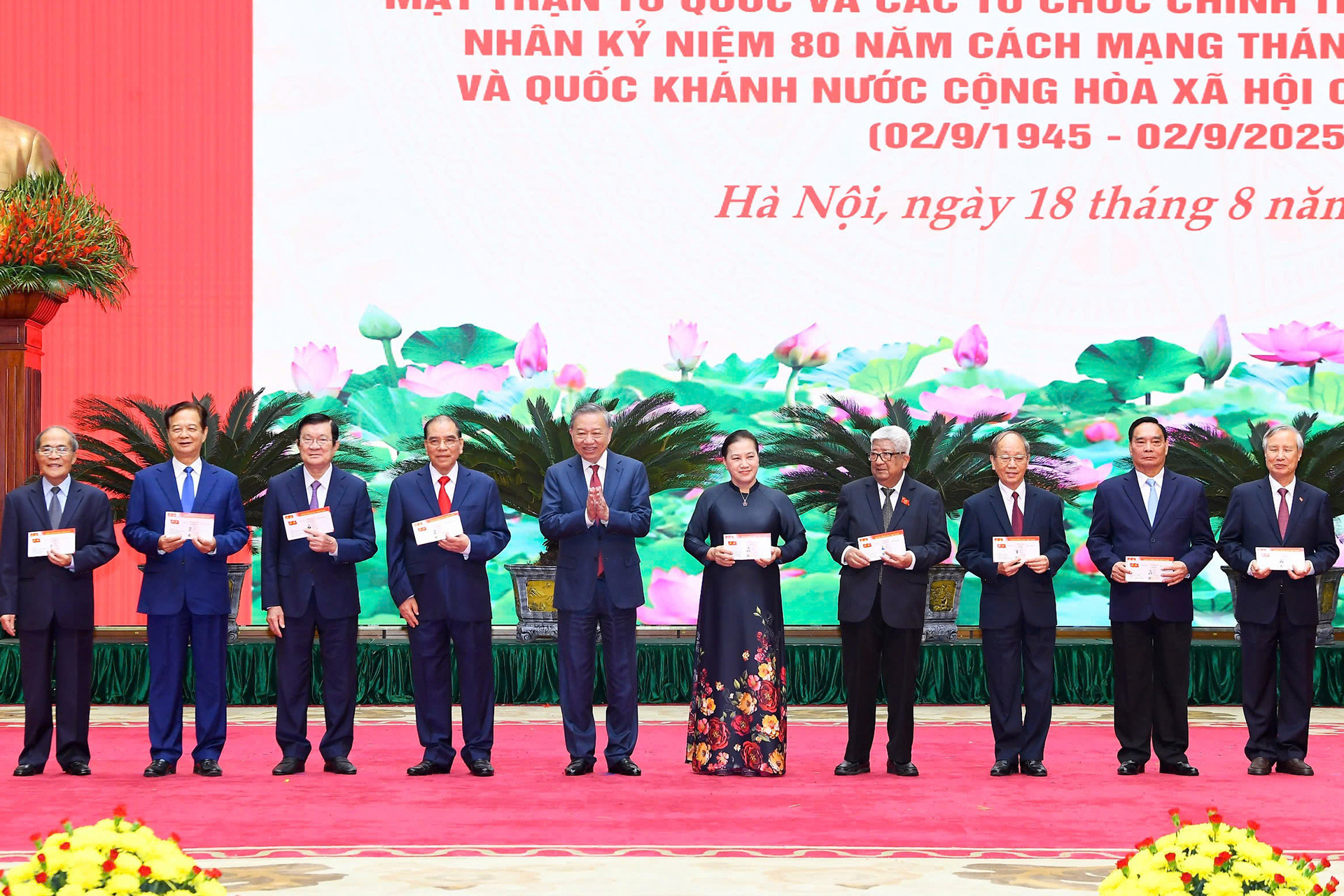
On August 18, marking the 80th anniversary of the August Revolution and National Day, General Secretary To Lam chaired a meeting with veteran revolutionaries, former Central Committee members, and former leaders of Party agencies, the Vietnam Fatherland Front, and socio-political organizations.

General Secretary To Lam speaks at the meeting with veteran revolutionaries.
He emphasized that Vietnam’s achievements today - from a war-torn, underdeveloped agricultural country to a middle-income nation with growing global stature - stem in part from the contributions of past leaders and revolutionaries. Their legacy lies not only in strategies, policies, and infrastructure, but also in political courage, strategic vision, unity, and resilience.
The General Secretary noted that the country is entering a new era, aspiring to become a high-income, developed nation by the mid-21st century. Alongside the entire political system and people, the Party and State need the continued wisdom and experience of veteran leaders who deeply understand development and have guided the nation through difficult times.
Streamlining the system for sustainable growth
He stressed the importance of safeguarding sovereignty, ensuring peace and stability, and accelerating sustainable development. He noted that improving citizens’ material and spiritual life is central to these efforts.
On restructuring, he remarked: “To advance, our apparatus must be streamlined so it can soar higher and further.” He praised the efficiency of the two-tier local government system, calling it not just a structural reduction but a fundamental shift in governance thinking.
Administrative reforms, he added, must be centered at the commune level, where citizens’ needs can be directly addressed: “If commune authorities don’t solve it, no one else can.”
At the meeting, he also presented Party badges to veteran revolutionaries.
Driving innovation through new resolutions

Highlighting recent Party resolutions, Party Chief To Lam pointed to Resolution 57 on science and technology, stressing that Vietnam must “leapfrog” to catch up with global advancements. On Resolution 59 on international integration, he noted that with trade reaching $800 billion annually, Vietnam must fully engage in global supply chains and cultural exchanges.
Resolution 66 on legal reform, he said, aims to break barriers and create a transparent institutional environment, while Resolution 68 underscores the vital role of private enterprise. Currently, over 250 major projects worth about $51 billion are underway nationwide, with nearly 70% funded by the private sector. “This shows the immense strength and creativity of our people,” he said.
He set ambitious targets: by 2030, Vietnam should have 2 million private enterprises, including 20 major firms in global value chains, contributing 55-58% of GDP and employing 85% of the workforce. By 2045, that number should reach at least 3 million, contributing over 60% of GDP with global competitiveness.
While strengthening the private sector, he affirmed that the state economy remains the backbone, and a new resolution will further define its leading role.
Preparing for the historic 14th Party Congress
The General Secretary said the 14th National Party Congress, scheduled for early 2026, is being prepared as a historic milestone to usher Vietnam into a new era of prosperity and sustainable development. For the first time, three key reports - on politics, the economy, and Party building - will be combined into one comprehensive political report.
The Congress will also adopt an “Action Program” specifying annual tasks, responsibilities, and local contributions, avoiding delays caused by waiting for separate resolutions. Draft documents are currently being circulated for feedback from Party organizations, members, and the public.
Regarding personnel for the new Central Committee, To Lam emphasized a balance of quality, structure, and mission requirements. The plan envisions more members in critical sectors, with over 10% younger than 47 and 10-12% being women and ethnic minorities.
“Candidates must be exemplary, clean, courageous in thinking and action, willing to take responsibility and sacrifice personal interests for the people, always putting national interests first,” he stressed. He added that beyond correct resolutions, effective implementation depends on the integrity and competence of those in charge.
Tran Thuong
.svg)
