 Vietnamnet.vn

 Podcast



At 10am this morning (January 29), Phan Thi Thu, a resident of Duc Nhuan Ward in Ho Chi Minh City, visited the Mi Hong jewelry store in nearby Gia Dinh Ward to buy one chỉ of gold as a wedding gift for her niece.
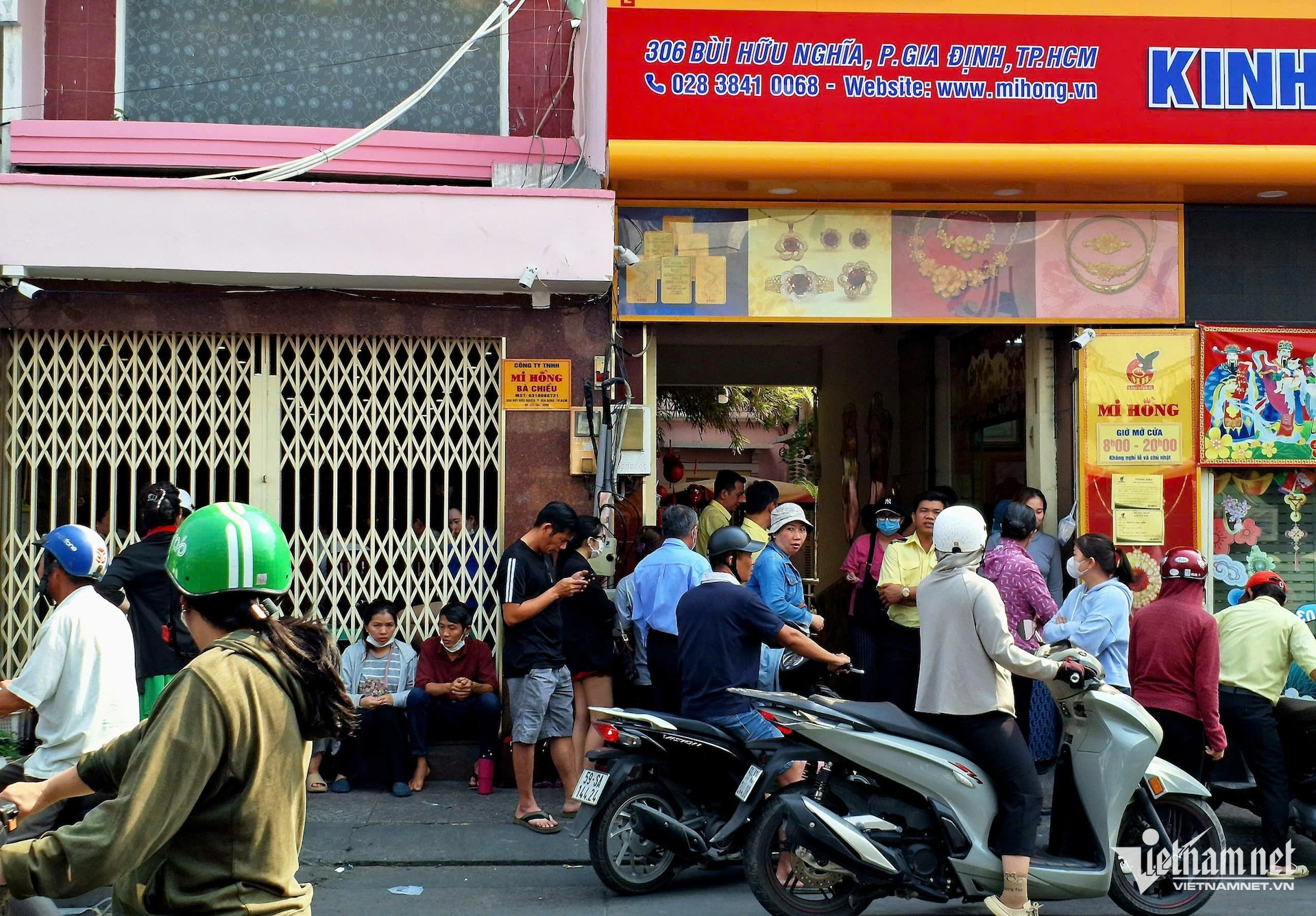
People wait to buy gold rings at Mi Hong jewelry store, January 29. (Photo: T.C)
But when she arrived, the shop had already run out of queue numbers for gold rings - with dozens still waiting inside. "Gold prices are sky-high right now. I didn’t expect so many people to show up to buy," she said.
At Mi Hong, one of the city’s oldest and busiest gold retailers, the scene was intense. Most customers were buying rather than selling. The shop’s security staff had to turn people away repeatedly, asking them to return at 6am the next morning if they wanted to get a spot in line.
A similar situation unfolded at the headquarters of SJC - Saigon Jewelry Company - in Ban Co Ward. Outside, a sign had already been posted: “Not accepting more customers for gold ring transactions.”
"We’ve sold out our ring quota for the morning. Please come back early tomorrow to queue," said a security guard.
As for SJC gold bars, buyers are now required to register online in advance. Only those who succeed in registering can enter the store, where supply is scarce and prices are soaring.
At the opening of the January 29 trading session, SJC gold bars jumped by 5.5 million VND in buying price and 6 million VND in selling price compared to yesterday’s close, trading at 187.2–190.2 million VND per tael (roughly $7,680–$7,800).
Gold rings also followed the upward trend. SJC’s 1–5 chỉ rings were quoted at 186.8–189.8 million VND per tael (buy–sell), a surge of 6.1 million VND on both ends.
Internationally, at 11:05am Vietnam time, spot gold was trading around $5,541.2–$5,543.2 per ounce - up a staggering $127.2 from the opening, or 2.35%.
According to Kitco, futures contracts posted the largest one-day dollar gain in history, jumping by $231 per ounce to close at a record $5,447. This explosive rally was fueled by a weakening US dollar, escalating geopolitical tensions, and a global flight to safety - with intra-day trades pushing prices even higher.
Back home, even as domestic gold prices repeatedly smash previous records, Vietnamese investors show little interest in taking profits. Many believe the metal still has room to grow.
Could SJC gold soon cross the 200 million VND per lượng threshold?
"Absolutely," said Dr. Nguyen Tuan Anh, a finance lecturer at RMIT University Vietnam, citing current trends and macroeconomic factors.
Major institutions like Goldman Sachs project year-end prices to hit $5,400 per ounce, while JP Morgan expects $5,000–$6,000 due to geopolitical volatility, high inflation, and low interest rates.
Tuan Anh noted that if global prices rise another 10–15% and Vietnamese inflation hovers around 4–5% in 2026, domestic SJC prices could easily pass 200 million VND per tael.
He pointed to 2020, when gold rose nearly 40% globally during the COVID-19 pandemic, driving SJC prices from 42 million to 62 million VND per tael in just eight months.
The risks of gold mania
Yet, rapid price hikes come with serious risks - including market bubbles and financial losses.
"History shows the dark side of gold rallies too," Tuan Anh said. Between 1976 and 1980, gold skyrocketed from $100 to $850 per ounce amid US inflation over 13%. But the bubble burst, and prices collapsed 65% over the next five years - plunging below $300 by 1985 and wiping out many investors.
Other dangers include opportunity costs. Investors who pour money into gold might miss better returns from stocks or bonds in a recovery. Sudden rate hikes by the US Federal Reserve could also jolt the market, as could stagflation or a global recession, where gold might no longer provide a safe haven.
In Vietnam, runaway prices could trigger excessive speculation, distorting the monetary system.
Still, Tuan Anh said the State Bank of Vietnam (SBV)’s recent policies - allowing commercial banks and firms to import/export gold, and reauthorizing bullion trading licenses since late 2025 - were steps in the right direction to improve supply and transparency.
But these measures alone won't cool prices quickly or bring them closer to global levels. The core issues remain structural: tight supply, strong speculative demand, and outdated regulatory frameworks.
Vietnam’s domestic supply is limited, with local mining contributing very little. Imports remain the primary source - yet tightly controlled, as SBV prioritizes foreign currency for other essential needs.
Investor psychology is also driving hoarding behavior. With global instability and local inflation expected around 4–5% this year, many see gold as the only safe asset - reducing sell-side supply and pushing prices higher.
On top of that, complex licensing procedures and strict import quotas continue to create localized scarcity, leaving the market uncompetitive.
By comparison, China maintains tight controls too, but its price gap with global markets rarely exceeds 1–2%, even during peaks. This efficiency is thanks to the Shanghai Gold Exchange (SGE), which helps channel supply more effectively.
"Vietnam still needs time and deeper reforms - like setting up a national exchange or breaking market monopolies - for stabilization policies to truly take effect," the RMIT lecturer concluded.
Tran Chung
.svg)
