 Vietnamnet.vn

 Podcast



This morning, on behalf of the Prime Minister, Minister of Construction Tran Hong Minh submitted a proposal to the National Assembly regarding adjustments to Resolution No. 94/2015/QH13 on the investment policy for Long Thanh International Airport.
Minister Minh stated that the Government is requesting the National Assembly to amend the resolution to allow the Government to approve the feasibility study report for Phase 2 of the project on its own authority, without requiring the National Assembly’s prior approval.
The proposal explains that under the 2014 Law on Public Investment, the Prime Minister has the power to decide on major national projects once the investment policy has been approved by the National Assembly - without needing further legislative consent before making final investment decisions.
However, due to the large scale and complexity of the Long Thanh Airport project - being implemented for the first time and without a fully defined investment plan - the National Assembly had previously required, in Resolution No. 94/2015/QH13, that the Government submit a feasibility report for each phase for legislative review and approval before proceeding.

Following this guidance, the Government prepared and submitted the feasibility study for Phase 1, which was subsequently approved by the National Assembly. Based on that approval, the Prime Minister authorized the project’s investment.
Phase 1 was divided into four sub-projects, with specific investors or implementing agencies selected to suit the nature of each component, ensuring national defense, security, and national interests were upheld.
During the implementation of Phase 1, based on a government proposal to shift the construction of the second runway from Phase 3 to Phase 1, the National Assembly permitted the Government to approve the revised feasibility study for Phase 1 without needing additional legislative approval.
The feasibility study for Phase 1 estimated that Phase 2 (including a third runway and a second passenger terminal) would be developed between 2028 and 2032.
However, with Vietnam's GDP forecast to grow at double-digit rates from 2026, passenger demand at airports nationwide - especially Long Thanh - is expected to surge beyond earlier projections. Therefore, the Government believes it is necessary to begin studying and investing in Phase 2 earlier than previously planned.

Moreover, launching the construction of the third runway in Phase 2 now would take advantage of the labor force, machinery, and equipment already on-site from Phase 1 contractors. This approach would save time, reduce costs, shorten timelines, and enhance investment efficiency. It would also minimize the impact of Phase 2 construction on airport operations, particularly issues like dust and noise.
As per the approved investment plan, Phase 2 is set to include one runway, a second terminal with a capacity of 25 million passengers per year, and other auxiliary facilities to support operations.
Based on the reasons outlined, granting the Government authority to approve the feasibility report for Phase 2 without National Assembly ratification would enable proactive research, appraisal, and investment decisions. It also aligns with the broader policy of decentralization and delegation of authority.
Proposal aligns with decentralization and legislative reform
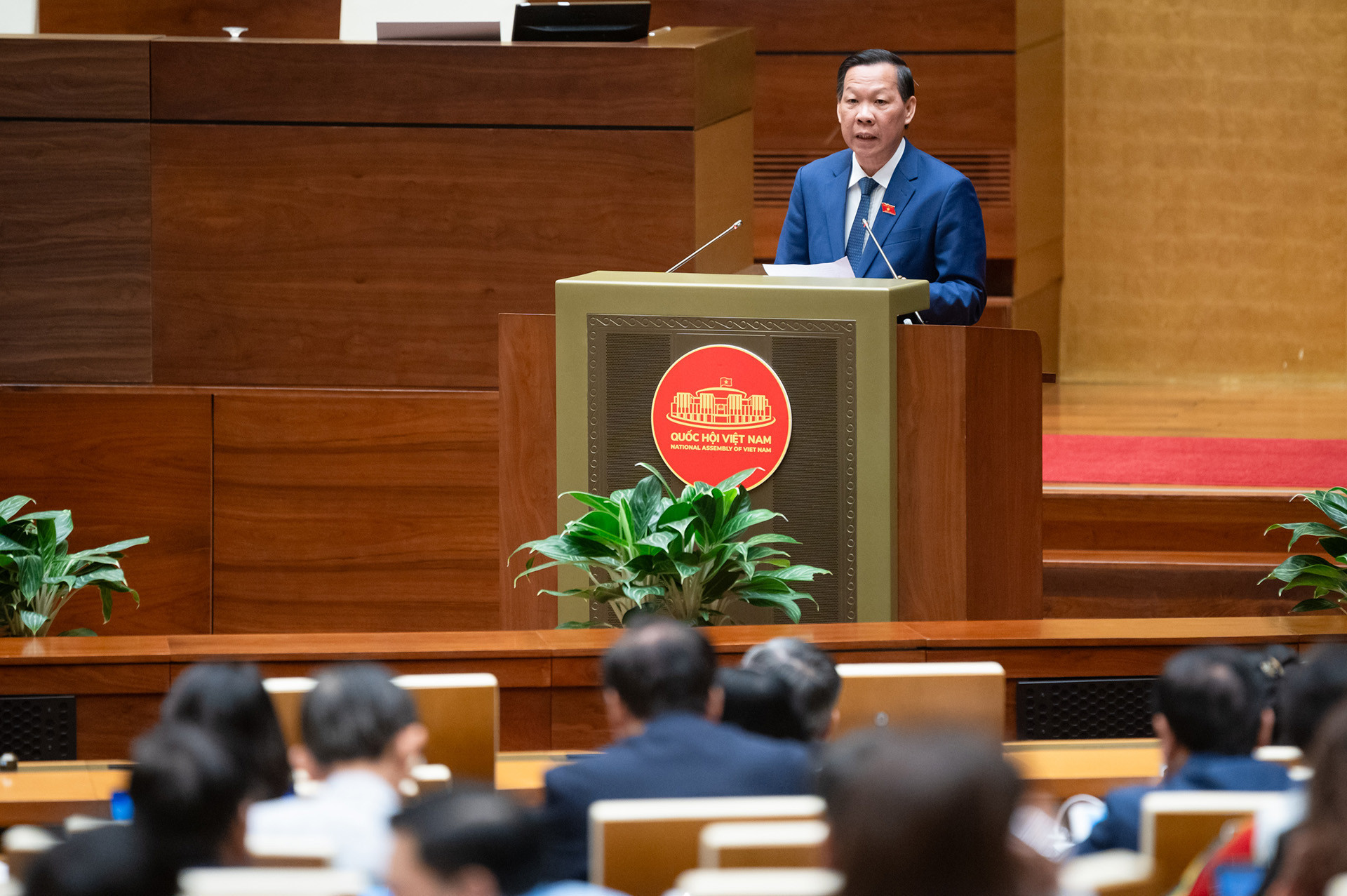
Presenting the assessment report, Chairman of the Economic and Financial Committee Phan Van Mai stated that the project has so far met the requirements set by the National Assembly.
He also recalled that during Phase 1 implementation, when the Government proposed moving construction of the second runway from Phase 3 to Phase 1, the National Assembly permitted the Government to approve the revised feasibility report independently.
The reviewing agency noted that planning for Phase 2 was already identified in Conclusion No. 199 dated October 10 at the 13th Central Committee Plenary Meeting, and in Resolution No. 244/2025/QH15 dated November 13 by the National Assembly.
For these reasons, the Economic and Financial Committee considers the Government’s request well-founded and consistent with current legal provisions, as well as in line with the Party’s policy of promoting decentralization and delegation to meet the development needs of a new era.
The reviewing body also concluded that this proposal fits within the legal framework promoting decentralization, simplifying procedures, and shortening the timeline for preparing feasibility studies and investment decisions for major national projects.
Tran Thuong
.svg)
