 Vietnamnet.vn

 Podcast


If self-driving cars can operate well in Hanoi, then they can run anywhere in the world because "Hanoi traffic is a very complex problem," experts have said.
For autonomous vehicles and robotics, Vietnam lags years behind technological powerhouses like the US and China regarding hardware supply chains and investment capital.
However, Assoc. Prof. Dr. Le Anh Son, Director of Phenikaa University, said the domestic market holds a "data goldmine": a dense mixed-traffic environment dominated by unpredictable motorcycle movements that defy standard driving conventions.
This presents a challenge that has caused many foreign algorithms to fail during trial runs. Yet it creates an opportunity for domestic technology companies if they can turn the market's complexity into a competitive advantage.
Bottlenecks hindering robotics commercialization
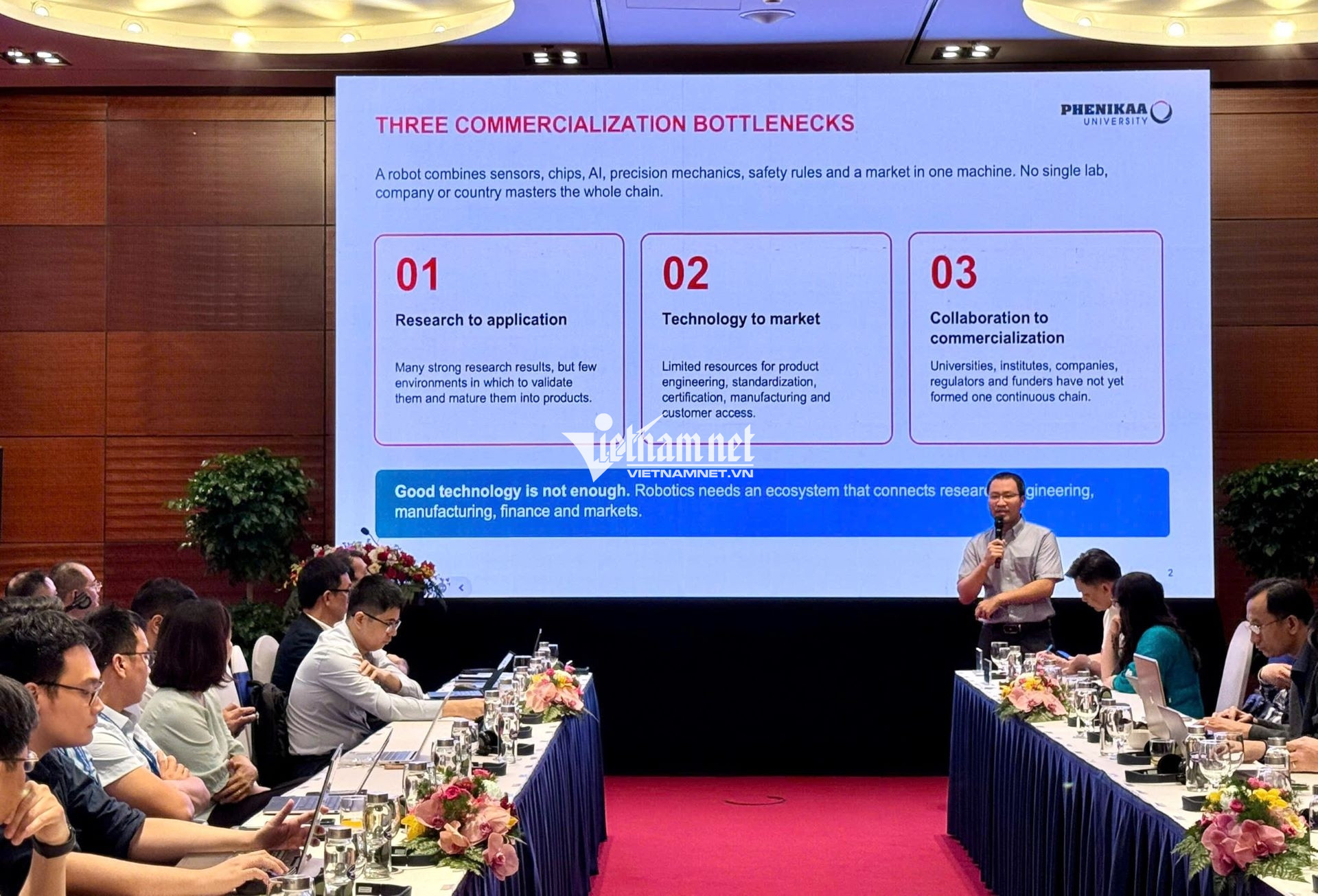
Speaking at a discussion panel on strategic technology transfer on November 5, Prof. Son identified three main bottlenecks preventing laboratory robots from reaching commercial markets.
The first bottleneck involves the mindset gap between academic research and practical deployment. Professors frequently focus on solving narrow, complex academic problems without accounting for mass-production feasibility, external integration, or real-world deployment ease.
The second obstacle centers on engineering resources for product refinement. Son said limited resources exist for product engineering, standardization, certification, manufacturing, and technical customer support - all vital elements for commercial scalability.
The final hurdle is the lack of integration between System Integrators (SI) and robot manufacturers.
“Superior technology alone is insufficient. Robotics requires a connected ecosystem spanning research, engineering, manufacturing, finance, and market access,” he emphasized.
Turning traffic challenges into competitive assets
When initiating self-driving vehicle development, Phenikaa University tested imported foreign algorithms in Hanoi and HCMC, but found they failed to operate. Son said operating robot taxis requires understanding local driver behavior.
"The most complex behavior in Vietnam is that of motorbike riders," he observed.
As a result, foreign platforms programmed for roads with clearly marked lanes and orderly car traffic proved completely unsuited to local conditions.
This forced the company to develop its own control software and computer vision technology. Its engineering team developed specialized visual recognition systems capable of identifying up to 300 moving objects around a vehicle in a single frame. These systems run on common graphics processing units (GPUs).
In addition, Phenikaa University has mastered core technology for synchronizing data from all sensors, including 3D laser scanning devices (LiDAR) and cameras. This allows autonomous vehicles not only to recognize objects but also to predict their movements and calculate their trajectories.
“If self-driving systems run stably under local traffic conditions, Hanoi autonomous vehicle testing proves they can operate in any metropolis worldwide,” Son said.
Based on practical experience, he noted that bringing high-tech products to market requires real-world testbeds and risk-tolerant early adopters.
For example, before commercial rollout, delivery robots underwent testing inside Phenikaa University Hospital, while autonomous road sweepers and Level 4 self-driving cars operated within the Vicostone stone manufacturing facility and university campus.
University spin-off models like Phenikaa-X allow inventors to hold equity stakes and directly drive product commercialization.
Additionally, Hanoi municipal authorities granted a 24-month controlled sandbox mechanism at the Hoa Lac Hi-Tech Park for four vehicle categories (autonomous buses, robot taxis, street sweepers, and delivery robots). This framework enables large-scale real-world data collection, laying the foundation for broad commercialization and international export following Hanoi autonomous vehicle testing cycles.
In related news, Vice Chair of the Hanoi People's Committee Truong Viet Dung in mid-2026 signed a decision allowing controlled testing of an intelligent autonomous transportation system.
The four groups of vehicles to be tested include self-driving buses, robotaxis, cleaning robots, and delivery robots. The operating area is limited to fixed routes that have been mapped with high accuracy and are under a monitoring system at Hoa Lạc High-Tech Park and the Hoa Lạc campus of Vietnam National University, Hanoi. During the 24-month trial period, enterprises are not allowed to organize commercial transport services or collect passenger fares.
Self-driving buses are allowed to carry a maximum of 8 passengers per trip, while robotaxis can carry up to 4 passengers. Although the vehicles are designed with Level 4 autonomous technology, both buses and robotaxis must operate under controlled mode, with a supervisor seated in the driver’s position. Cleaning robots and delivery robots must have an on-site supervisor present.
Du Lam

