 Vietnamnet.vn

 Podcast



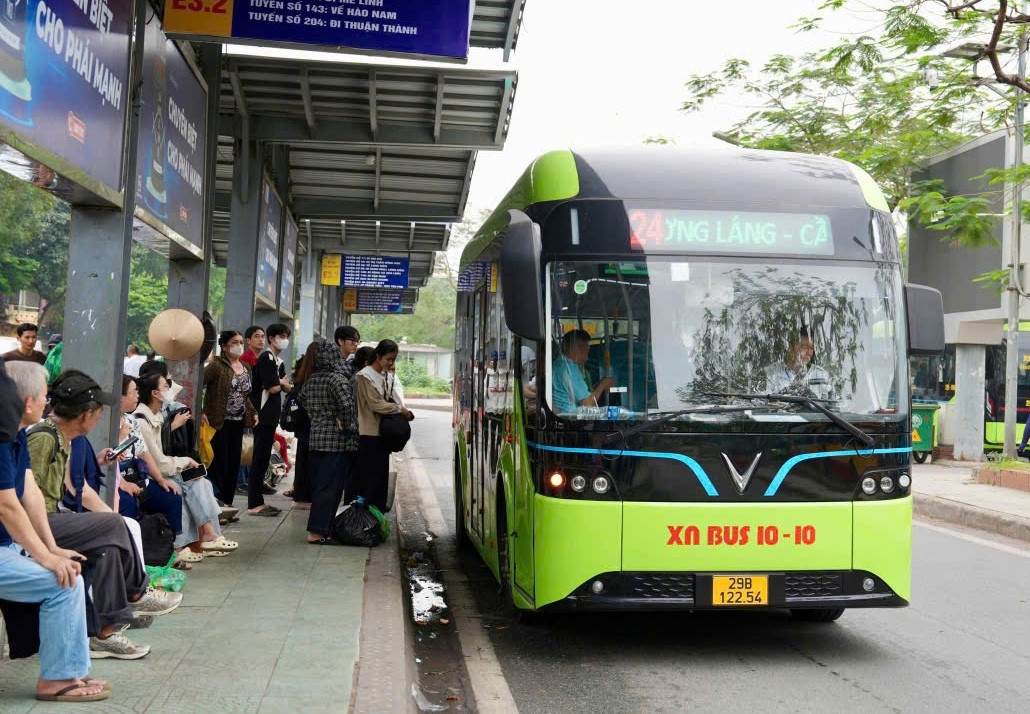
By April 30, Hanoi will continue deploying more electric buses across additional routes. Photo: H.N.
Under Plan No. 149 dated May 28, 2025, issued by the Hanoi People’s Committee, the city is gradually implementing its project to develop a public passenger transport system powered by electricity and green energy.
The initiative is seen as a key step toward modernising transport, improving service quality, and reducing urban air pollution.
On April 18, Hanoi officially introduced electric buses on routes 16, 24, and 29, marking further progress in its roadmap for green public transport development.
The transition has been widely welcomed by passengers, who see it as a positive shift for the urban environment. Unlike diesel-powered buses, electric vehicles produce no CO2 emissions or fine dust during operation, helping to improve air quality - a major concern in Hanoi.
Experiencing route 16 from My Dinh to Nuoc Ngam bus station on the morning of April 18, Nguyen Tang Len said the most noticeable difference was not only the smooth ride but also the cleaner air when the bus stopped for passengers.
“Standing near buses used to mean breathing in exhaust fumes. Now, there’s almost none, and it feels much more comfortable,” he said.
Similarly, Le Dinh Hoan, a frequent bus user, shared after taking route 24 from Long Bien to Cau Giay that electric buses are significantly cleaner and quieter compared to traditional diesel buses.
He added that increasing the share of electric and green-energy buses would help substantially reduce emissions from transport - one of the major sources of urban pollution. In addition to cutting emissions, electric buses also reduce noise, contributing to a more civilised and livable environment.
Thai Ho Phuong, Director of the Hanoi Public Transport Management Centre under the Hanoi Department of Construction, said that from April 18, the city has deployed an additional 53 electric buses across routes 16, 24, and 29. These vehicles are part of the project to enhance sustainable urban transport linked to Hanoi’s metro line No. 3.
As the operator of these routes, a representative of the Hanoi Transport Corporation (Transerco) noted that they connect key residential areas and city centres, helping to promote the image of modern, environmentally friendly public transport along major traffic corridors.
Beyond environmental benefits, the new buses are designed with greater convenience and inclusivity. They feature low-floor designs, making boarding easier for elderly passengers, children, and people with disabilities.
The interior layout is thoughtfully arranged and equipped with essential amenities, providing a safer, more comfortable, and more convenient travel experience for daily commuters.
With the addition of 53 electric buses, the total number of electric and green-energy buses across the network has reached 699, accounting for approximately 35.8 percent of all subsidised buses.
By April 30, Hanoi plans to deploy an additional 122 electric buses across eight routes, bringing the total number of green-energy vehicles to 821, or about 42.1 percent of the fleet.
By the end of 2026, the city is expected to add 30 more electric buses across two routes, raising the total to 851 vehicles, equivalent to 43.6 percent of the network.
This result significantly exceeds the initial target of 20-23 percent, underscoring Hanoi’s strong commitment to developing a sustainable public transport system and building a green, modern, and livable city.
Vu Diep
.svg)
