 Vietnamnet.vn

 Podcast




According to the resolution:
Gasoline-powered motorbikes will be restricted by time or area within the low-emission zone.
Ride-hailing motorcycles will be entirely banned from the zone.
Cars failing Euro 4 emission standards will be progressively restricted and eventually banned from entering the area on specific roads or times as designated by the Hanoi People's Committee.
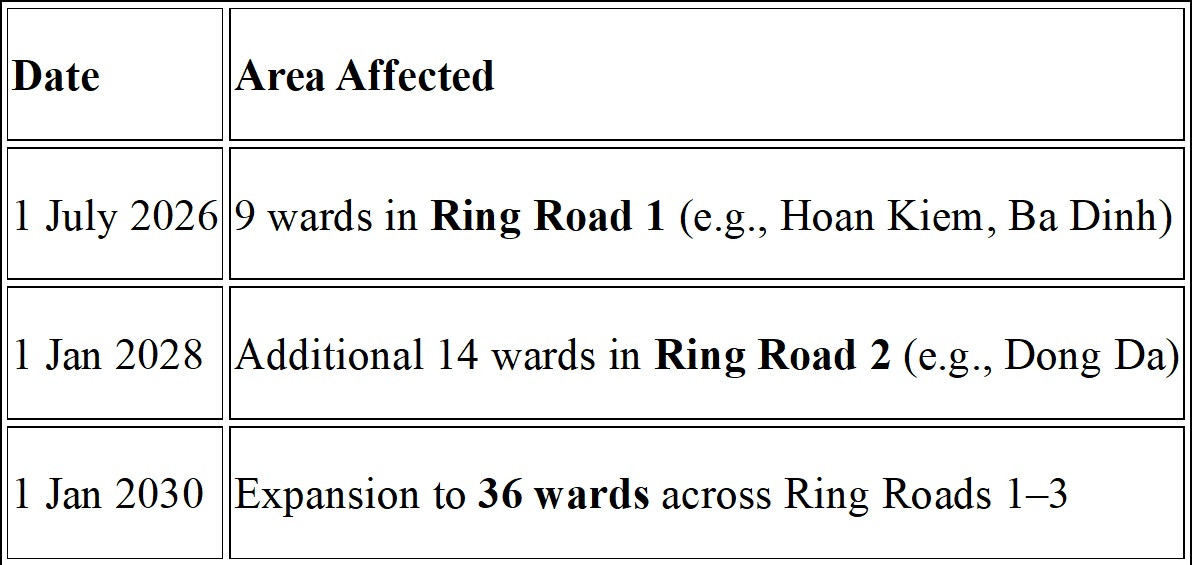
The first phase affects 9 wards within Ring Road 1 from July 2026, expanding to 14 wards within Ring Road 2 by January 2028, and eventually to 36 wards across Ring Roads 1–3 by 2030.
Electric transition roadmap and public feedback
To facilitate the transition:
All ride-hailing motorbikes must switch to electric by 2030.
From July 2026, new taxis must be electric or powered by green energy.
From 2035, broader traffic restrictions may apply based on evolving conditions.
The city plans to offer up to VND 5 million (~$200) in subsidies for residents switching to electric motorbikes.
Surveys show broad public support for the initiative, with many citing Hanoi’s high pollution levels and dense traffic.
“Rush hour fumes are unbearable. Prioritizing electric vehicles will reduce noise and pollution,” said Hong Hanh, a parent who often books ride-hailing services.
“Fine dust levels in Hanoi are always high. Cutting down on gas bikes will help air quality,” added Minh Quan, an office worker in Ba Dinh district.
Many support the gradual approach that allows for adaptation without sudden disruptions.
Concerns from ride-hailing drivers and delivery workers
Despite general support, the policy has raised serious concerns among ride-hailing drivers, especially those heavily dependent on short trips within the city center.
“If we can’t enter the center, we lose most of our income. Electric bikes are still expensive, and we have nowhere to charge overnight in our rental homes,” said Tran Duc Long, a ride-hailing driver.
“I’m still paying off a gas bike I just bought. Now they’re saying I’ll have to replace it? And there’s no clear support package yet,” said Tran Van Son, a delivery driver working in Hanoi’s Old Quarter.
Customers also worry about reduced availability of ride-hailing services, especially during peak hours or bad weather.
“I use 3–5 rides daily. What if no electric drivers are nearby? Delivery and food orders will also cost more if drivers must detour around banned areas,” said Thu Trang, a white-collar worker.
She and others call for a clear rollout plan, financial support for drivers, and increased charging infrastructure to prevent service disruptions.
Expert opinion: Transition must be well-planned
Prof. Dr. Tu Sy Sua, senior lecturer at the University of Transport and Communications, supports the initiative but emphasizes the need for thorough planning.
“Tens of thousands will need new electric vehicles - this affects livelihoods, especially for low-income workers. Enforcement logistics, monitoring, and traffic management all need to be carefully mapped out,” he cautioned.
Without clear preparation, the ban risks being seen as a top-down move that could backfire or strain public trust.
Hoang Hiep
.svg)
