 Vietnamnet.vn

 Podcast



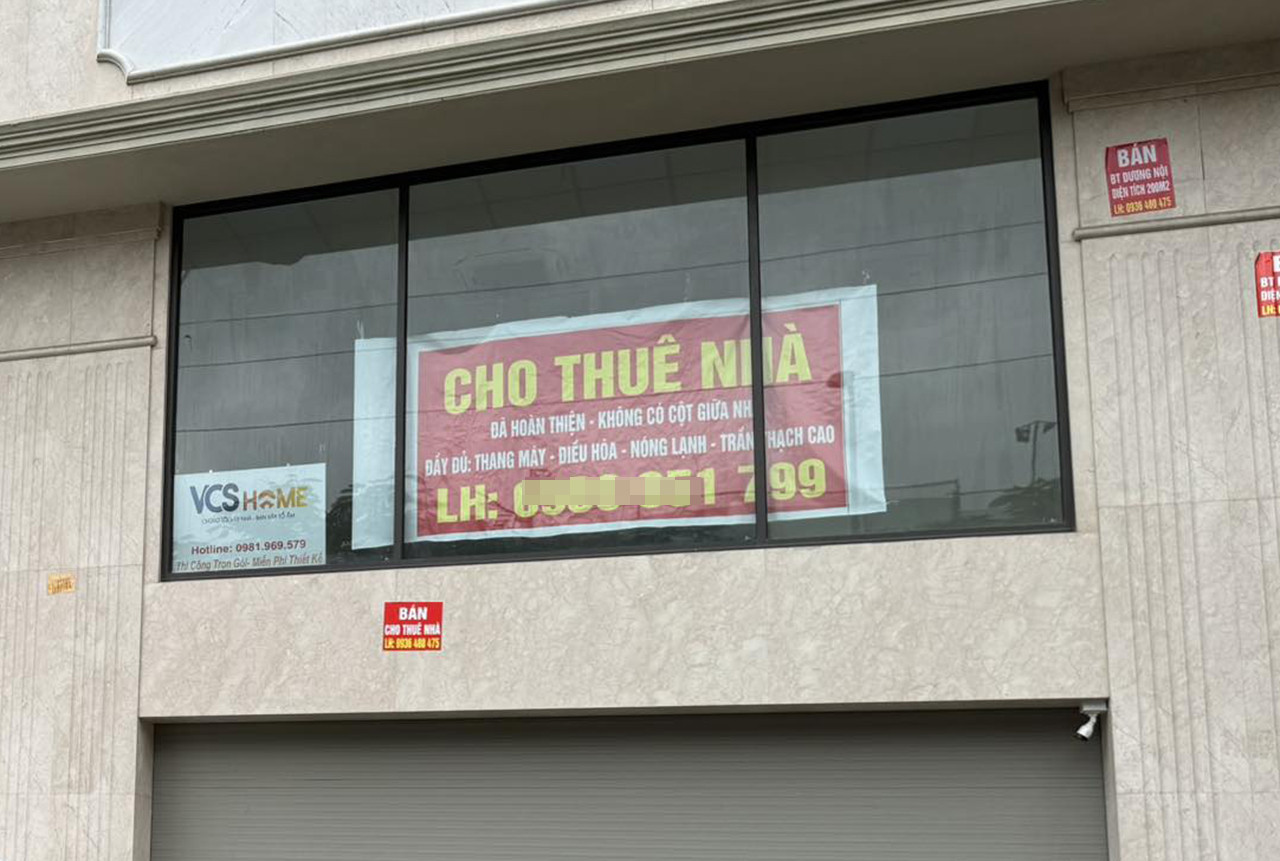
The days of "hanging a sign and getting inquiries from buyers" are over. Many street-front house owners are now leaving properties vacant for extended periods, with price reductions still failing to attract tenants.
Minh (Ha Dong, Hanoi) is listing for sale a house with a 4m frontage, more than 60 sqm in area, located on a busy street. Previously, he had stable income from leasing the property for business. In 2024, after the tenant, the owner of a mobile phone shop, returned the premises, his house has remained vacant for a prolonged period.
Over the past year, he has continuously posted listings and relied on brokers to find tenants. The initial rent of more than VND40 million per month was considered reasonable for the location. Now, he cut it to VND25 million per month, but has had no inquiries.
Earlier this year, Minh switched to selling the house in hopes of rotating capital. However, the number of potential buyers is limited, mostly brokers. Despite working with multiple major property platforms, he has yet to close a deal.
Minh's case is not unique; many streets in Ha Dong and other areas of Hanoi have recorded an increase in vacant premises. Some landlords accept deep price cuts and even flexible rental conditions, but still struggle to find suitable tenants.
A few years ago, similar street-front houses almost never fell into a state of vacancy. Landlords easily rented them out and maintained a stable monthly income. The market has changed rapidly as the demand for commercial space rental declines, especially in traditional retail sectors.
According to a survey in the Ha Dong area, many street-front houses are displaying rental signs. Common rental prices range from about VND20–30 million/month for medium-sized premises on small streets.
In central streets, large-area houses can be offered for VND40–80 million/month. Specifically, a house on Tran Phu Street (Ha Dong) with an area of 80m2 is asking for VND80 million/month; with the same area, a house on Nguyen Van Loc Street is lower, at about VND60 million/month; and a 56m2 house on Van Quan Street is being offered for VND40 million/month.
In the Thanh Xuan area, premises with an area of about 50–100m2 are commonly offered for VND20–40 million/month. Prime positions on axes such as Nguyen Trai or Le Van Luong can reach VND40–100 million/month. In Hai Ba Trung District, premises of 50–100m2 are commonly offered for VND30–50 million/month, while prime positions can reach VND70–110 million/month.
Despite landlords reducing prices, rental signs remain for a year without customers. From once being "golden-egg-laying geese," rental townhouses are gradually losing their appeal, forcing many owners to consider selling the assets.
Hard to sell
Hoang Kim, a broker specializing in the townhouse segment, said the supply of central street-front houses is trending upward significantly as many owners offer them for sale. Prior to that, these houses were mainly rented out as hotels, offices, or short-term accommodation models, bringing in stable cash flow.
Amid unfavorable business activities, many landlords have shifted toward selling assets. Kim currently holds a large list of Old Quarter townhouses in prime locations, offered at prices several billion VND lower than before the Lunar New Year.
Compared to the same period last year, street-front house prices in many areas have decreased significantly. Many owners have adjusted prices downward from several hundred million to several billion VND to increase liquidity. Common decreases range from 5–15 percent.
Hanoi street-front houses have lost their attraction primarily because of the shift of the retail market. The explosion of e-commerce along with the strong development of modern shopping centers has changed consumer habits, causing traditional street-front business models to lose their advantage.
While shop revenues decline, operating costs like electricity, water and personnel remain high, which, coupled with landlords continuing to anchor high prices, leads to prolonged vacancies.
According to Kim, to close a deal quickly, landlords need to change their approach instead of anchoring high prices and waiting. The most important factor is pricing the asset close to the market, and being ready to reduce to competitive levels, even 10–30 percent lower than the peak period if necessary to attract real cash flow.
Additionally, landlords should "refresh" the real estate by repairing the facade and optimizing functionality to increase attractiveness during actual viewings.
Hong Khanh
.svg)
