 Vietnamnet.vn

 Podcast



Hanoi's decision to ban gasoline-powered motorbikes within Ring Road 1 starting July 1, 2026, is being hailed as a bold but necessary step to reduce inner-city emissions.
At the “2025 Workers for the Environment Forum” on the afternoon of September 19, a representative from the Department of Environmental Protection (Ministry of Natural Resources and Environment) stated that air pollution in northern Vietnam follows a clear seasonal pattern, becoming especially severe during the winter and spring months (October to April). During this period, temperature inversions and still air frequently occur, preventing pollutants from dispersing and causing prolonged ground-level air pollution episodes.
Among the sources of air pollution, emissions from transportation are the largest contributors. With an enormous number of privately-owned motor vehicles, many of which are outdated and fail to meet emissions standards, pollutants are released not only through exhaust fumes but also from road dust and precursors that form secondary particulate matter.
The second largest source comes from industrial activity, particularly thermal power plants, cement factories, and steelworks in Hanoi and neighboring provinces, which significantly contribute to levels of fine particulate matter (PM2.5).
Additional sources include dust from construction and demolition sites, and unshielded material transport. Another significant and often overlooked contributor is the open burning of straw after harvest and spontaneous waste burning in suburban and rural areas.
A bold but necessary step
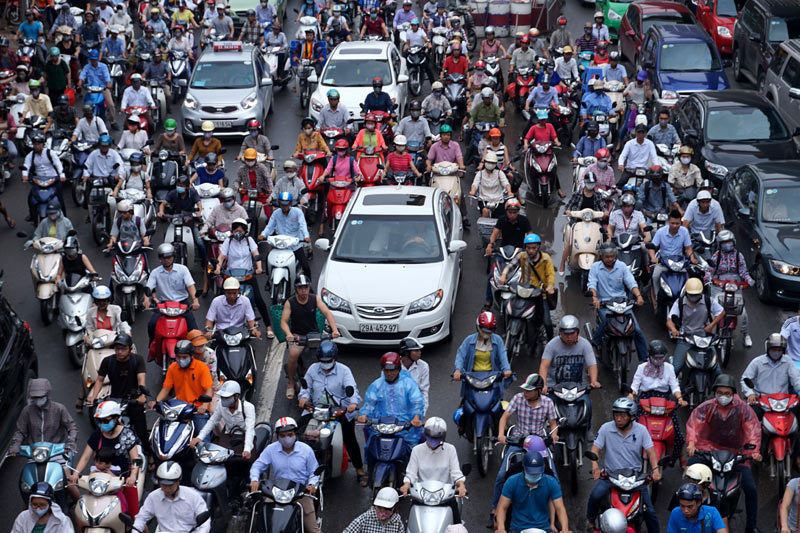
Pham Hong Quan, a representative from the Department of Environment (Ministry of Natural Resources and Environment), emphasized that a key highlight in addressing air pollution is the implementation of Government Directive 20 on controlling air pollution. Accordingly, starting July 1, 2026, Hanoi will prohibit the operation of fossil-fueled motorbikes within Ring Road 1.
To actualize this policy, Hanoi must develop a comprehensive and synchronized transition roadmap that includes investment in infrastructure such as a charging station network, modern public transportation, and smart traffic systems. The Ministry has also sent directives to 34 provinces and cities, urging strict measures to reduce air pollution.
Le Thanh Thuy, Deputy Head of the Environmental Management Division (Hanoi Department of Natural Resources and Environment), stressed that although this is a bold measure, it is necessary to reduce urban emissions and provide citizens with cleaner air.
According to the plan, Hanoi aims to reduce PM2.5 levels by at least 20% by 2030 compared to the current average concentration of 47 µg/m³ across eight monitoring stations. Ho Chi Minh City and other localities have also been assigned targets appropriate to their specific conditions.
Additionally, the Department of Environment is collaborating with the Institute of Meteorology, Hydrology and Climate Change and other experts to integrate artificial intelligence (AI) into air quality forecasting systems. With this upgrade, forecasts could reach an accuracy window of 5–7 days, compared to the current three-day limit.
Following directives from Deputy Prime Minister Tran Hong Ha, all environmental management activities must be based on scientific data, factual statistics, and concrete evidence. By the third quarter of 2026, four internationally standardized automatic air monitoring stations must be completed, aligned with the national planning framework. No delays beyond 2030 will be tolerated.
The Department of Environment emphasized that environmental action is not merely a responsibility, but a mandate of life—vital for the health of current and future generations.
Vu Diep
.svg)
