 Vietnamnet.vn

 Podcast



October’s full moon, also known as the Harvest Moon, marks the first supermoon of 2025.
This occurs when the Moon becomes full while positioned closest to Earth along its elliptical orbit - a point called perigee.
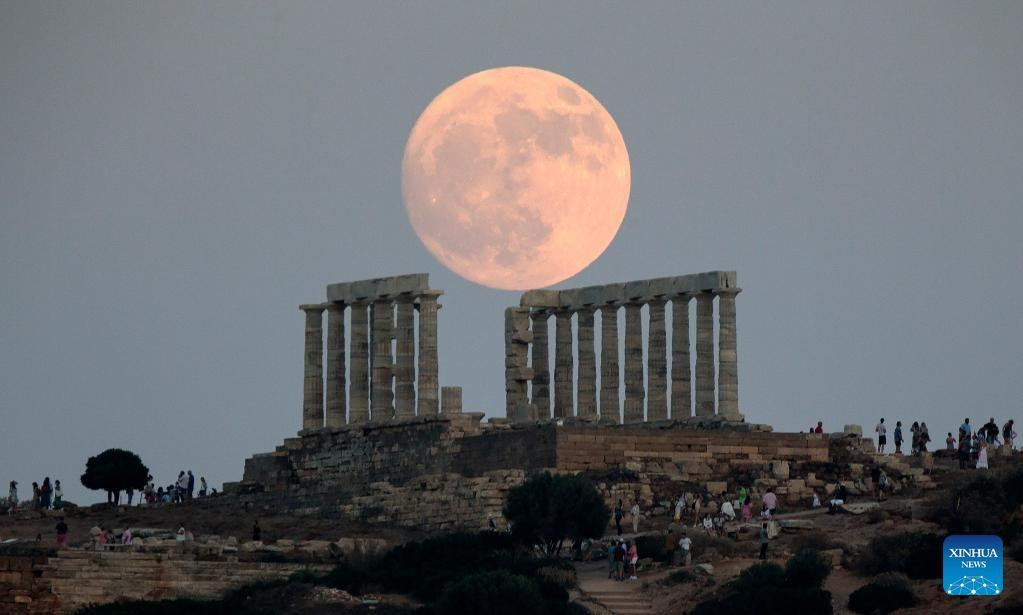
Astronomers predict four consecutive supermoons will appear from now through early 2026, beginning with this week’s Harvest Moon.
The Moon will reach full illumination just before midnight on Tuesday, October 7.
However, observers will see it appear nearly full on the surrounding nights as well.
The evening of Monday, October 6, is considered the ideal viewing time.
The Moon will rise in the east shortly after sunset, creating a striking scene against the twilight sky.
According to NASA, during a supermoon the Moon comes as close as 224,600 miles (about 361,000 km) from Earth - much nearer than its average distance of 238,900 miles (384,000 km).
This proximity makes the Moon appear up to 30% brighter and 14% larger than an ordinary full moon.
A supermoon happens because the Moon’s orbit around Earth is not perfectly circular but elliptical.
During its 27-day cycle, the Moon moves from its closest point to Earth (perigee) to its farthest point (apogee).
When a full moon coincides with perigee, we see a supermoon.
NASA notes that “supermoon” is not an official astronomical term, but it is commonly used to describe any full moon that occurs within 90% of its closest possible distance to Earth.
“This phenomenon isn’t particularly rare or mysterious,” explained Derrick Pitts, chief astronomer at the Franklin Institute in Philadelphia.
According to him, anyone can enjoy the view with the naked eye - no telescope or special equipment is needed, as long as the skies are clear.
However, the difference between a supermoon and a regular full moon is often subtle unless one closely observes the Moon over several nights.
“If you simply look up when the Moon is high in the sky, there’s nothing nearby to compare it to, so it’s hard to sense that it’s larger than usual,” Pitts said.
In contrast, a micromoon occurs when a full moon coincides with the Moon’s farthest point from Earth, making it appear smaller and dimmer.
October’s supermoon is only the beginning.
Two more full moons in November and December will also be supermoons, with the one on November 5 being the closest to Earth in 2025.
Another supermoon will follow on January 3, 2026, ushering in the new year.
Typically, three to four supermoons appear each year due to the Moon’s regular orbital pattern.
This October’s supermoon is expected to have a noticeable impact on coastal tides along the southeastern United States.
Stronger lunar gravity during perigee can cause unusually high tides - known as “king tides.”
Meteorological agencies forecast that water levels will peak midweek, just after the full moon phase.
Coastal flood and rip current warnings have been issued from the Carolinas down to Florida.
Du Lam
.svg)
