 Vietnamnet.vn

 Podcast


Ho Chi Minh City is developing a new mechanism to commission and finance high-quality workforce training, aiming to address shortages of skilled professionals in strategic industries and support the city's economic growth ambitions.
Huynh Thanh Nhan, vice chairman of the Ho Chi Minh City People's Council, outlined the proposal during a meeting between municipal lawmakers and voters in Dong Hoa, Linh Xuan and Thu Duc wards on November 16.
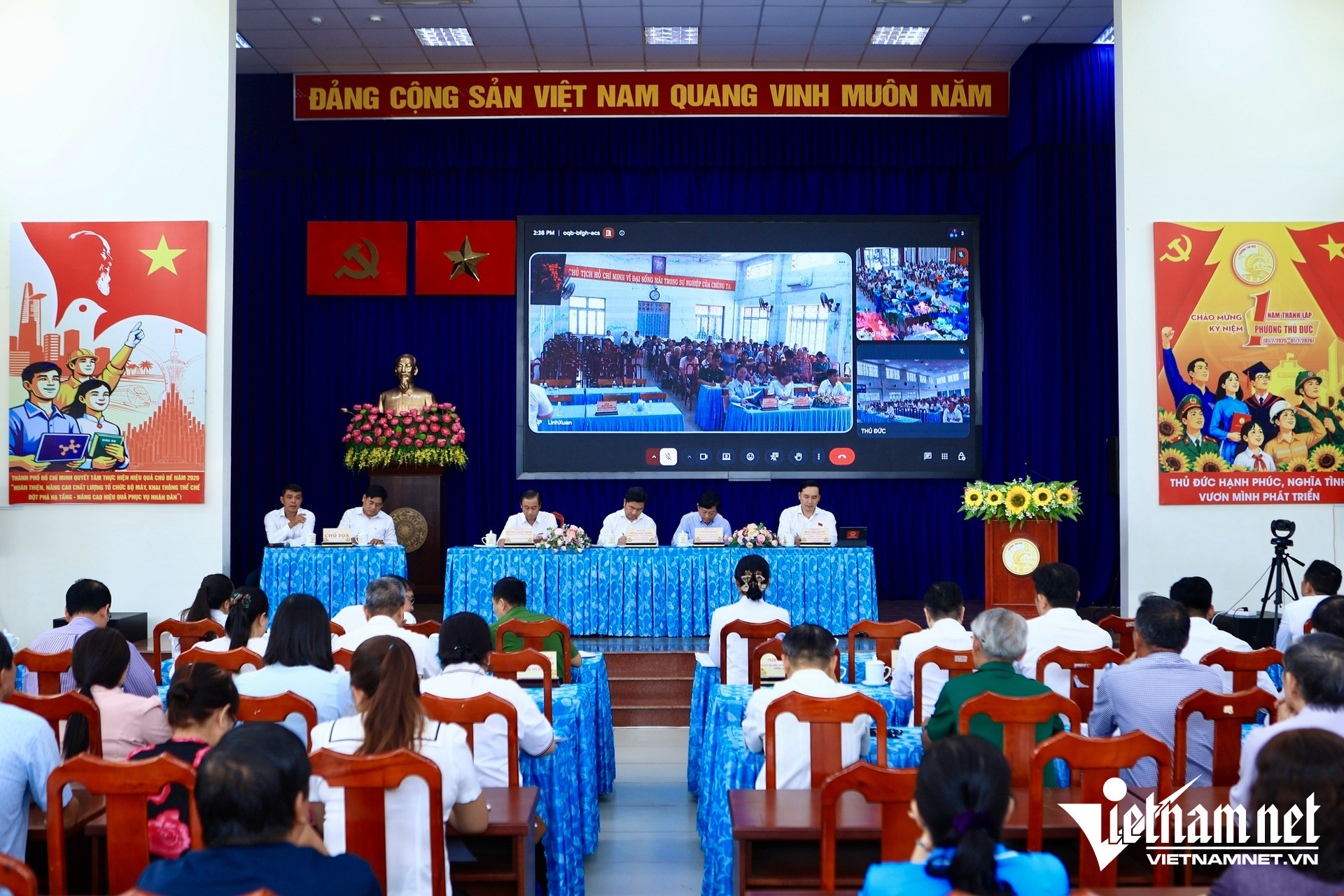
Delegation No. 9 of the Ho Chi Minh City People's Council meets voters ahead of the council's seventh session, a special sitting.
The meeting, held ahead of the council's seventh session, a special sitting, gathered public concerns about urban infrastructure, social welfare, land-use right certificates and major development projects.
Among the issues raised was a shortage of highly skilled workers, particularly in science, engineering and digital technology, which residents warned could undermine the city's ambition to maintain double-digit economic growth.
Cao Van Hung, a resident of Linh Xuan Ward, called for stronger cooperation among government agencies, educational institutions and businesses to address the problem.
He proposed allocating public funding to commission specialized training programs and provide digital skills retraining for young workers.
Hung also urged the city to introduce incentives encouraging businesses to improve salaries and employee benefits to attract and retain highly qualified professionals.
Responding to the concerns, Nhan said the city had already implemented programs to develop highly qualified professionals with international-level expertise while strengthening cooperation between the government, universities and businesses.
The city has also introduced policies to attract specialists and scientists and develop skilled workers in priority industries.
Universities and research institutes could receive training contracts
At its year-end session, the Ho Chi Minh City People's Council is expected to consider a resolution establishing mechanisms for commissioning workforce training through direct assignments, service orders or competitive bidding.
Eligible providers would include universities, vocational education institutions and research institutes in Vietnam and abroad that are qualified to deliver specialized training and professional development programs.
The proposed policy aims to develop a workforce with advanced expertise and internationally recognized qualifications to support socioeconomic development, scientific research, digital transformation and the green transition.
The municipal Department of Science and Technology is currently gathering feedback on the draft resolution before submitting it to the People's Council.
Under the proposal, the city would adopt three methods for organizing training: assigning tasks to qualified institutions, commissioning specific training programs and selecting providers through competitive bidding.
Six broad sectors have been identified as priorities: healthcare; education; urban development, infrastructure and transport; finance and banking; culture, tourism and sports; and strategic technologies, digital transformation and the green economy.

Huynh Thanh Nhan, vice chairman of the Ho Chi Minh City People's Council, responds to voters' concerns on November 16.
Within these sectors, specialized training would focus on semiconductor microchips, artificial intelligence, urban railways, logistics, high-tech healthcare, information security and new energy technologies.
Training could be delivered by qualified domestic or international universities, vocational institutions, research institutes and other eligible organizations.
Participants selected for the programs would receive funding covering 100% of approved training costs, for up to 10 months per academic year, from the municipal budget.
However, recipients would be required to fulfill post-training commitments to ensure that public investment produces practical benefits.
Those who withdraw from a program, fail to complete their studies or leave their jobs before fulfilling their agreed service obligations could be required to repay all or part of the financial support.
Exemptions or reductions would apply in cases permitted under relevant regulations.
The proposed arrangement is intended to link public investment in training more closely with the city's actual workforce requirements, particularly in industries requiring advanced technical expertise.
Scholarships and incentives for outstanding talent
Alongside the workforce training mechanism, the city is preparing additional policies to support talented individuals and encourage innovation.
Nhan said the People's Council is expected to consider proposals providing scholarships and special benefits for people with exceptional abilities and achievements across various fields, including education and training.
The city also plans to introduce incentives supporting learning, scientific research and inventions, as well as assistance for eligible beneficiaries.
These measures are designed to complement existing efforts to attract experts, scientists and highly qualified professionals to strategic sectors.
By combining commissioned training with scholarships and talent incentives, the city aims to strengthen its ability to develop, attract and retain the skilled workforce needed for long-term growth.
Social insurance and pension policies also under review
Beyond workforce development, voters raised concerns about salaries, pensions and social security.
Nhan said Ho Chi Minh City had already introduced several policies relating to health insurance and social insurance.
At its upcoming session, the People's Council is expected to consider additional support for voluntary social insurance contributions for people aged 60 and above.
Regarding salary and pension reform, Nhan said the National Assembly and Government had established policy directions and allocated resources in the 2026 and 2027 state budget estimates to support implementation.
He also referred to Government Decree 162, which regulates pensions, social insurance allowances and monthly benefits.
The decree includes an 8% increase in monthly pensions compared with June 2026 levels for eligible groups.
Nhan emphasized that adjustments to salaries and pensions must be accompanied by measures to control prices and maintain social protection.
He said balancing income improvements with inflation management remains an important responsibility for both central and local authorities, particularly in protecting vulnerable groups and people receiving social policy benefits.
The planned workforce training policy, together with proposed talent incentives and social insurance measures, reflects Ho Chi Minh City's efforts to align human resource development with broader economic and social priorities.
If approved, the training mechanism would provide a new channel for using municipal budget resources to develop specialized expertise in industries considered essential to the city's future competitiveness.
Phuoc Sang

