 Vietnamnet.vn

 Podcast



Ho Chi Minh City is taking a decisive step toward reshaping its urban landscape with the launch of five major infrastructure projects worth more than VND280 trillion (US$11 billion), unlocking strategic resources for its ambition to become an international megacity.
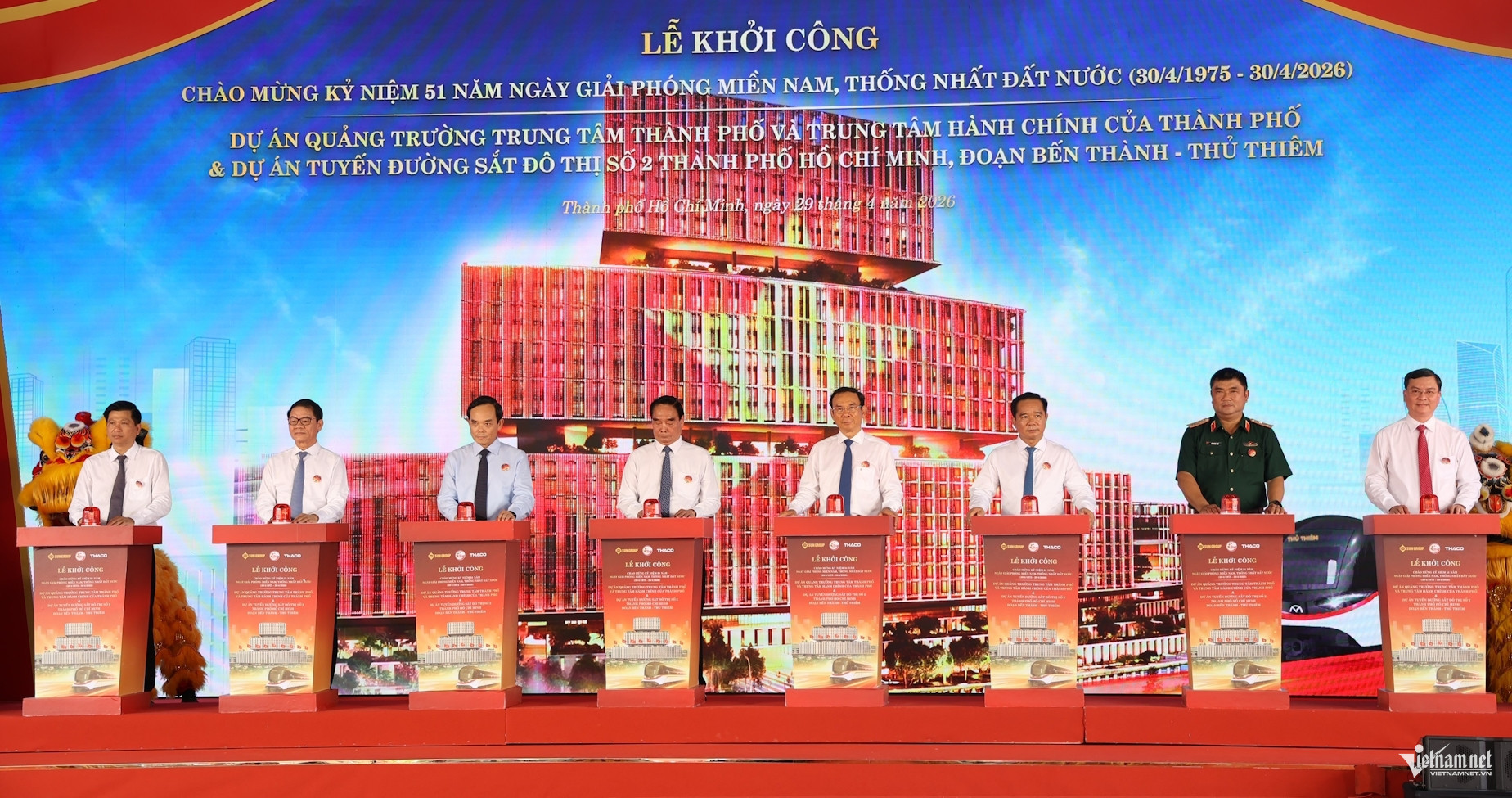
Central and city leaders press the button to launch five major projects worth over VND280 trillion. Photo: Tuan Kiet
On the morning of April 29, the city’s People’s Committee simultaneously broke ground and issued investment decisions for five large-scale urban transport and infrastructure projects. The move is seen as a powerful catalyst for socio-economic development, while also reflecting a strong commitment to urban renewal and long-term growth.
The projects include Metro Line 2 (Ben Thanh - Thu Thiem), the Central Square and Ho Chi Minh City Administrative Center, the renovation of the Ho Chi Minh Museum - Ho Chi Minh City branch, and the International University Urban Area in Xuan Thoi Son Commune.
At the same time, the city finalized the selection of investors for the Can Gio International Transshipment Port project.
Speaking at the ceremony, Chairman of the Ho Chi Minh City People’s Committee Nguyen Van Duoc described the simultaneous launch of these projects as a concrete commitment by the Party, government and citizens, expressing a shared aspiration to build a modern, civilized and compassionate city in a new phase of development.
According to city leaders, the projects will help shape a megacity of regional and global standing, establish a modern and transparent governance space, enhance public service delivery, and develop a connected public transport system. They will also contribute to creating cultural institutions that balance contemporary development with the preservation of historical values.
Regarding Metro Line 2 (Ben Thanh - Thu Thiem), Tran Ba Duong, Chairman of Thaco, said the project would be the deepest urban railway line in the city, facing complex geological conditions.
The line stretches about 6km underground, with six stations, and is expected to serve as a backbone connecting Tan Son Nhat Airport, the city center, Thu Thiem and Long Thanh. To cross the Saigon River and address weak soil conditions, the project will apply advanced technologies, while also promoting the localization of components and rolling stock manufacturing.
The project is being implemented under a PPP model (BT contract), with total investment of VND36.744 trillion (US$1.44 billion), and is expected to be completed by the fourth quarter of 2030.
Meanwhile, Sun Group has broken ground on two major projects: the Central Square and the new Administrative Center complex, along with development in the Nha Rong - Khanh Hoi port area and the expansion of the Ho Chi Minh Museum site.
The new Administrative Center project covers 47 hectares, with total investment of VND29.600 trillion (US$1.16 billion), designed by US-based firms including Skidmore, Owings & Merrill (SOM) and EDSA. The complex is envisioned as a modern architectural hub directly connected to Metro Line 2, serving more than 8,000 civil servants.
Developed under the philosophy “of the people, by the people, for the people,” the project features three main zones, highlighted by a 30-story administrative tower, a 2,000-seat theater and a 12-hectare central lake park designed for cultural events, water performances and fireworks.
The project is expected to elevate the city’s position as Vietnam’s economic engine, while enabling the restructuring of public assets by converting old administrative offices into cultural spaces and public parks.
The renovation of the Ho Chi Minh Museum - Ho Chi Minh City branch at Nha Rong Port covers more than 1.4 hectares, with an investment of around VND68.7 billion (US$2.7 million), focusing on landscape and infrastructure upgrades. It is scheduled for completion in August 2026, contributing to the development of the Saigon River waterfront.
In the northwest area, the International University Urban Area project in Xuan Thoi Son spans about 880 hectares, with investment of nearly VND59 trillion (US$2.3 billion). It is planned as a green, ecological and knowledge-based urban zone, with more than 183 hectares dedicated to education and research.
On the same day, the city awarded the investment decision for the Can Gio International Transshipment Port project, covering 571 hectares with capital of about VND128.872 trillion (US$5 billion).
The port is designed as a smart, green transshipment hub with an expected capacity of 4.8 million TEU by 2030. The investment consortium includes VIMC and MSC/TiL, the world’s largest container shipping group, which holds roughly 25% of global market share.
Tuan Kiet
.svg)
