 Vietnamnet.vn

 Podcast



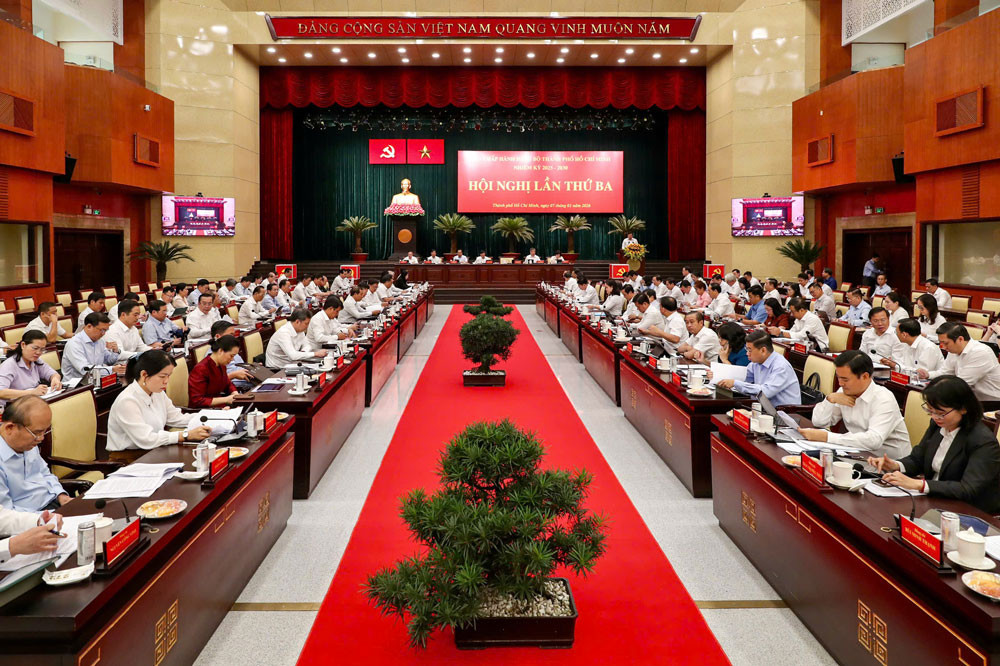
The proposal was presented by Vice Chairman Bui Xuan Cuong during the third session of the municipal Party Executive Committee for the 2025–2030 term, held on January 7.
According to Cuong, consolidating Party and government offices in Thu Thiem addresses the long-standing issue of scattered and deteriorating administrative facilities across the city. The plan not only promises a more efficient government but also opens up space for modern urban development following recent municipal mergers.
The proposed complex features an arc-shaped, 26-story design that embraces the city’s central axis. The building will accommodate over 7,000 officials and civil servants, while remaining accessible to the public through open-space planning and citizen-friendly services.
Designed to be both “green” and “open,” the center’s flexible layout includes shared spaces for meetings, conferences, and working areas - minimizing waste and optimizing urban governance in a metropolis of nearly 10 million people.
The city aims to complete planning and investment procedures in the first quarter of 2026, with construction starting later that year. The goal is to have the center operational by 2027.
To align with the project, the city is also considering adjustments to the Thu Thiem master plan, including relocation of certain cultural and public service projects.
Among the proposed changes: the Symphony, Ballet, and Opera House - originally planned for the Ba Son area - may be relocated next to the new administrative center. The Ba Son site would then be converted into a green public park. Similarly, the city’s Children’s Cultural Center could be moved to prioritize open space and waterfront access.
Party Secretary Tran Luu Quang emphasized that the new complex must be an inviting public space that functions day and night. “It should not be an isolated government building, but a place that connects with its surroundings and the people it serves,” he said.
At the same meeting, Quang discussed the draft review report on five years of implementing Resolution 26, which calls for completion of Thu Thiem's development before 2030. He confirmed that the Standing Committee of the Party Committee is accelerating efforts to resolve legacy issues tied to the area and create room for growth.
The Committee also outlined a detailed roadmap to begin several major projects in 2026, including the Performance and Conference Center, the Unification Monument, the Thu Thiem 4 Bridge, the International Financial Center, and the Thu Thiem–Long Thanh rail line, along with its future connections to regional transit systems.
Approved by the Prime Minister in 1996, the Thu Thiem New Urban Area spans 930 hectares, including 770 hectares for the main development and 160 hectares for resettlement. Located on the eastern bank of the Saigon River, it boasts modern infrastructure and strategic proximity to the city center via key arterial roads.
Previous plans had placed the city's administrative headquarters either within the existing downtown core or in the Binh Quoi–Thanh Da peninsula. Before municipal consolidation, the Department of Construction had proposed a smaller government building at 86 Le Thanh Ton, covering 1.8 hectares for around 1,692 officials. However, that plan proved inadequate in scale and lacked crucial transportation connectivity.
The current proposal represents not only a significant leap in urban planning, but also a symbolic gesture toward transparency, sustainability, and smarter governance in the city’s next chapter.
Quoc Ngoc
.svg)
