 Vietnamnet.vn

 Podcast



The northern area of Ho Chi Minh City is set to become a major science and technology urban zone, marking a transformative step in the city’s spatial and economic development. The former site of Binh Duong New City will be repurposed into a sprawling innovation-driven district under the newly unveiled plan “Northern HCMC Science and Technology Urban Area.”
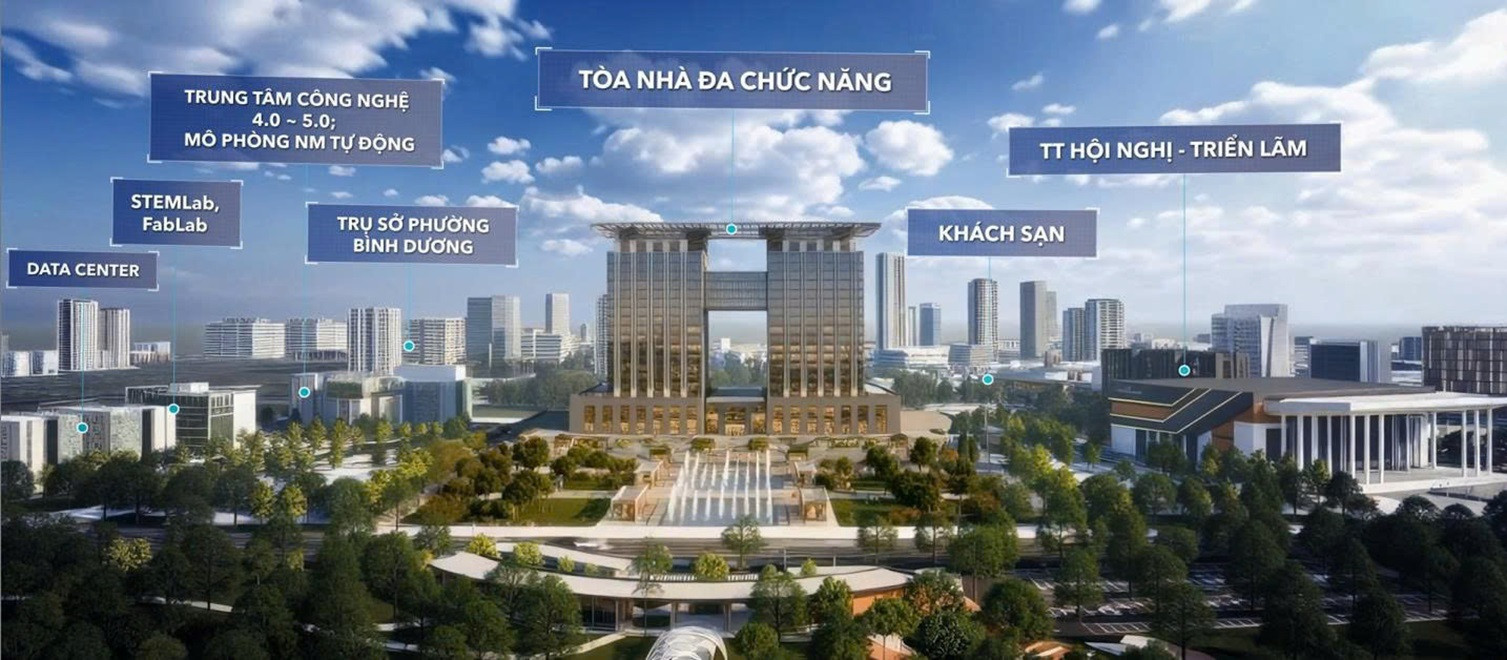
The announcement was made on January 15, with participation from the Ho Chi Minh City People’s Committee, government agencies, and major partners including Becamex, VSIP, and global technology giants such as Qualcomm, Coherent, Warburg Pincus, and Fraunhofer ENAS.
According to the development plan, the core of the new urban area will center around a 20-hectare science and technology complex, anchored by the former Binh Duong provincial administrative center, which will be converted into a science-technology tower.
The project builds upon the existing foundations of the previous "smart city" concept, combining both hard and soft infrastructure to foster innovation and scientific advancement.
Key elements of the new urban zone include the 100-hectare Saigon Innovation Campus, a 15-hectare digital technology zone, a science exploration center for STEM education and knowledge dissemination, and various campuses dedicated to training and research.
A high-tech industrial ring will also be developed, connecting large-scale industrial parks such as Binh Duong Riverside, Lai Hung, Cay Truong, and VSIP III.
Complementary infrastructure like an ecological science park, a digital infrastructure cluster, and the WTC Expo Center will form the backbone for prototyping and scaling scientific research into real-world production.
In the project’s initial phase, Becamex plans to launch eight core developments, including the transformation of the Binh Duong administrative center into a science hub, a science discovery center, an ecological science park, a World Trade Center building with expo facilities, a training and R&D campus, and multiple digital technology parks including a 15.47-hectare and a 100-hectare site, along with the BWID Supply Chain City for industrial leasing.
Speaking at the event, Vice Chairman of the Ho Chi Minh City People’s Committee Bui Minh Thanh emphasized the significance of the initiative, stating that it aligns with the city’s newly granted special policy mechanisms from the central government.
“These institutional foundations allow us to pursue a bold and flexible development approach that meets international standards,” he said.
He further noted that the northern science-technology urban area plays a strategically vital role in the overall spatial and economic development of both Ho Chi Minh City and the Southeast Region.
The area is envisioned as a logistics gateway and clean energy hub for the region, with direct access to international seaports, airports, inter-regional transport infrastructure, and large-scale renewable energy sources.
The transformation also includes repurposing the former Binh Duong provincial administrative tower, a twin-tower complex with 21 floors, previously home to around 60 provincial departments and up to 1,400 personnel. Built under a build-transfer (BT) scheme by Becamex at an investment of over USD 57 million, the building began operations in February 2014.
Following the merger of Binh Duong into Ho Chi Minh City, the tower was handed back to Becamex to be maintained and upgraded for science and technology development purposes.
PV
.svg)
