 Vietnamnet.vn

 Podcast


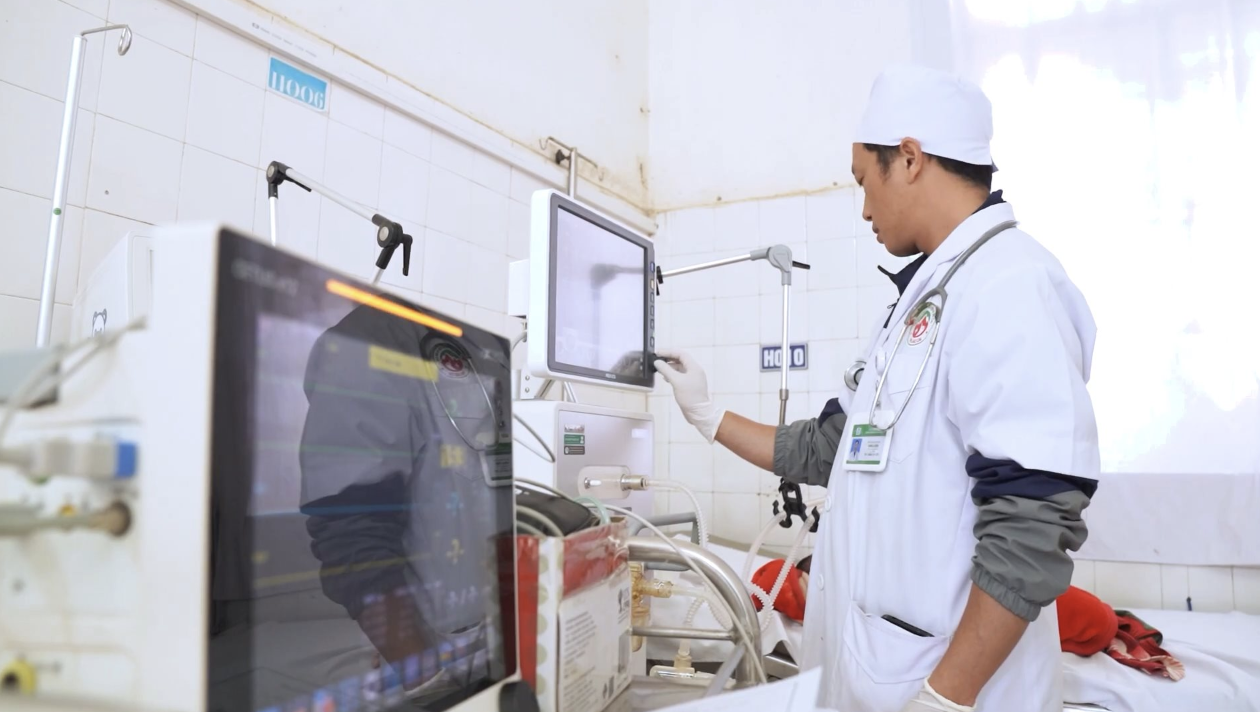
From training and providing professional support to local doctors to transferring medical techniques, offering remote consultations and bringing healthcare services closer to communities, various solutions are being implemented to narrow regional disparities in healthcare access.
After graduating from Thai Binh University of Medicine in 2018, Nguyen Tien Trung, born in 1993, returned to Muong Lat in Thanh Hoa Province, where he had attended high school, to work as a doctor. After completing a basic surgical training program, he joined Project 585 in 2021 to specialize in obstetrics and earned a Level I specialist qualification. At the time, he was the youngest doctor at the hospital to hold this qualification.
Some colleagues invited him to move to Hanoi to work at obstetrics clinics and hospitals. Nevertheless, he wanted to stay in Thanh Hoa and contribute to the community with which he had built a strong connection.
For ethnic minority residents in Muong Lat, reaching the central hospital is difficult, while traveling to provincial or central-level hospitals is even more costly and arduous.
Some patients are reluctant to continue treatment because of the long journeys and expenses. This is why Trung finds his work meaningful when patients can receive care in their own locality.
However, a sense of fulfillment and a passion for medicine alone are not enough to retain qualified doctors in disadvantaged areas. The obstetrics department where Trung works receives around 15-20 patients a day and handles approximately 40 deliveries and surgical procedures each month.
Demand for medical examinations and treatment is high, but equipment and medical supplies remain insufficient.
Policies targeting healthcare workers in disadvantaged areas
A shortage of highly qualified healthcare personnel remains a major challenge in mountainous provinces.
In Lai Chau, Project 585 provided training for 53 Level I specialist doctors in various fields between 2017 and 2025, including internal medicine, surgery, obstetrics, pediatrics, anesthesiology and intensive care, and emergency medicine.
After completing their training, the doctors returned to their localities and introduced techniques for diagnosis, treatment and emergency care, helping reduce the need for patient transfers to higher-level hospitals.
However, according to Nguyen Thi Huong, deputy director of the Lai Chau Department of Health, commune-level health stations in the province have an average of only 2.8 doctors each. The province is still short of around 83 doctors compared with the target under Resolution 72 of having four to five doctors at each health station by 2027.
At the government level, two new policies introduced in 2026 focus on income and sector-specific benefits for healthcare workers.
Decree No. 350/2026/ND-CP provides occupational preferential allowances, including an 80 percent allowance for public employees performing professional healthcare duties at commune-level health stations and preventive healthcare facilities in border and island areas, as well as in Category II and Category III communes in ethnic minority and mountainous areas, as prescribed by regulations.
Decree No 192/2026/ND-CP sets out certain special allowances for the healthcare sector and increases monthly support for village and residential-group health workers, as well as village midwives. The respective support levels have risen to 0.5 and 0.7 times the statutory base salary, from 0.3 and 0.5 times previously.
In addition to central government policies, some localities have introduced recruitment incentives tailored to their own circumstances. Son La aims to attract up to 225 doctors and pharmacists between 2026 and 2030, offering one-time support based on qualifications, professional expertise and training results.
In Quang Tri, the healthcare workforce policy for 2026-2030 provides higher support for certain doctors recruited to health stations in Category III and Category II areas with ethnic minority communities and mountainous terrain, as well as border communes.
However, the amounts and eligibility criteria vary by locality, and initial financial support is only one part of the broader challenge of retaining healthcare workers.
What makes doctors stay in disadvantageous areas?
For Trung, after two years of training under Project 585, his main wish is to have sufficient equipment to apply the techniques he has learned and provide better treatment for local residents in Muong Lat. Without the necessary tools and practical conditions, he will not be able to fully apply his training.
This is also an issue raised by the healthcare sector in Lai Chau. Alongside training, the province has proposed extending support to more groups of healthcare personnel, improving working conditions and expanding access to professional expertise for lower-level facilities.
“Retaining doctors requires us to address income, working conditions and opportunities for professional development at the same time,” said Le Lan Huong, deputy head of the Personnel Department at the Ministry of Health when discussing measures to attract and retain doctors at grassroots facilities and in disadvantaged areas.
Vo Thu

