 Vietnamnet.vn

 Podcast



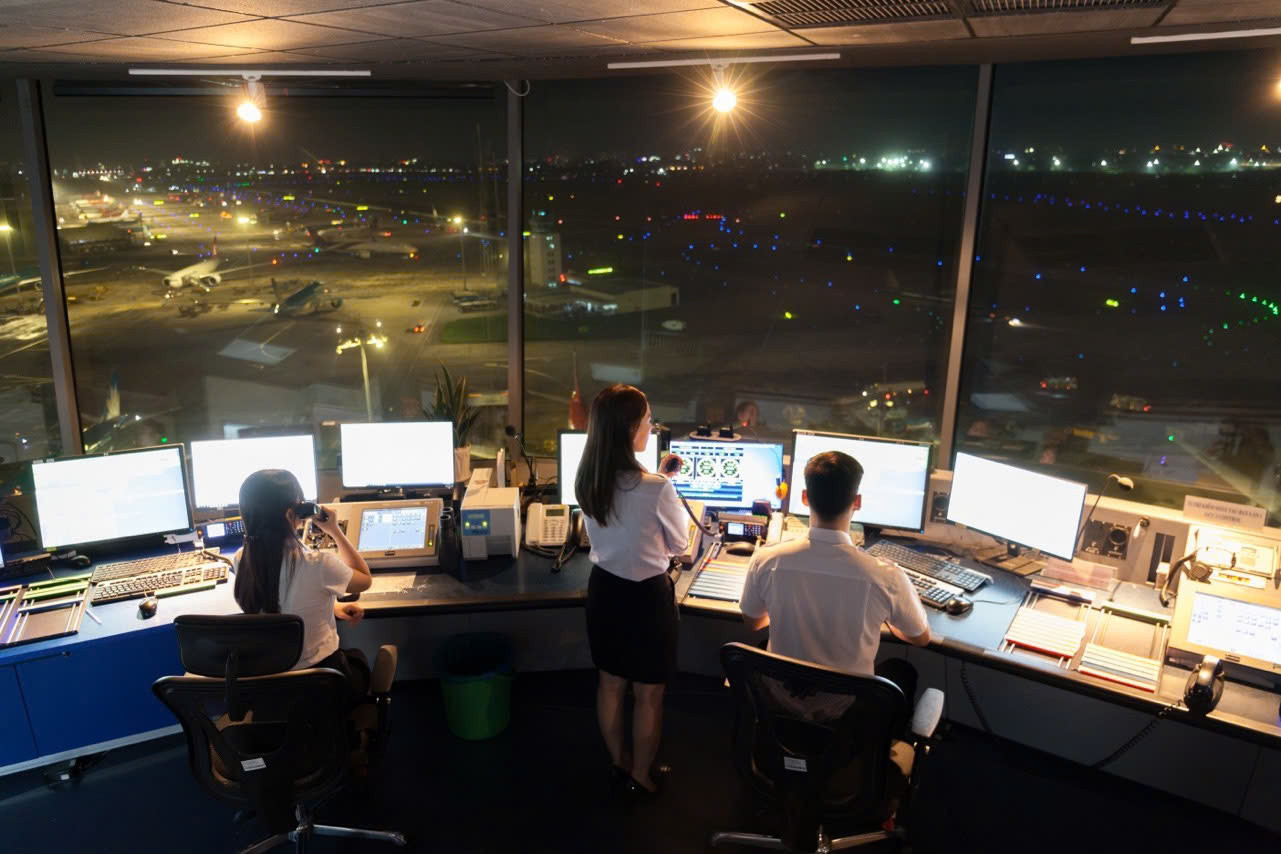
Tan Son Nhat International Airport was forced to suspend all takeoffs and landings twice on the evening of Aug. 11 after unauthorized unmanned aerial vehicles (UAVs), or drones, were detected within the airport's protected airspace.
The disruption, which lasted more than two hours, triggered widespread knock-on effects, altering travel plans for dozens of flights and thousands of passengers.
Two shutdowns, more than 50 flights forced to circle
According to an account of the incident, at 5:34 p.m. on Aug. 11, the pilot of flight VJ601 from Cam Ranh to Ho Chi Minh City spotted a drone at an altitude of around 3,000 feet, or nearly 900 meters, about 10 miles from the airport. At 6:14 p.m., flight 3S621, which had just taken off for Hanoi, reported another drone about 500 meters from the aircraft at an altitude of 1,800 feet.
At 6:28 p.m., the airport announced its first suspension of all takeoffs and landings, with operations resuming at 7:16 p.m.
However, at 7:40 p.m., another drone was spotted to the west-southwest of the airport, forcing Tan Son Nhat to suspend operations for a second time. Normal flight operations did not fully resume until 8:34 p.m.
Official data from the Vietnam Air Traffic Management Corporation (VATM) showed that the incident directly affected 73 flights. In response, VATM simultaneously activated airport-level operational measures and air traffic flow management (ATFM). Its Air Traffic Flow Management Center issued calculated takeoff times (CTOTs) for 71 flights scheduled to arrive at Tan Son Nhat, allowing traffic to be regulated before aircraft departed for Ho Chi Minh City.
Notably, air traffic authorities implemented a Ground Stop at departure airports and a Ground Delay Program to keep aircraft on the ground, while gradually adjusting Tan Son Nhat's arrival capacity from zero to 24 flights per hour as conditions allowed.
More than 50 flights were forced to hold in the air, with 27 diverting or landing at alternate airports. Three requested priority landing because their fuel levels were running low.
Beyond domestic measures, VATM also contacted regional air traffic flow management centers in Bangkok, Thailand, and Sanya, China, to provide updates and coordinate the management of international flights.
Passengers face disrupted journeys late into the night
The incident disrupted the travel plans of around 12,000 passengers. Hoang Viet, a Ho Chi Minh City resident, landed at Tan Son Nhat at nearly 10 p.m. after his flight, VJ377, was diverted to Buon Ma Thuot to wait. He said the nearly two-hour delay threw his entire work schedule into disarray.
Meanwhile, Phan Thanh Nhon, from Ca Mau, was traveling with his family of five, including two young children, from Hai Phong to Ho Chi Minh City. Their flight was delayed by more than 40 minutes, causing them to miss their coach home.
“My family had to cancel our original bus tickets and struggle to find another way home in the middle of the night. Traveling with young children made it particularly exhausting,” Nhon said.
According to VATM, the incident highlights the serious threat drones can pose to aviation safety. To prevent similar risks in the future, the corporation said it will continue reviewing its response procedures, step up training for air traffic controllers and propose technological solutions to improve UAV detection and early-warning capabilities.
VATM will also strengthen information coordination among flight crews, air traffic controllers and relevant authorities to maintain safe and stable flight operations.
Tuan Kiet
.svg)
