 Vietnamnet.vn

 Podcast



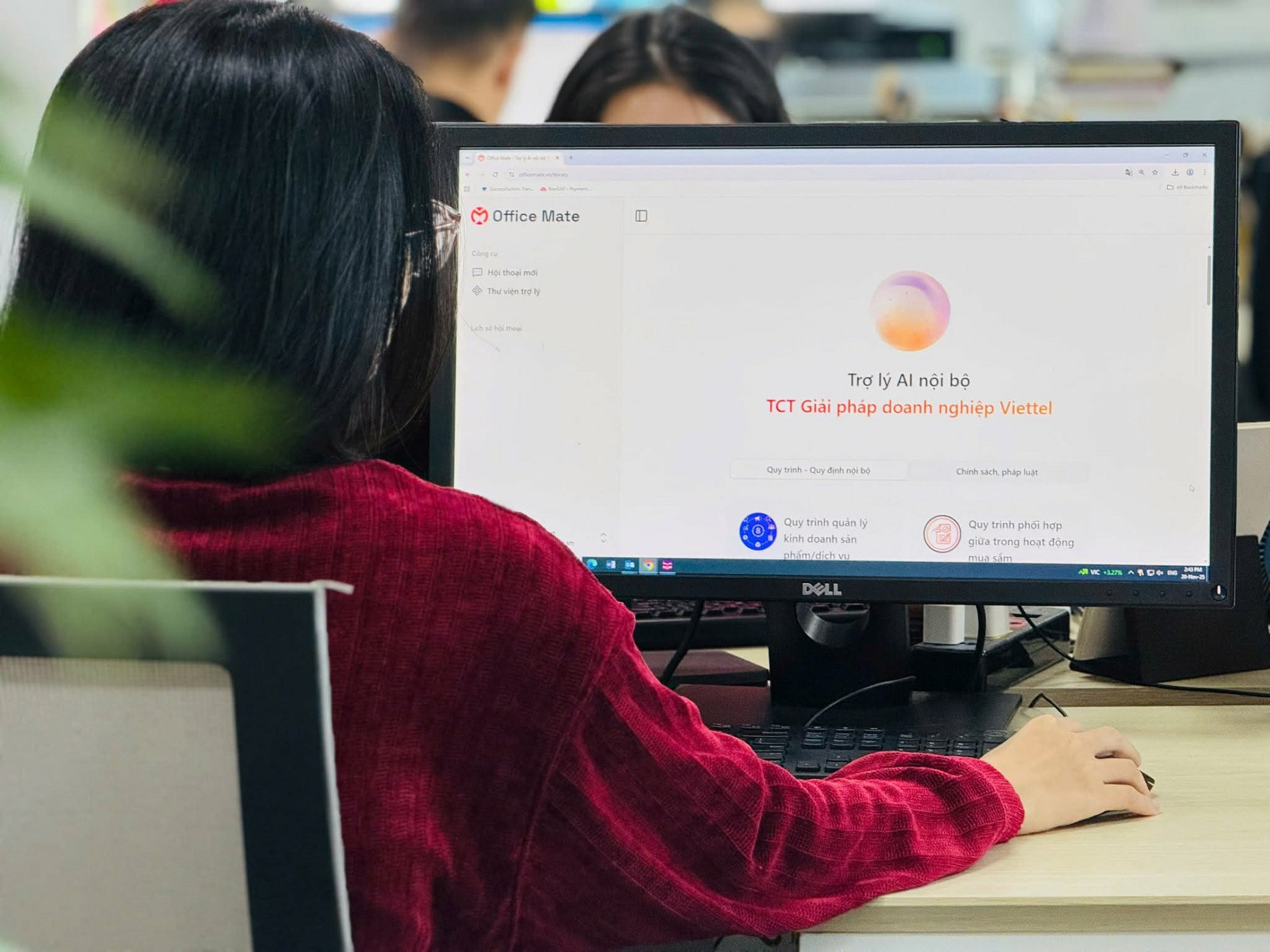
Viettel Solutions’ journey in applying AI did not begin with abstract concepts but with challenges in its daily work. Le Thanh Cong, Deputy General Director of Viettel Solutions, said that for AI to truly deliver value, businesses need to start with their own real "pain points", the problems that may be small but address a genuine need.
This means choosing the right problem, and focusing on issues that are truly pressing where technology can create the clearest impact.
Viettel Solutions identified typical bottlenecks: the highly complex business process management and customer care workflows that require strict compliance.
This involves choosing the right problem for themselves, focusing on the issues that are truly "painful," where technology can create the most tangible change.
Viettel Solutions identified a typical "bottleneck" in the complex problem of business process management and customer care, which requires strict compliance.
Starting from here, AI has been applied and has helped reduce the violation rate in operations by 30-50 percent. This is clear evidence that when technology is applied in the right place, the value it can create is substantive and sustainable.
Beyond addressing organizational-level issues, AI also touches smaller problems in daily work.
Previously, an employee had to spend hours reading and searching through documents. Now, with the internal Viettel AI assistant, they only need to type a question and get answers in seconds.
Small improvements like this lead to major leaps in work efficiency, making AI no longer a “lofty” concept but a practical tool used every day.
Heavy investment
In addition to solving internal problems, Viettel Solutions uses AI in its operating procedures and product development, with the goal of providing more practical and effective digital technology solutions.
AI has been present in Viettel Solutions' products for many years, such as intelligent traffic systems, vehicle license plate recognition, image analysis, and security monitoring solutions.
However, now, AI is present at a "smarter" level in most key sectors, from transportation, oil and gas, education, and healthcare to government and businesses, marking an upgrade of AI to a larger scale, becoming a crucial factor in competitive differentiation.
And AI has been identified as a pillar in the 2026–2030 strategy of Viettel Group as well as Viettel Solutions.
The driving force for acceleration also comes from the boom of the GenAI wave like ChatGPT, forcing businesses to invest more heavily.
To realize the AI strategy, Viettel is investing in two core factors: resources and people.
On resources, Viettel now owns a powerful hardware infrastructure with thousands of GPUs, providing massive computational capacity for training and operating large-scale AI models.
At the same time, Viettel is building a team of hundreds of AI engineers capable of mastering the entire value chain, from research, development to deployment.
Alongside internal development, Viettel Solutions collaborates with Big Tech partners such as NVIDIA and Qualcomm. This enhances AI capacity, provides access to core technologies and advanced knowledge, even those still in laboratories, thus significantly shortening R&D time.
With this strong foundation, Viettel Solutions aims not for “showcase” products or short-term breakthroughs but for “popular AI” - widespread, fast, and safe applications.
Instead of building flashy solutions for a small user base, Viettel Solutions wants to bring AI to all customers, from government agencies to corporations and internal teams.
In Hanoi, Viettel Solutions has piloted AI-powered traffic density measurement using telecom data, creating a highly accurate traffic map similar to Google Maps but customized for the city’s specific characteristics.
In the long term, to ensure sustainable growth and avoid an “AI bubble,” Viettel Solutions focuses on specialized, domain-specific AI rather than “know-it-all” AI.
Energy, healthcare, and finance are fields believed to have great potential for AI to create direct impact.
For instance, in the energy sector, the team is researching specific problems to optimize the cost of exploration and reserve estimation. In healthcare, AI will support diagnosis, making services more accessible to remote areas.
AI is a tool, not a competitor. It increases automation and handles repetitive tasks, allowing employees to focus on creative, complex work requiring critical thinking.
In reality, many enterprises fail in AI deployment because they lack readiness to change processes, choose the right problems, manage clean data, or develop capable teams.
Viettel solves this through experienced engineers, internal development models, and flexibility across industries.
Du Lam
.svg)
