 Vietnamnet.vn

 Podcast



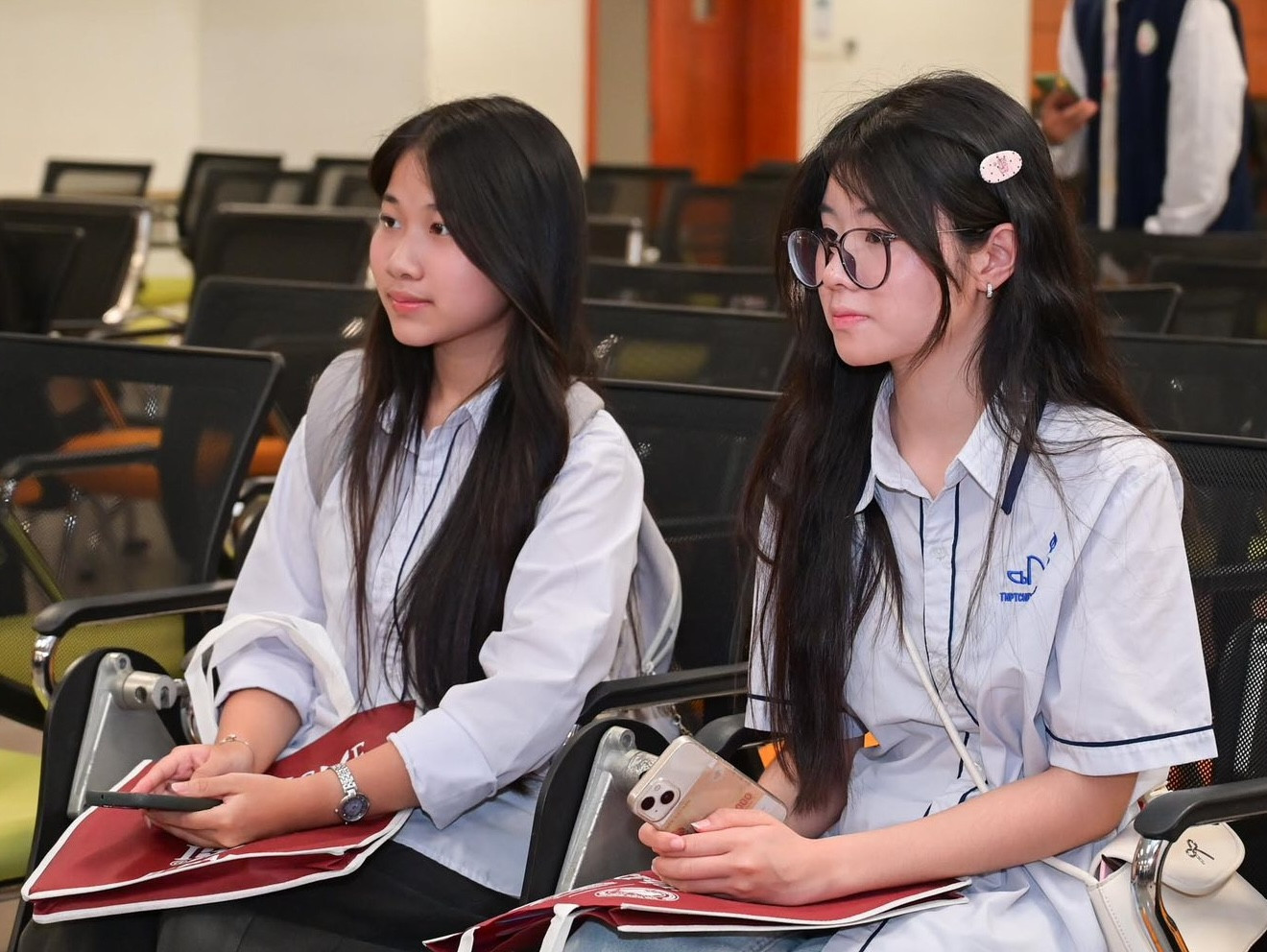
On April 5, the National Economics University (NEU) organized a "One Day as a Student" program to answer candidates' questions about the school's enrollment this year. Many candidates wanted to know whether the SAT or IELTS offers better chance at admission.
Dr. Le Anh Đức, Head of the Training Management Department at NEU, said SAT and IELTS are two very different exams in terms of assessment objectives. While IELTS focuses on measuring English proficiency, the SAT is a standardized American test that evaluates many skills such as reading comprehension, logical thinking, and mathematics, in which English is only one part.
In 2026, many Vietnamese universities plan to implement admissions based on international certificates such as SAT and IELTS, either as an independent method or in combination with high school graduation exam scores and competency assessment scores. However, the conversion methods and the level of advantage are not the same.
Duc said that at NEU, if a candidate achieves a 6.5 IELTS score, it can be converted into 9 points for the English subject. If they improve to a 7.5 IELTS, the score will be converted to 10. However, this improvement from 6.5 to 7.5 only increases the score by 1 point, which does not create a huge breakthrough.
Meanwhile, regarding the SAT, Duc noted that if a candidate is at a level of about 1200 points, they can try to improve the certificate score.
“But giving an exact answer is also very difficult because it also depends on how many SAT/IELTS points the candidate achieves and which factors they will combine with for admission,” Duc said.
Duc noted that if a candidate does not achieve an SAT score of about 1400–1450 or higher, their competitiveness will not be as advantageous as having an IELTS from 6.5 combined with other criteria.
Nevertheless, whether using SAT or IELTS scores, Duc said candidates should determine their strategy early and obtain these certificates before the second semester of 12th grade, then focus maximum effort on the high school graduation exam, because this exam score is still widely used for admission at most universities.
University degree is not ‘passport for life’
Sharing with students regarding concerns about which major to choose, Assoc. Prof. Dr. Bui Huy Nhuong, Director of NEU, emphasized that whichever major is chosen, it needs to stem from the ability, strengths, and career orientations of each individual.
Amid a constantly fluctuating world and labor market, many students study one major but end up doing another job upon graduation. University education, therefore, mainly equips a foundation of knowledge, methods, and thinking as a basis for learners to adapt to their future careers.
He noted that a university degree is not a “passport” that guarantees a career throughout one's life, because changes in technology and society lead to fluctuations in professions.
“Therefore, students need to adapt and equip themselves with multi-disciplinary and inter-disciplinary knowledge. Learning does not stop at four years of university but must continue after graduation to update new knowledge and meet the increasing requirements of the labor market,” Nhuong said.
Amid strong international integration, many leading universities in Vietnam have used IELTS or SAT as an important admission criterion. Along with that, the trend of studying abroad is becoming stronger and students are becoming younger, making the possession of international certificates an almost mandatory goal for many high school students.
According to a survey from several language centers in Hanoi, an IELTS training roadmap to improve a score from 5.5 to 7.5 usually lasts 12–18 months with a cost ranging from VND60 to over VND100 million. With the SAT, many students have to study an extra 2–3 sessions per week throughout 11th grade to reach a score of 1400+.
Many high schools in Hanoi have begun to design integrated curricula, bringing modules like IELTS Preparation, SAT Preparation, and Academic English into the formal curriculum.
According to educational experts, this approach helps students learn English in a methodical and long-term way instead of just practicing test-taking techniques.
Bringing international certificates into schools is not simply bringing the entire language center curriculum into the classroom. The core of this trend is to equip students with language capacity and study skills rather than just exam-taking tips.
Thanh Hung
.svg)
