 Vietnamnet.vn

 Podcast


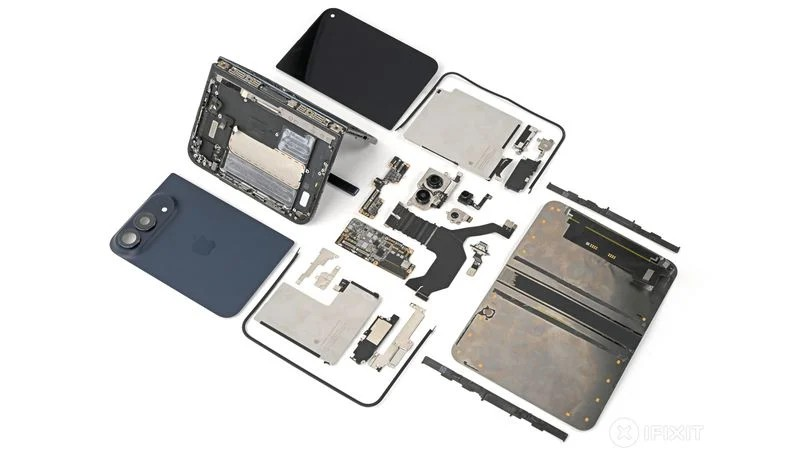
iFixit, the repair specialist known for its detailed electronic device teardowns, has taken apart the iPhone Duo, Apple's first foldable smartphone, to examine its internal design and investigate possible causes of screen damage.
Before opening the device, iFixit coated it with fluorescent dust to test its resistance to particle intrusion. The iPhone Duo carries an IP68 dust and water resistance rating.
Following the test, dust was found in the USB-C port, speaker grilles and around the display edges, but very few particles had penetrated the phone's interior.
Some particles did enter the hinge, causing it to jam and potentially putting the display at risk of damage. However, the iPhone Duo's hinge accumulated less dust than those of the Galaxy Z Fold8 and Pixel 11 Pro Fold in comparable tests.
iFixit described the result as encouraging, although it cautioned that the phone might not be the best companion for a trip to the beach, as dust can still accumulate around moving components.
YouTuber JerryRigEverything conducted a separate dust test and also found that particles could enter the hinge, damaging the magnets responsible for keeping the phone closed.
During the teardown, iFixit was able to peel away the display's protective layer with relative ease, just as Apple had intended.
Apple designed the nanostructured protective layer to be removable, allowing it to be replaced at a relatively low cost. Replacement costs $19 with AppleCare+ coverage or $49 without it.
The iPhone Duo also uses the electrically releasable battery adhesive Apple introduced with the iPhone 16. Applying a small electrical charge loosens the adhesive, making battery removal considerably easier.
iFixit called it the best battery removal experience it had encountered on a foldable smartphone.
The outer display was similarly straightforward to remove and featured what iFixit described as a very robust construction.
This is a significant advantage for repairability, as most internal repairs require technicians to access the device through the outer screen.
The inner display bezel can be detached using heat, although removing the flexible display panel itself requires dealing with a substantial amount of adhesive.
Apple describes the iPhone Duo's inner display as a 10-layer structure. iFixit managed to separate several of these layers and examine them under a microscope.
Another notable design choice is the iPhone Duo's non-stacked logic board, the first such configuration in an iPhone since the iPhone 8.
Using a single-layer board is one of the ways Apple has managed to keep the foldable device relatively thin and lightweight.
Turning to reports of screen failures, iFixit suggested several possible explanations, including pressure, trapped foreign objects, repeated bending and manufacturing defects.
The organization also noted that the display might not necessarily be physically cracked. Damage to electrical conductors could produce similar visual symptoms.
In many reported cases, the affected devices feature a distinctive hinge geometry, with damage appearing close to the area where a folded ribbon cable passes through the hinge and several component edges meet.
This arrangement could create a concentration of mechanical stress in a particularly vulnerable section of the display.
To investigate further, iFixit constructed a three-dimensional hinge model using teardown footage, patent documents and computed tomography (CT) scans, then compared the model with reported damage locations.
"To identify stress concentration points during folding, we built a 3D model of the hinge based on teardown footage, patents and CT scans, then compared it with the reported failure locations," iFixit explained.
"The cracks cluster near the transition between the slot for the ribbon cable running through the hinge and the central hinge support."
"From the images, we can see that the damage does not occur exactly where the display cable passes through the hinge, but slightly below it. This is where several component edges converge, changing how the thin display is supported as it bends."
iFixit also identified the curved rails inside the hinge as another possible source of stress.
These rails move along the display's pivot points and may rise above the hinge's flat plates when the phone is folded.
Notably, one of the rails aligns directly with a location where screen damage has been reported.
Another possibility is that a retracting hinge component is not functioning as intended. However, iFixit emphasized that there is not yet enough evidence to establish the precise cause of the failures.
To help users better understand the mechanism, iFixit has made an interactive CT scan model of the iPhone Duo's hinge available, allowing viewers to explore how the supports, cables and other components are arranged beneath the display.
Despite the concerns surrounding its inner screen, the iPhone Duo received a provisional repairability score of 5 out of 10 from iFixit.
The inner display and hinge assembly were identified as its biggest weaknesses, preventing the device from achieving a higher score.
"This is the most repairable foldable smartphone we've ever seen, but repairs are still going to be very difficult," iFixit concluded.
By comparison, both the Samsung Galaxy Z Fold8 and Google's Pixel 11 Pro Fold received repairability scores of 4 out of 10.
Du Lam

