 Vietnamnet.vn

 Podcast



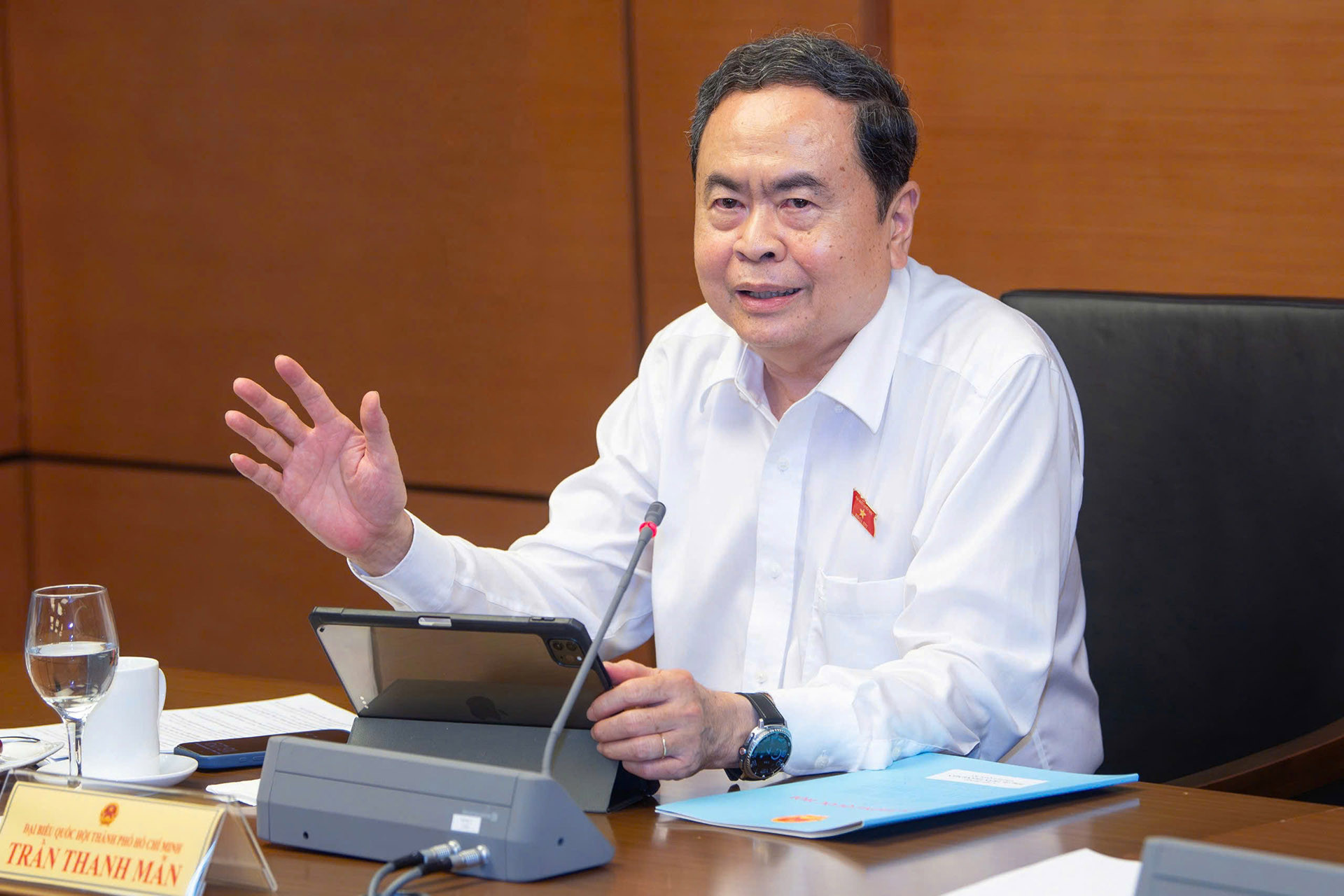
On April 5, the National Assembly discussed and gave opinions on the draft revised Capital Law.
Minister of Justice Hoang Thanh Tung, presenting the Capital Law (amended) project, stated that instead of specifying contents as in Capital Law No. 39/2024/QH15, the draft law focuses on delegating power to the City to decide, creating maximum space for creativity and the self-responsibility of the Capital's government, while strengthening requirements for power control, inspection, supervision and accountability.
The draft proposes a comprehensive decentralization to the City government to regulate and decide on matters within its authority in all fields.
This aims to increase the proactiveness, creativity, autonomy, and self-responsibility of the Hanoi City government in areas, including organization and apparatus; budget revenue and expenditure, especially regulations that create conditions to attract resources for the Capital's development; and implementation of planning, urban renovation, and reconstruction.
According to the draft, the City is entitled to decide on piloting new mechanisms and policies that differ from laws or resolutions of the National Assembly, or for issues not yet regulated by law, to be applied within Hanoi City.
Commenting on the draft law, Man said that in 2025, 89 laws were enacted, many of which introduced mechanisms and policies more advanced than those in the current Capital Law, making it increasingly outdated and unable to keep up with development demands.
Previously, the Politburo issued Resolution 15 defining directions and tasks for Hanoi’s development to 2030, with a vision to 2045. Recently, the Politburo has adjusted and supplemented this resolution. On March 17, General Secretary To Lam signed Resolution No02 on “Building and developing Hanoi in a new era.”
In a context where Hanoi is “very impatient” with development demands, the city sought approval from the National Assembly at its 10th session to pass Resolution 258/2025 on piloting special mechanisms and policies for major and important projects.
Notably, according to Man, this resolution was completed in about 20 days, while the Capital Law has taken two years to prepare.
He emphasized that in practice, many important projects in Hanoi are currently being accelerated thanks to mechanisms from Resolution 258. Similarly, HCMC previously had Resolutions 54, 58, and later 260, but found them insufficient to create enough space for development.
“Therefore, this revision of the Capital Law is also seen as a premise for eventually building a Special Urban Law,” he said.
Man went on to say that the General Secretary and President have also given opinions on HCMC coordinating with ministries, government agencies, and the National Assembly to carry out procedures for drafting such a law.
“The overarching spirit of this revision is giving comprehensive and maximum decentralization to Hanoi’s government, following the principle: Hanoi decides, Hanoi acts, Hanoi takes responsibility,” Man stressed.
On specific contents, he outlined key highlights in the draft.
Regarding urban management tools, he said they must be strong enough, especially in handling violations related to planning, construction order, fire prevention, and environment, enabling effective implementation.
Emphasizing the importance of planning, he noted that during a meeting with Hanoi about three months ago, the General Secretary required the city to adopt a planning vision of 100 years or even longer, ensuring sustainable development. Planning must go hand in hand with transparency so that people are informed, and must be closely linked with construction implementation, compensation, resettlement, and land acquisition for socio-economic development projects.
The spirit of the Capital Law this time is that power must be thoroughly decentralized; ministries and sectors must not take on too much work but must hand it over strongly to Hanoi. Second, protecting officials and encouraging innovation. Third, strengthening powerful and effective urban management tools.
Fourth, striving for a sustainable development model based on a knowledge economy, a polycentric urban area, Red River regional linkages, and cultural preservation, consistent with the orientation of building a “Civilized - Modern - Happy” Hanoi.
Man expressed hope that the revised Capital Law will be passed at the first session under a shortened one-session procedure and take effect from July 1.
“If Hanoi can enjoy strong decentralization under the revised Capital Law, it will serve as a springboard to help Hanoi address its major bottlenecks – traffic congestion, environmental pollution, and social housing deficiency, and will help make a breakthrough in economic development,” he said.
Tran Thuong
.svg)
