 Vietnamnet.vn

 Podcast



The conference focused on studying, disseminating and implementing the Politburo’s Resolution No. 10-NQ/TW on developing the foreign-invested economic sector.
Chairman of the Ho Chi Minh City People’s Committee Nguyen Van Duoc proposed priorities linked to the Vietnam International Financial Centre (VIFC) to draw new-generation, high-quality capital flows.
These include shifting from a project-attraction approach towards building an investment ecosystem and positioning the IFC as a strategic instrument for implementing Vietnam’s new-generation FDI strategy.
Ho Chi Minh City is committed to leading IFC implementation in the spirit of serving national interests and supporting nationwide development, he said.
Duoc stressed that the assignment to establish and operate the IFC represented both national trust and significant responsibility. The initiative should not be viewed as a project for Ho Chi Minh City alone but as a national financial institution serving the broader economy and acting as a bridge connecting local authorities, Vietnamese enterprises and strategic international partners with global capital flows.
Sharing a similar perspective, Vu Dai Thang, Chairman of the municipal People’s Committee, said Hanoi viewed high-quality human resource development not only as a local priority but also as a contribution to strengthening the country’s foundation in talent, knowledge and innovation.
According to him, the capital city’s strengths extend beyond market size, geographic positioning and increasingly modern infrastructure to include its ability to bring together all components of an innovation ecosystem – from education and scientific research to business development and commercialisation of research outcomes.
He stated that Hanoi is committed to leading implementation of Resolution No. 10-NQ/TW alongside the Politburo’s Resolution No. 15-NQ/TW on the development direction of the capital through to 2030 with a vision to 2045, and to turning itself into Vietnam’s centre for talent, research and development, and innovation while contributing to advancing Vietnam’s standing as a destination for high-quality investment and strategic industries in the new era.
Addressing the conference, Ho Ky Minh, Permanent Vice Chairman of the Da Nang People’s Committee, presented proposals for attracting quality investment linked to the development of a free trade zone as a new growth driver for the North Central and Central Coastal region.
According to Minh, the key priorities include developing a new-generation free trade zone to attract high-quality investment; shifting from a quantity-based investment attraction strategy to selecting strategic investors and high-value-added industries; building a comprehensive investment ecosystem to reduce costs and enhance the competitiveness of the investment environment; leveraging the IFC to attract foreign investment; and strengthening the city's role in promoting regional connectivity to create a shared development space.
He noted that one of the key features of Resolution No. 10-NQ/TW is its move beyond traditional administrative boundaries towards organising economic development through interconnected economic ecosystems. Investment attraction, he said, would be associated with specialised growth centres and regional development zones built around geographic advantages, infrastructure, human capital and value-chain connectivity.
Under this approach, Da Nang will continue strengthening regional cooperation and building integrated value chains. The central coastal city plans to focus on international logistics, finance, innovation, research and development, and high-value services, while neighbouring localities capitalise on strengths in manufacturing, supporting industries, energy and the marine economy.
Through its seaports, airports, expressways and the East–West economic corridor, Da Nang is expected to serve as a gateway connecting the region with international markets and improving overall competitiveness.
“Development based on regional connectivity will create a larger market scale, improve infrastructure efficiency, reduce competition driven by investment incentives and enhance attractiveness for international investors,” Minh said.
Takuya Sahashi, Vice President of Mitsubishi Corporation Vietnam, expressed strong support for Resolution No. 10-NQ/TW and Resolution No. 68-NQ/TW dated May 4, 2025 on private economic sector development, describing them as the two wheels of growth.
He proposed expanding business networking opportunities through a shared database and direct exhibitions organised through cooperation between the Vietnamese Government and FDI enterprises.
The Japanese business representative also called for stronger support policies for small- and medium-sized enterprises, including start-ups in emerging industries and businesses participating in global value chains.
Welcoming government support for training and workforce development projects implemented by FDI companies, he expressed hope that Vietnam would consider tax incentives for investment in education and training as well as equipment provision for vocational schools.
Citing the latest research by the Japan External Trade Organisation (JETRO), Sahashi said that 57% of Japanese companies planned to expand operations in Vietnam – the highest proportion in the Association of Southeast Asian Nations (ASEAN). The Japanese Business Association in Vietnam pledged continued cooperation with local authorities and stakeholders to realise the objectives of Resolution No. 10-NQ/TW.
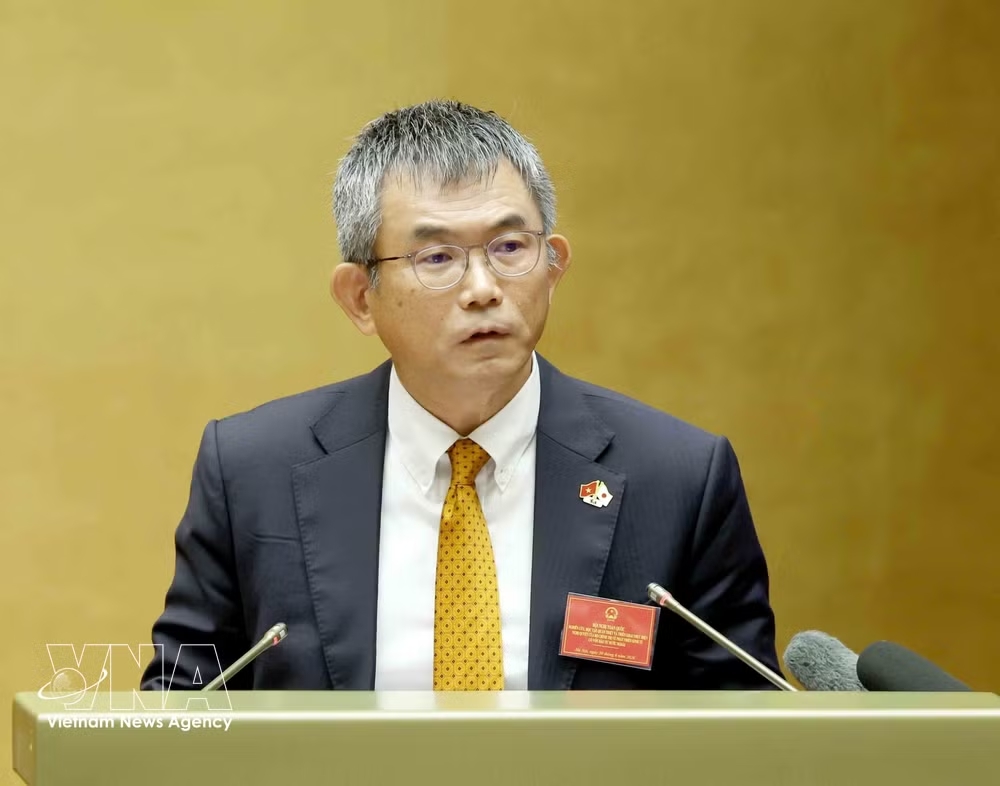
Dominic Scriven, Chairman of Dragon Capital Group Limited, described the resolution as particularly significant for foreign investors and proposed measures to encourage FDI enterprises to retain profits within Vietnam’s banking system rather than transferring them overseas, including consideration of interest mechanisms for US dollar deposits held by foreign-invested firms.
He also urged continued efforts to upgrade Vietnam’s stock market classification and achieve emerging market status before 2030.
While recognising progress by the State Securities Commission and the Ministry of Finance in introducing a central counterparty (CCP) clearing mechanism, he recommended further reforms to foreign ownership limits in sectors unrelated to national security and improvements to foreign exchange trading mechanisms for overseas investors.
Dragon Capital also proposed reviewing stock exchange listing requirements. According to Scriven, current restrictions preventing companies with accumulated losses from listing create barriers for firms operating in the digital economy and artificial intelligence sectors, which often require extended periods before reaching profitability.
The firm additionally called for accelerating the development of the IFC in Da Nang and Ho Chi Minh City, viewing it as opportunities for Vietnam to establish private placement mechanisms for professional foreign institutional investors.
Michael Kokalari, Chief Economist at VinaCapital, said Resolution No. 10-NQ/TW reaffirmed that the foreign-invested economic sector forms an integral part of Vietnam’s economy, ensuring equal treatment for foreign investors and promoting high-quality investment linked to technology transfer.
Kokalari added that globally there are investment funds managing hundreds of billions of US dollars prepared to commit capital to Vietnam once conditions are met and the country secures an upgrade in MSCI market classification./. VNA
.svg)
